



 Chat with AI
Exam 10: Long-Term Assets

Exam 1: Accounting in Business245 Questions
Exam 2: Analyzing and Recording Transactions201 Questions
Exam 3: Adjusting Accounts and Preparing Financial Statements227 Questions
Exam 4: Completing the Accounting Cycle177 Questions
Exam 5: Accounting for Merchandising Operations189 Questions
Exam 6: Inventories and Cost of Sales194 Questions
Exam 7: Accounting Information Systems166 Questions
Exam 8: Cash and Internal Controls195 Questions
Exam 9: Accounting for Receivables162 Questions
Exam 10: Long-Term Assets208 Questions
Exam 11: Current Liabilities and Payroll Accounting178 Questions
Exam 12: Accounting for Partnerships141 Questions
Exam 13: Accounting for Corporations210 Questions
Exam 14: Long-Term Liabilities158 Questions
Exam 15: Investments and International Operations156 Questions
Exam 16: Statement of Cash Flows173 Questions
Exam 17: Analysis of Financial Statements182 Questions
Exam 18: Managerial Accounting Concepts and Principles199 Questions
Exam 19: Job Order Cost Accounting165 Questions
Exam 20: Process Cost Accounting172 Questions
Exam 21: Cost Allocation and Performance Measurement173 Questions
Exam 22: Cost-Volume-Profit Analysis190 Questions
Exam 23: Master Budgets and Planning166 Questions
Exam 24: Flexible Budgets and Standard Costs178 Questions
Exam 25: Capital Budgeting and Managerial Decisions153 Questions
Select questions type


A patent is an exclusive right granted to its owner to manufacture and sell a patented device or to use a process for 20 years.
(True/False)
4.9/5  (84)
(84) A depreciable asset costing $75,000 is purchased on September 1, Year 1. The asset is estimated to have a residual value of $10,000 and an estimated useful life of 4 years. Double-declining-balance depreciation is used. If the asset is sold on December 31, Year 3 for $13,000, the journal entry to record the sale will include:
(Multiple Choice)
4.7/5 (73)
(73) The carrying amount of an asset when using double-declining-balance depreciation is always greater than the carrying amount from using straight-line depreciation, except at the beginning and the end of the asset's useful life, when it is the same.
(True/False)
4.8/5 (81)
(81) Revising an estimate of the useful life or residual value of an item of property, plant and equipment is referred to as a change in accounting estimate, and is reflected in the past, current, and future financial statements.
(True/False)
4.8/5 (69)
(69) A company purchased property for a building site. The costs associated with the property were: What portion of these costs should be allocated to the cost of the land and what portion should be allocated to the cost of the new building?
(Multiple Choice)
5.0/5 (83)
(83) A company purchased a cash register on January 1 for $5,400. This register has a useful life of 10 years and a residual value of $400. What would be the depreciation expense for the second year of its useful life using the double-declining-balance method?
(Multiple Choice)
4.9/5 (69)
(69) On January 2, 2007, a company purchased a delivery truck for $45,000 cash. The truck had an estimated useful life of seven years and an estimated residual value of $3,000. The straight-line method of depreciation was used. Prepare the journal entries to record depreciation expense and the disposition of the truck on September 1, 2011, under the following assumptions:
The truck and $45,000 cash were given in exchange for a new delivery truck that had a cash price of $60,000. This transaction has commercial substance.
(Essay)
4.9/5 (69)
(69) A company had average total assets of $897,000. Its gross sales were $1,090,000 and its net sales were $1,000,000. The company's total asset turnover equals:
(Multiple Choice)
4.9/5 (83)
(83) Describe the accounting for intangible assets, including their acquisition, cost allocation, and accounts involved.
(Essay)
4.9/5 (85)
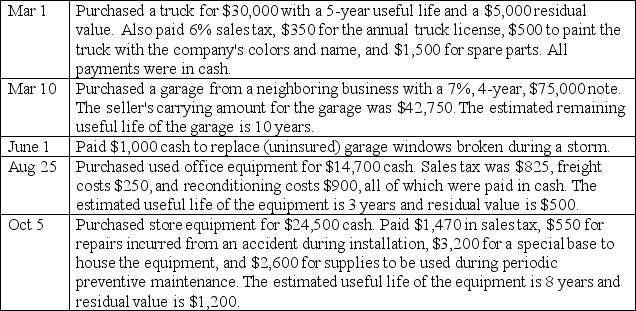
(85) Prepare journal entries to record the following transactions of a company during the current year:
(Essay)
4.9/5 (66)
(66) The double-declining balance method is applied by (1) computing the asset's straight-line depreciation rate, (2) doubling it, (3) subtracting residual value from cost, and (4) multiplying the rate times the net value.
(True/False)
4.8/5 (84)
(84) A company purchased a delivery van for $23,000 with a residual value of $3,000 on September 1, Year 1. It has an estimated useful life of 5 years. Using the straight-line method, how much depreciation expense should the company recognize on December 31, Year 1?
(Multiple Choice)
4.8/5 (74)
(74) Salta Company installs a manufacturing machine in its factory at the beginning of the year at a cost of $87,000. The machine's useful life is estimated to be 5 years, or 400,000 units of product, with a $7,000 residual value. During its second year, the machine produces 84,500 units of product. Determine the machines' second year depreciation under the units-of-production method.
(Multiple Choice)
4.9/5 (88)
(88) A company purchased property for $100,000. The property included a building, a parking lot, and land. The building was appraised at $62,000; the land at $45,000, and the parking lot at $18,000. Land should be recorded in the accounting records with an allocated cost of:
(Multiple Choice)
4.9/5 (86)
(86) When originally purchased, a vehicle had an estimated useful life of 8 years. The vehicle cost $23,000 and its estimated residual value is $1,500. After 4 years of straight-line depreciation, the asset's total estimated useful life was revised from 8 years to 6 years and there was no change in the estimated residual value. The depreciation expense in year 5 equals:
(Multiple Choice)
4.7/5 (82)
(82) Record the following events and transactions for Axle Company for the current year.
1. On January 2, Axle purchased a patent for $35,000 with a useful life of 10 years. Prepare the journal entry to amortize the patent at the end of the first year.
2. On January 4, Axle purchased a music distributor's collection of lyrics and songs for $1,425,000. The copyrights are expected to last another 30 years. Prepare the journal entry to amortize the copyright at the end of the first year.
(Essay)
4.7/5 (86)
(86) 
Filters
- Essay(0)
- Multiple Choice(0)
- Short Answer(0)
- True False(0)
- Matching(0)