



 Chat with AI
Exam 10: Long-Term Assets

Exam 1: Accounting in Business245 Questions
Exam 2: Analyzing and Recording Transactions201 Questions
Exam 3: Adjusting Accounts and Preparing Financial Statements227 Questions
Exam 4: Completing the Accounting Cycle177 Questions
Exam 5: Accounting for Merchandising Operations189 Questions
Exam 6: Inventories and Cost of Sales194 Questions
Exam 7: Accounting Information Systems166 Questions
Exam 8: Cash and Internal Controls195 Questions
Exam 9: Accounting for Receivables162 Questions
Exam 10: Long-Term Assets208 Questions
Exam 11: Current Liabilities and Payroll Accounting178 Questions
Exam 12: Accounting for Partnerships141 Questions
Exam 13: Accounting for Corporations210 Questions
Exam 14: Long-Term Liabilities158 Questions
Exam 15: Investments and International Operations156 Questions
Exam 16: Statement of Cash Flows173 Questions
Exam 17: Analysis of Financial Statements182 Questions
Exam 18: Managerial Accounting Concepts and Principles199 Questions
Exam 19: Job Order Cost Accounting165 Questions
Exam 20: Process Cost Accounting172 Questions
Exam 21: Cost Allocation and Performance Measurement173 Questions
Exam 22: Cost-Volume-Profit Analysis190 Questions
Exam 23: Master Budgets and Planning166 Questions
Exam 24: Flexible Budgets and Standard Costs178 Questions
Exam 25: Capital Budgeting and Managerial Decisions153 Questions
Select questions type


The three main factors in computing depreciation are: ___________________, ___________________, __________________.
(Essay)
4.9/5  (81)
(81) Capital intensive companies have a relatively large amount invested in assets to generate a given level of sales.
(True/False)
4.9/5 (75)
(75) An accelerated depreciation method yields smaller depreciation expense in the early years of an asset's life and larger depreciation expense in later years.
(True/False)
4.8/5 (69)
(69) On September 30 of the current year, a company acquired and placed in service a machine at a cost of $700,000. It has been estimated that the machine has a service life of five years and a residual value of $40,000. Using the double-declining-balance method of depreciation, prepare a schedule showing depreciation amounts for the current year and the next 4 years (round answers to the nearest dollar). The company closes its books on December 31 of each year.
(Essay)
4.9/5 (78)
(78) A company purchased mining property containing 7,350,000 tons of ore for $1,837,500. In Year 1, it mined and sold 857,000 tons of ore and in Year 2, it mined and sold 943,000 tons of ore. Calculate the depletion expense for Year 1 and Year 2. What was the carrying amount of the property at the end of Year 2?
(Essay)
4.7/5 (90)
(90) A company purchased a tract of land for its natural resources at a cost of $1,500,000. It expects to mine 2,000,000 tons of ore from this land. The residual value of the land is expected to be $250,000. The depletion expense per ton of ore is:
(Multiple Choice)
4.8/5 (72)
(72) Compare the different depreciation methods (straight-line, units-of-production, and double-declining-balance) with respect to the computation of depreciation per period and the total depreciation over the life of the asset.
(Essay)
4.9/5 (77)
(77) Four main accounting issues for property, plant and equipment are: ________________________, ____________________________, ________________________, ____________________________.
(Essay)
4.8/5 (88)
(88) Salta Company installs a manufacturing machine in its factory at the beginning of the year at a cost of $87,000. The machine's useful life is estimated to be 5 years, or 400,000 units of product, with a $7,000 residual value. During its second year, the machine produces 84,500 units of product. Determine the machines' second year depreciation under the double-declining-balance method.
(Multiple Choice)
4.8/5 (79)
(79) Salta Company installs a manufacturing machine in its factory at the beginning of the year at a cost of $87,000. The machine's useful life is estimated to be 5 years, or 400,000 units of product, with a $7,000 residual value. During its second year, the machine produces 84,500 units of product. Determine the machines' second year depreciation under the straight-line method.
(Multiple Choice)
4.8/5 (83)
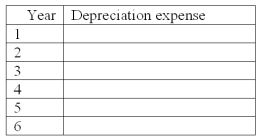
(83) The Weiss Company purchased a truck for $95,000 on January 2. The truck was estimated to have a $3,000 residual value and a 4 year life. The truck was depreciated using the straight-line method. During the third year, it was obvious that the truck's total useful life would be 6 years rather than 4, and the residual value at the end of the 6th year would be $1,500. Determine the depreciation expense for the truck for the 6 years of its life.
(Essay)
4.8/5 (81)
(81) The total cost of an asset less its accumulated depreciation is called:
(Multiple Choice)
4.8/5 (79)
(79) Thomas Enterprises purchased a depreciable asset on October 1, Year 1 at a cost of $100,000. The asset is expected to have a residual value of $15,000 at the end of its five-year useful life. If the asset is depreciated on the double-declining-balance method, the asset's carrying amount on December 31, Year 3 will be:
(Multiple Choice)
4.9/5 (80)
(80) The going concern assumption supports the reporting of property, plant and equipment at carrying amount rather than market value.
(True/False)
4.8/5 (94)
(94) Monte Ray leases office space for $7,000 per month. On January 3, Monte Ray incurs $75,000 to improve his leased office space. These improvements are expected to yield benefits for 8 years. Ray has 6 years remaining on his lease. Compute the amount of expense that should be recorded the first year related to the improvements.
(Multiple Choice)
4.7/5 (78)
(78) A machine was purchased for $37,000 and depreciated for five years on a straight-line basis under the assumption it would have a ten-year life and a $1,000 residual value. At the beginning of the machine's sixth year it was recognized the machine had three years of remaining life instead of five and that at the end of the remaining three years its residual value would be $1,600. What amount of depreciation should be recorded in each of the machine's remaining three years?
(Essay)
5.0/5 (72)
(72) A depreciation method in which an item of property, plant and equipment's depreciation expense for a period is determined by applying a constant depreciation rate to the asset's beginning-of-period carrying amount is called:
(Multiple Choice)
4.7/5 (66)
(66) 
Filters
- Essay(0)
- Multiple Choice(0)
- Short Answer(0)
- True False(0)
- Matching(0)