



 Chat with AI
Exam 10: Long-Term Assets

Exam 1: Accounting in Business245 Questions
Exam 2: Analyzing and Recording Transactions201 Questions
Exam 3: Adjusting Accounts and Preparing Financial Statements227 Questions
Exam 4: Completing the Accounting Cycle177 Questions
Exam 5: Accounting for Merchandising Operations189 Questions
Exam 6: Inventories and Cost of Sales194 Questions
Exam 7: Accounting Information Systems166 Questions
Exam 8: Cash and Internal Controls195 Questions
Exam 9: Accounting for Receivables162 Questions
Exam 10: Long-Term Assets208 Questions
Exam 11: Current Liabilities and Payroll Accounting178 Questions
Exam 12: Accounting for Partnerships141 Questions
Exam 13: Accounting for Corporations210 Questions
Exam 14: Long-Term Liabilities158 Questions
Exam 15: Investments and International Operations156 Questions
Exam 16: Statement of Cash Flows173 Questions
Exam 17: Analysis of Financial Statements182 Questions
Exam 18: Managerial Accounting Concepts and Principles199 Questions
Exam 19: Job Order Cost Accounting165 Questions
Exam 20: Process Cost Accounting172 Questions
Exam 21: Cost Allocation and Performance Measurement173 Questions
Exam 22: Cost-Volume-Profit Analysis190 Questions
Exam 23: Master Budgets and Planning166 Questions
Exam 24: Flexible Budgets and Standard Costs178 Questions
Exam 25: Capital Budgeting and Managerial Decisions153 Questions
Select questions type


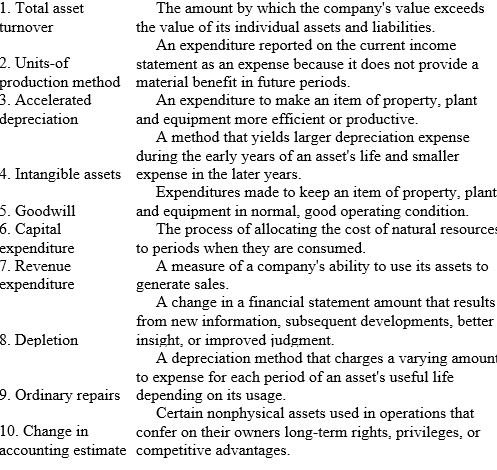

A copyright gives its owner the exclusive right to publish and sell a musical, literary, or artistic work during the life of the creator plus 17 years.
(True/False)
4.9/5  (79)
(79) Decision makers and other users of financial statements are especially interested in evaluating a company's ability to use its assets in generating sales.
(True/False)
4.8/5 (87)
(87) The three usual means for disposal of an asset are: ________________________________________________________.
(Essay)
4.7/5 (82)
(82) A company used straight-line depreciation for an item of equipment that cost $12,000, had a residual value of $2,000, and had a five-year useful life. After depreciating the asset for three complete years, the residual value was reduced to $1,200 and its total useful life was increased from 5 years to 6 years. Determine the amount of depreciation to be charged against the machine during each of the remaining years of its useful life:
(Multiple Choice)
4.8/5 (70)
(70) A company sold for $40,000 cash a machine that originally cost $90,000. The accumulated depreciation on this machine was $47,000 at the time of the sale. What was the company's gain or loss on this sale?
(Essay)
4.9/5 (74)
(74) On January 1, a company purchased a machine for $75,000 that had a 6-year useful life and a residual value of $6,000. After three years of straight-line depreciation, the company paid $7,500 cash at the beginning of the year to improve the efficiency of the machine. The effect of the expenditure was to increase the productivity of the machine without increasing its remaining useful life or changing its residual value. Straight-line depreciation is used throughout the machine's life.
1. Prepare the journal entry to record the $7,500 expenditure.
2. Prepare the journal entry to record depreciation expense for the fourth year.
(Essay)
5.0/5 (85)
(85) A company sold a machine that originally cost $100,000 for $60,000 cash. The accumulated depreciation on the machine was $40,000. The company should recognize a:
(Multiple Choice)
4.8/5 (75)
(75) A company purchased a computer system on January 1, Year 1, for $1,600,000. Prepare the journal entries to record depreciation for the first 6 months of Year 3 and the sale of the computer assuming it is sold on July 1, Year 3, for $1,000,000 cash. The straight-line method of depreciation was used based on an expected life of six years and a residual value of $130,000.
(Essay)
4.9/5 (75)
(75) Wilson Engineering purchased a depreciable asset costing $45,000 on January 1, Year 1. The asset is estimated to have a residual value of $5,000 and an estimated useful life of 8 years. Straight-line depreciation is used. If the asset is sold on July 1, Year 5 for $20,000, the journal entry to record the sale will include:
(Multiple Choice)
4.8/5 (80)
(80) An asset's carrying amount is $18,000 on June 30, Year 6. The asset is being depreciated at an annual rate of $3,000 on the straight-line method. Assuming the asset is sold on December 31, Year 7 for $15,000, the company should record:
(Multiple Choice)
4.8/5 (80)
(80) If a machine is damaged during unpacking, the repairs are added to its cost.
(True/False)
4.8/5 (89)
(89) _______________________ depreciation recognizes equal amounts of annual depreciation over the life of an asset.
(Essay)
4.8/5 (81)
(81) Explain the impact, if any, on depreciation when estimates that determine depreciation change.
(Essay)
4.9/5 (89)
(89) Define property, plant and equipment and identify the four primary issues in accounting for them.
(Essay)
4.9/5 (88)
(88) The cost of an intangible asset is systematically allocated to depreciation expense over its estimated useful life.
(True/False)
4.9/5 (85)
(85) Revising estimates of the useful life or residual value of an item of property, plant and equipment is referred to as a ___________________________________________.
(Essay)
4.8/5 (84)
(84) Mahoney Company had the following transactions involving property, plant and equipment during Year 1 and Year 2. Unless otherwise indicated, all transactions were for cash.
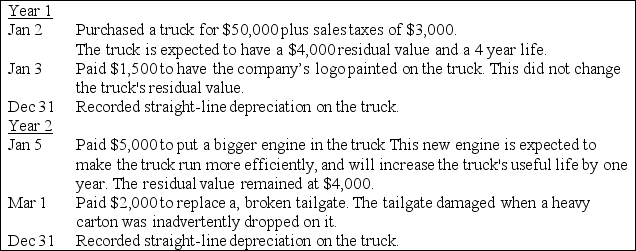 Prepare the general journal entries to record these transactions.
 (Essay)
4.9/5 (80)
(80) 
Filters
- Essay(0)
- Multiple Choice(0)
- Short Answer(0)
- True False(0)
- Matching(0)