



 Chat with AI
Exam 14: Long-Term Liabilities

Exam 1: Accounting in Business245 Questions
Exam 2: Analyzing and Recording Transactions201 Questions
Exam 3: Adjusting Accounts and Preparing Financial Statements227 Questions
Exam 4: Completing the Accounting Cycle177 Questions
Exam 5: Accounting for Merchandising Operations189 Questions
Exam 6: Inventories and Cost of Sales194 Questions
Exam 7: Accounting Information Systems166 Questions
Exam 8: Cash and Internal Controls195 Questions
Exam 9: Accounting for Receivables162 Questions
Exam 10: Long-Term Assets208 Questions
Exam 11: Current Liabilities and Payroll Accounting178 Questions
Exam 12: Accounting for Partnerships141 Questions
Exam 13: Accounting for Corporations210 Questions
Exam 14: Long-Term Liabilities158 Questions
Exam 15: Investments and International Operations156 Questions
Exam 16: Statement of Cash Flows173 Questions
Exam 17: Analysis of Financial Statements182 Questions
Exam 18: Managerial Accounting Concepts and Principles199 Questions
Exam 19: Job Order Cost Accounting165 Questions
Exam 20: Process Cost Accounting172 Questions
Exam 21: Cost Allocation and Performance Measurement173 Questions
Exam 22: Cost-Volume-Profit Analysis190 Questions
Exam 23: Master Budgets and Planning166 Questions
Exam 24: Flexible Budgets and Standard Costs178 Questions
Exam 25: Capital Budgeting and Managerial Decisions153 Questions
Select questions type


A company calls $150,000 par value of bonds with a carrying amount of $147,950. The company calls the bonds at $151,000. Prepare the journal entry to record the retirement of the bonds.
(Essay)
4.9/5  (68)
(68) A corporation borrowed $125,000 cash by signing a 5-year, 9% installment note requiring equal annual payments each December 31 of $32,136. What journal entry would the issuer record for the first payment?
(Multiple Choice)
4.8/5 (95)
(95) A company issued 10-year, 9% bonds, with a par value of $500,000 when the market rate was 9.5%. The issuer received $484,087 in cash proceeds. Prepare the issuer's journal entry to record the bond issuance.
(Essay)
4.8/5 (70)
(70) A 10-year bond issue with a $100,000 par value, 8% annual contract rate, with interest payable semiannually means that the issuer must repay $100,000 at the end of 10 years and make 20 semiannual interest payments of $4,000 each.
(True/False)
4.8/5 (78)
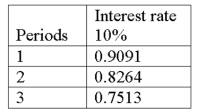
(78) Hornet Corporation has a loan agreement that provides it with cash today, and the company must pay $25,000 one year from today, $15,000 two years from today, and $5,000 three years from today. Hornet agrees to pay 10% interest. The following are factors from a present value table:
What is the amount of cash that Hornet receives today?
(Essay)
4.9/5 (80)
(80) Callable bonds reduce the bondholder's risk by requiring the issuer to create a sinking fund of assets set aside at specified amounts and dates to repay the bonds at maturity.
(True/False)
4.9/5 (74)
(74) Describe the journal entries required to record the issuance of bonds and the payment of bond interest.
(Essay)
4.8/5 (88)
(88) The contract between the bond issuer and the bondholders, which identifies the rights and obligations of the parties, is called a(n):
(Multiple Choice)
4.8/5 (77)
(77) The effective interest method yields increasing amounts of bond interest expense and decreasing amounts of premium amortization over the bond's life for bonds issued at a premium.
(True/False)
4.8/5 (64)
(64) A company issued 5-year, 7% bonds with a par value of $100,000. The market rate when the bonds were issued was 6.5%. The company received $101,137 cash for the bonds. Using the effective interest method, the amount of recorded interest expense for the first semiannual interest period is:
(Multiple Choice)
4.9/5 (75)
(75) Bonds owned by investors whose names and addresses are recorded by the issuing company, and for which interest payments are made with checks or cash transfers to the bondholders, are called:
(Multiple Choice)
4.9/5 (81)
(81) On January 1, a company issued a $500,000, 10%, 8-year bond payable, and received proceeds of $487,000. Interest is payable each June 30 and December 31. The total interest expense on the bond over its eight-year life is $400,000.
(True/False)
4.9/5 (82)
(82) A bond is a written promise to pay an amount identified as the par value of the bond along with interest.
(True/False)
4.8/5 (71)
(71) The carrying amount (book value) of a bond payable is the par value of the bonds plus the discount.
(True/False)
4.8/5 (78)
(78) On January 1, a company issues bonds dated January 1 with a par value of $400,000. The bonds mature in 5 years. The contract rate is 7%, and interest is paid semiannually on June 30 and December 31. The market rate is 8% and the bonds are sold for $383,793. The journal entry to record the first interest payment using the effective interest method of amortization is:
(Multiple Choice)
4.8/5 (71)
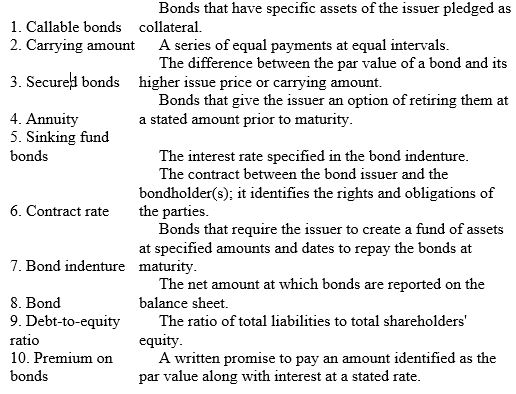
(71) 

Filters
- Essay(0)
- Multiple Choice(0)
- Short Answer(0)
- True False(0)
- Matching(0)