



 Chat with AI
Exam 14: Long-Term Liabilities

Exam 1: Accounting in Business245 Questions
Exam 2: Analyzing and Recording Transactions201 Questions
Exam 3: Adjusting Accounts and Preparing Financial Statements227 Questions
Exam 4: Completing the Accounting Cycle177 Questions
Exam 5: Accounting for Merchandising Operations189 Questions
Exam 6: Inventories and Cost of Sales194 Questions
Exam 7: Accounting Information Systems166 Questions
Exam 8: Cash and Internal Controls195 Questions
Exam 9: Accounting for Receivables162 Questions
Exam 10: Long-Term Assets208 Questions
Exam 11: Current Liabilities and Payroll Accounting178 Questions
Exam 12: Accounting for Partnerships141 Questions
Exam 13: Accounting for Corporations210 Questions
Exam 14: Long-Term Liabilities158 Questions
Exam 15: Investments and International Operations156 Questions
Exam 16: Statement of Cash Flows173 Questions
Exam 17: Analysis of Financial Statements182 Questions
Exam 18: Managerial Accounting Concepts and Principles199 Questions
Exam 19: Job Order Cost Accounting165 Questions
Exam 20: Process Cost Accounting172 Questions
Exam 21: Cost Allocation and Performance Measurement173 Questions
Exam 22: Cost-Volume-Profit Analysis190 Questions
Exam 23: Master Budgets and Planning166 Questions
Exam 24: Flexible Budgets and Standard Costs178 Questions
Exam 25: Capital Budgeting and Managerial Decisions153 Questions
Select questions type


The issue price of bonds is found by computing the future value of the bond's cash payments, discounted at the market rate of interest.
(True/False)
4.8/5  (82)
(82) A company enters into an agreement to make 5 annual year-end payments of $3,000 each, starting one year from now. The annual interest rate is 6%. The present value of an annuity factor for 5 periods, 6% is 4.2124. What is the present value of these five payments?
(Essay)
4.8/5 (83)
(83) Owners of coupon bonds are not required to pay tax on the interest earned.
(True/False)
4.8/5 (70)
(70) A basic present value concept is that cash paid or received in the future is worth more than the same amount of cash received today.
(True/False)
4.7/5 (81)
(81) The use of debt financing insures an increase in return on equity.
(True/False)
4.9/5 (75)
(75) Explain the present value concept as it applies to long-term liabilities.
(Essay)
4.9/5 (66)
(66) The market value or issue price of a bond is equal to the present value of all future cash payments provided by the bond.
(True/False)
4.8/5 (66)
(66) An installment note is an obligation of the issuing company that requires a series of periodic payments to the lender.
(True/False)
4.8/5 (69)
(69) ______________ bonds are bonds that are scheduled for maturity on one specified date.
(Essay)
5.0/5 (83)
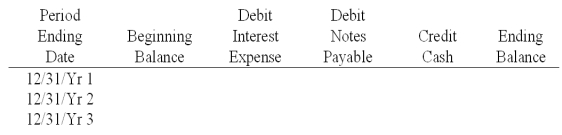
(83) A company purchased two new delivery vans for a total of $250,000 on January 1, Year 1. The company paid $40,000 cash and signed a $210,000, 3-year, 8% note for the remaining balance. The note is to be paid in three annual end-of-year payments of $81,487 each, with the first payment on December 31, Year 1. Each payment includes interest on the unpaid balance plus principal.
(1) Prepare a note amortization table using the format below:
(2) Prepare the journal entries to record the purchase of the vans on January 1, Year 1 and the second annual installment payment on December 31, Year 2.
(Essay)
4.7/5 (71)
(71) Bonds that have interest coupons attached to their certificates, which the bondholders detach during each interest period and present to a bank for collection, are called:
(Multiple Choice)
4.9/5 (75)
(75) The debt-to-equity ratio is calculated by dividing total shareholders' equity by total liabilities.
(True/False)
4.9/5 (83)
(83) The present value of an annuity factor at 8% for 10 years is 6.7101. This implies that an annuity of ten $15,000 payments at 8% yields a present value of $2,235.
(True/False)
4.9/5 (86)
(86) A discount on bonds payable occurs when a company issues bonds with an issue price less than par value.
(True/False)
4.8/5 (75)
(75) The carrying amount of bonds at maturity is always equal to:
(Multiple Choice)
4.9/5 (78)
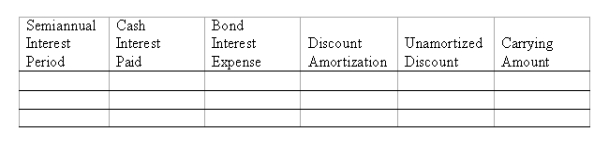
(78) A company issued 10%, 10-year bonds with a par value of $1,000,000 on January 1, at a selling price of $885,295, to yield the buyers a 12% return. The company uses the effective interest amortization method. Interest is paid semiannually each June 30 and December 31.
(1) Prepare an amortization table for the first two payment periods using the format shown below:
 (2) Prepare the journal entry to record the first semiannual interest payment.
 (Essay)
4.9/5 (82)
(82) 
Filters
- Essay(0)
- Multiple Choice(0)
- Short Answer(0)
- True False(0)
- Matching(0)