



 Chat with AI
Exam 14: Long-Term Liabilities

Exam 1: Accounting in Business245 Questions
Exam 2: Analyzing and Recording Transactions201 Questions
Exam 3: Adjusting Accounts and Preparing Financial Statements227 Questions
Exam 4: Completing the Accounting Cycle177 Questions
Exam 5: Accounting for Merchandising Operations189 Questions
Exam 6: Inventories and Cost of Sales194 Questions
Exam 7: Accounting Information Systems166 Questions
Exam 8: Cash and Internal Controls195 Questions
Exam 9: Accounting for Receivables162 Questions
Exam 10: Long-Term Assets208 Questions
Exam 11: Current Liabilities and Payroll Accounting178 Questions
Exam 12: Accounting for Partnerships141 Questions
Exam 13: Accounting for Corporations210 Questions
Exam 14: Long-Term Liabilities158 Questions
Exam 15: Investments and International Operations156 Questions
Exam 16: Statement of Cash Flows173 Questions
Exam 17: Analysis of Financial Statements182 Questions
Exam 18: Managerial Accounting Concepts and Principles199 Questions
Exam 19: Job Order Cost Accounting165 Questions
Exam 20: Process Cost Accounting172 Questions
Exam 21: Cost Allocation and Performance Measurement173 Questions
Exam 22: Cost-Volume-Profit Analysis190 Questions
Exam 23: Master Budgets and Planning166 Questions
Exam 24: Flexible Budgets and Standard Costs178 Questions
Exam 25: Capital Budgeting and Managerial Decisions153 Questions
Select questions type


Return on equity increases when the expected rate of return from the acquired assets is higher than the interest rate on the debt issued to finance the acquired assets.
(True/False)
5.0/5  (92)
(92) A company borrowed cash from the bank by signing a 5-year, 8% installment note. The present value of an annuity at 8% for 5 years is 3.9927. Each annuity payment equals $75,137.13. The present value of the note is:
(Multiple Choice)
4.9/5 (75)
(75) Debentures always have specific assets of the issuing company pledged as collateral.
(True/False)
5.0/5 (74)
(74) A company previously issued $2,000,000, 10% bonds, receiving a $120,000 premium. On the current year's interest date, after the bond interest was paid and after 40% of the total premium had been amortized, the company purchased the entire bond issue on the open market at 98 and retired it. Prepare the journal entry to record the retirement of these bonds.

(Essay)
4.8/5 (80)
(80) The carrying amount (book value) of a bond at the time when it is issued is always equal to its par value.
(True/False)
4.8/5 (75)
(75) When applying equal total payments to a note, with each payment the amount applied to the note principal _______________ while the interest expense for the note ______________.
(Essay)
4.8/5 (79)
(79) On January 1, a company issues bonds with a par value of $300,000. The bonds mature in 5 years, and pay 8% annual interest, payable each June 30 and December 31. On the issue date, the market rate of interest for the bonds is 10%. Compute the price of the bonds on their issue date. The following information is taken from present value tables:
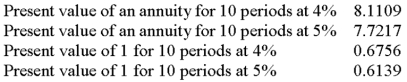
(Essay)
4.9/5 (84)
(84) On January 1, Year 1 a company borrowed $70,000 cash by signing a 9% installment note that is to be repaid with 4 annual year-end payments of $21,607, the first of which is due on December 31, Year 1.
(a) Prepare the company's journal entry to record the note's issuance.
(b) Prepare the journal entries to record the first and second installment payments.
(Essay)
4.8/5 (77)
(77) The present value of an annuity factor for 6 years at 10% is 4.3553. This implies that an annuity of six $2,000 payments at 10% would equal $8,710.60.
(True/False)
4.7/5 (86)
(86) Bonds issued in the names and addresses of their holders are ____________________ bonds.
(Essay)
4.9/5 (80)
(80) The rate of interest that borrowers are willing to pay and lenders are willing to accept for a particular bond and its risk level is the ____________________ of interest.
(Essay)
4.8/5 (69)
(69) Explain the amortization of a bond premium. Identify and describe the amortization method.
(Essay)
4.9/5 (73)
(73) An ________________________________ is an obligation requiring a series of payments to the lender.
(Essay)
4.8/5 (90)
(90) Martin Corporation issued $3,000,000 of 8%, 20-year bonds payable at par value on January 1. Interest is payable each June 30 and December 31.
(a) Prepare the general journal entry to record the issuance of the bonds on January 1.
(b) Prepare the general journal entry to record the first interest payment on June 30.
(Essay)
4.9/5 (91)
(91) ____________________ bonds reduce a bondholder's risk by requiring the issuer to create a fund of assets set aside as specified amounts and dates to repay the bonds at maturity.
(Essay)
4.8/5 (95)
(95) A company has bonds outstanding with a par value of $100,000. The unamortized premium on these bonds is $2,700. If the company retired these bonds at a call price of 99, the gain or loss on this retirement is:
(Multiple Choice)
4.9/5 (67)
(67) An advantage of bond financing is that issuing bonds does not affect owner control.
(True/False)
4.9/5 (78)
(78) A company invests $10,000 at 7% compounded annually. At the end of the second year, the company should have $11,400 in the fund.
(True/False)
4.8/5 (94)
(94) 
Filters
- Essay(0)
- Multiple Choice(0)
- Short Answer(0)
- True False(0)
- Matching(0)