



 Chat with AI
Exam 14: Long-Term Liabilities

Exam 1: Accounting in Business245 Questions
Exam 2: Analyzing and Recording Transactions201 Questions
Exam 3: Adjusting Accounts and Preparing Financial Statements227 Questions
Exam 4: Completing the Accounting Cycle177 Questions
Exam 5: Accounting for Merchandising Operations189 Questions
Exam 6: Inventories and Cost of Sales194 Questions
Exam 7: Accounting Information Systems166 Questions
Exam 8: Cash and Internal Controls195 Questions
Exam 9: Accounting for Receivables162 Questions
Exam 10: Long-Term Assets208 Questions
Exam 11: Current Liabilities and Payroll Accounting178 Questions
Exam 12: Accounting for Partnerships141 Questions
Exam 13: Accounting for Corporations210 Questions
Exam 14: Long-Term Liabilities158 Questions
Exam 15: Investments and International Operations156 Questions
Exam 16: Statement of Cash Flows173 Questions
Exam 17: Analysis of Financial Statements182 Questions
Exam 18: Managerial Accounting Concepts and Principles199 Questions
Exam 19: Job Order Cost Accounting165 Questions
Exam 20: Process Cost Accounting172 Questions
Exam 21: Cost Allocation and Performance Measurement173 Questions
Exam 22: Cost-Volume-Profit Analysis190 Questions
Exam 23: Master Budgets and Planning166 Questions
Exam 24: Flexible Budgets and Standard Costs178 Questions
Exam 25: Capital Budgeting and Managerial Decisions153 Questions
Select questions type


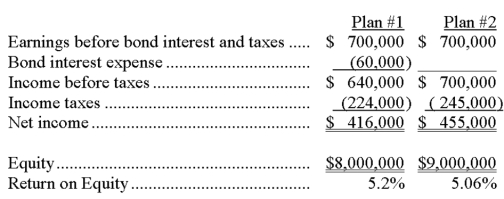
A corporation plans to invest $1 million in oil exploration. The corporation is considering two plans to raise the money. Under Plan #1, bonds with a contract rate of interest of 6% would be issued. Under Plan #2, additional ordinary shares would be issued at $20 per share. The corporation currently has 300,000 shares outstanding, and it expects to earn $700,000 per year before bond interest and income taxes. The net income and return on investment for both plans is shown below:
(Essay)
4.8/5  (86)
(86) A company issued 9.2%, 10-year bonds with a par value of $100,000. Interest is paid semiannually. The market interest rate on the issue date was 10%, and the issuer received $95,016 cash for the bonds. On the first semiannual interest date, what amount of cash should be paid to the holders of these bonds for interest?
(Essay)
4.9/5 (80)
(80) The _____________________ ratio is used to assess the risk of a company's financing structure.
(Essay)
5.0/5 (76)
(76) A company issued 7%, 5-year bonds with a par value of $100,000. The market rate when the bonds were issued was 7.5%. The company received $97,947 cash for the bonds. Using the effective interest method, the amount of interest expense for the first semiannual interest period is:
(Multiple Choice)
4.8/5 (77)
(77) A company's debt-to-equity ratio was 1.0 at the end of Year 1. By the end of Year 2, it had increased to 1.7. Since the ratio increased from Year 1 to Year 2, the degree of risk in the firm's financing structure decreased during Year 2.
(True/False)
4.8/5 (65)
(65) A company issues bonds with a par value of $800,000 on their issue date. The bonds mature in 5 years and pay 6% annual interest in two semiannual payments. On the issue date, the market rate of interest is 8%. Compute the price of the bonds on their issue date. The following information is taken from present value tables:

(Essay)
4.8/5 (78)
(78) On January 1, a company issues bonds dated January 1 with a par value of $400,000. The bonds mature in 5 years. The contract rate is 7%, and interest is paid semiannually on June 30 and December 31. The market rate is 8% and the bonds are sold for $383,793. The journal entry to record the issuance of the bond is:
(Multiple Choice)
4.7/5 (88)
(88) Bonds payable to whoever holds them are called _________________ bonds.
(Essay)
4.9/5 (95)
(95) On January 1, Year 1, Merrill Company borrowed $100,000 on a 10-year, 7% installment note payable. The terms of the note require Merrill to pay 10 equal payments of $14,238 each December 31 for 10 years. The required general journal entry to record the first payment on the note on December 31, Year 1 is:
(Multiple Choice)
4.8/5 (76)
(76) The legal contract between the issuing corporation and the bondholders is called the bond indenture.
(True/False)
4.8/5 (97)
(97) A company issued 10-year, 9% bonds with a par value of $500,000 when the market rate was 9.5%. The company received $484,087 in cash proceeds. Using the effective interest method, prepare the issuer's journal entry to record the first semiannual interest payment and the amortization of any bond discount or premium.
(Essay)
5.0/5 (74)
(74) Return on equity _______________ when the expected rate of return from the acquired assets is greater than the rate of interest on the bonds used to finance the asset acquisition.
(Essay)
4.8/5 (80)
(80) The party that has the right to exercise the call option on callable bonds is (are):
(Multiple Choice)
4.8/5 (68)
(68) The present value of an annuity can be best or easier computed as the sum of the individual future values for each payment.
(True/False)
4.8/5 (84)
(84) When the contract rate on a bond issue is less than the market rate, the bonds will generally sell at a discount.
(True/False)
5.0/5 (72)
(72) A company's ability to issue unsecured debt depends on its credit standing.
(True/False)
4.8/5 (83)
(83) ___________________ bonds have an option exercisable by the issuer to retire them at a stated dollar amount prior to maturity.
(Essay)
4.7/5 (77)
(77) The ____________ concept is the idea that cash paid (or received) in the future has less value now than the same amount of cash paid (or received) today.
(Essay)
4.8/5 (78)
(78) 
Filters
- Essay(0)
- Multiple Choice(0)
- Short Answer(0)
- True False(0)
- Matching(0)