



 Chat with AI
Exam 14: Long-Term Liabilities

Exam 1: Accounting in Business245 Questions
Exam 2: Analyzing and Recording Transactions201 Questions
Exam 3: Adjusting Accounts and Preparing Financial Statements227 Questions
Exam 4: Completing the Accounting Cycle177 Questions
Exam 5: Accounting for Merchandising Operations189 Questions
Exam 6: Inventories and Cost of Sales194 Questions
Exam 7: Accounting Information Systems166 Questions
Exam 8: Cash and Internal Controls195 Questions
Exam 9: Accounting for Receivables162 Questions
Exam 10: Long-Term Assets208 Questions
Exam 11: Current Liabilities and Payroll Accounting178 Questions
Exam 12: Accounting for Partnerships141 Questions
Exam 13: Accounting for Corporations210 Questions
Exam 14: Long-Term Liabilities158 Questions
Exam 15: Investments and International Operations156 Questions
Exam 16: Statement of Cash Flows173 Questions
Exam 17: Analysis of Financial Statements182 Questions
Exam 18: Managerial Accounting Concepts and Principles199 Questions
Exam 19: Job Order Cost Accounting165 Questions
Exam 20: Process Cost Accounting172 Questions
Exam 21: Cost Allocation and Performance Measurement173 Questions
Exam 22: Cost-Volume-Profit Analysis190 Questions
Exam 23: Master Budgets and Planning166 Questions
Exam 24: Flexible Budgets and Standard Costs178 Questions
Exam 25: Capital Budgeting and Managerial Decisions153 Questions
Select questions type


Mortgage contracts grant the lender the right to be paid from the cash proceeds of the sale of a borrower's assets identified in the mortgage.
(True/False)
4.9/5  (84)
(84) On October 1, a $30,000, 6%, 3-year installment note payable is issued by a company. The note requires equal payments of principal plus accrued interest be paid at the end of each year on September 30. The present value of an annuity factor for 3 years at 6% is 2.6730. The payment will be:
(Multiple Choice)
4.8/5 (88)
(88) A company borrowed $50,000 cash from the bank and signed a 6-year note at 7%. The present value of an annuity for 6 years at 7% is 4.7665. The annual annuity payments equal:
(Multiple Choice)
4.9/5 (80)
(80) On January 1, a company issues bonds dated January 1 with a par value of $300,000. The bonds mature in 5 years. The contract rate is 9%, and interest is paid semiannually on June 30 and December 31. The market rate is 8% and the bonds are sold for $312,177. The journal entry to record the issuance of the bond is:
(Multiple Choice)
4.8/5 (76)
(76) An annuity is a series of equal payments at equal time intervals.
(True/False)
4.8/5 (73)
(73) On January 1, a company issues bonds with a par value of $300,000. The bonds mature in 5 years and pay 8% annual interest each June 30 and December 31. On the issue date, the market rate of interest is 6%. Compute the price of the bonds on their issue date. The following information is taken from present value tables:
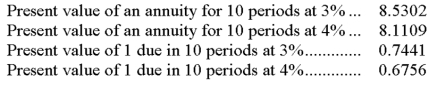
(Essay)
4.9/5 (84)
(84) A company purchased equipment and signed a 7-year installment loan at 9% annual interest. The annual payments equal $9,000. The present value of an annuity for 7 years at 9% is 5.0330. The present value of the loan is:
(Multiple Choice)
4.8/5 (71)
(71) The legal document identifying the rights and obligations of both the bondholders and the issuer is called the ___________________________________.
(Essay)
4.9/5 (86)
(86) Callable bonds can be exchanged for a fixed number of shares of the issuing corporation's ordinary shares.
(True/False)
4.9/5 (79)
(79) A company with a low level of liabilities in relation to shareholders' equity is likely to have a very high debt-to-equity ratio.
(True/False)
4.8/5 (71)
(71) A corporation issued 8% bonds with a par value of $1,000,000, receiving a $20,000 premium. On the interest date 5 years later, after the bond interest was paid and after 40% of the premium had been amortized, the corporation purchased the entire issue on the open market at 99 and retired it. The gain or loss on this retirement is:
(Multiple Choice)
4.9/5 (83)
(83) Premium on Bonds Payable is an adjunct or accretion liability account.
(True/False)
4.8/5 (85)
(85) A company received cash proceeds of $206,948 on a bond issue with a par value of $200,000. The difference between par value and issue price for this bond is recorded as a:
(Multiple Choice)
4.9/5 (74)
(74) The carrying amount of a long-term note is computed as the present value of all remaining future payments, discounted using the market rate at the time of issuance.
(True/False)
4.9/5 (89)
(89) Bonds that have an option exercisable by the issuer to retire them at a stated dollar amount prior to maturity are known as:
(Multiple Choice)
4.8/5 (81)
(81) Bonds that mature at different dates with the result that the entire principal amount is repaid gradually over a number of periods are known as:
(Multiple Choice)
4.7/5 (78)
(78) On January 1, a company issued 10%, 10-year bonds payable with a par value of $720,000. The bonds pay interest each July 1 and January 1. The bonds were sold for $817,860 cash, which provides the holders an annual yield of 8%. Prepare the issuer's journal entry to record the first semiannual interest payment assuming the effective interest method is used.
(Essay)
4.8/5 (92)
(92) 
Filters
- Essay(0)
- Multiple Choice(0)
- Short Answer(0)
- True False(0)
- Matching(0)