



 Chat with AI
Exam 7: Capital Asset Pricing and Arbitrage Pricing Theory

Exam 1: Investments: Background and Issues79 Questions
Exam 2: Asset Classes and Financial Instruments85 Questions
Exam 3: Securities Markets94 Questions
Exam 4: Mutual Funds and Other Investment Companies90 Questions
Exam 5: Risk, Return, and the Historical Record89 Questions
Exam 6: Efficient Diversification89 Questions
Exam 7: Capital Asset Pricing and Arbitrage Pricing Theory89 Questions
Exam 8: The Efficient Market Hypothesis92 Questions
Exam 9: Behavioral Finance and Technical Analysis89 Questions
Exam 10: Bond Prices and Yields96 Questions
Exam 11: Managing Bond Portfolios90 Questions
Exam 12: Macroeconomic and Industry Analysis93 Questions
Exam 13: Equity Valuation94 Questions
Exam 14: Financial Statement Analysis88 Questions
Exam 15: Options Markets91 Questions
Exam 16: Option Valuation90 Questions
Exam 17: Futures Markets and Risk Management92 Questions
Exam 18: Evaluating Investment Performance78 Questions
Exam 19: International Diversification50 Questions
Exam 20: Hedge Funds65 Questions
Exam 21: Taxes, Inflation, and Investment Strategy74 Questions
Exam 22: Investors and the Investment Process86 Questions
Select questions type


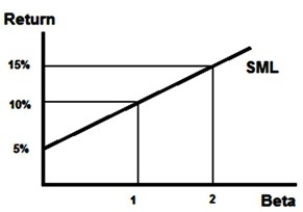 What is the beta for a portfolio with an expected return of 12.5%?
 (Multiple Choice)
4.9/5  (82)
(82) The graph of the relationship between expected return and beta in the CAPM context is called the ________.
(Multiple Choice)
4.8/5 (73)
(73) Consider the CAPM. The risk-free rate is 5%, and the expected return on the market is 15%. What is the beta on a stock with an expected return of 17%?
(Multiple Choice)
5.0/5 (81)
(81) An adjusted beta will be ________ than the unadjusted beta.
(Multiple Choice)
4.8/5 (74)
(74) An important characteristic of market equilibrium is ________.
(Multiple Choice)
4.9/5 (69)
(69) Empirical results estimated from historical data indicate that betas ________.
(Multiple Choice)
4.8/5 (74)
(74) Consider the single factor APT. Portfolio A has a beta of .2 and an expected return of 13%. Portfolio B has a beta of .4 and an expected return of 15%. The risk-free rate of return is 10%. If you wanted to take advantage of an arbitrage opportunity, you should take a short position in portfolio ________ and a long position in portfolio ________.
(Multiple Choice)
4.8/5 (79)
(79) 
Filters
- Essay(0)
- Multiple Choice(0)
- Short Answer(0)
- True False(0)
- Matching(0)