



 Chat with AI
Exam 14: Gene Expression: From Gene to Protein

Exam 1: Introduction: Evolution and the Foundations of Biology36 Questions
Exam 2: The Chemical Context of Life137 Questions
Exam 3: Carbon and the Molecular Diversity of Life136 Questions
Exam 4: A Tour of the Cell75 Questions
Exam 5: Membrane Transport and Cell Signaling97 Questions
Exam 6: An Introduction to Metabolism79 Questions
Exam 7: Cellular Respiration and Fermentation100 Questions
Exam 8: Photosynthesis72 Questions
Exam 9: The Cell Cycle56 Questions
Exam 10: Meiosis and Sexual Life Cycles62 Questions
Exam 11: Mendel and the Gene Idea63 Questions
Exam 12: The Chromosomal Basis of Inheritance46 Questions
Exam 13: The Molecular Basis of Inheritance67 Questions
Exam 14: Gene Expression: From Gene to Protein80 Questions
Exam 15: Regulation of Gene Expression50 Questions
Exam 16: Development, Stem Cells, and Cancer34 Questions
Exam 17: Viruses35 Questions
Exam 18: Genomes and Their Evolution29 Questions
Exam 19: Descent With Modification55 Questions
Exam 20: Phylogeny60 Questions
Exam 21: The Evolution of Populations70 Questions
Exam 22: The Origin of Species67 Questions
Exam 23: Broad Patterns of Evolution45 Questions
Exam 24: Early Life and the Diversification of Prokaryotes88 Questions
Exam 25: The Origin and Diversification of Eukaryotes71 Questions
Exam 26: The Colonization of Land by Plants and Fungi126 Questions
Exam 27: The Rise of Animal Diversity88 Questions
Exam 28: Plant Structure and Growth59 Questions
Exam 29: Resource Acquisition, Nutrition, and Transport in Vascular Plants110 Questions
Exam 30: Reproduction and Domestication of Flowering Plants67 Questions
Exam 31: Plant Responses to Internal and External Signals75 Questions
Exam 32: Homeostasis and Endocrine Signaling120 Questions
Exam 33: Animal Nutrition67 Questions
Exam 34: Circulation and Gas Exchange88 Questions
Exam 35: The Immune System91 Questions
Exam 36: Reproduction and Development118 Questions
Exam 37: Neurons, Synapses, and Signaling76 Questions
Exam 38: Nervous and Sensory Systems99 Questions
Exam 39: Motor Mechanisms and Behavior79 Questions
Exam 40: Population Ecology and the Distribution of Organisms93 Questions
Exam 41: Species Interactions60 Questions
Exam 42: Ecosystems and Energy90 Questions
Exam 43: Global Ecology and Conservation Biology72 Questions
Select questions type


Which of the following types of mutation, resulting in an error in the mRNA just after the 3ʹ AUG start codon, is likely to have the most serious effect on the polypeptide product?
(Multiple Choice)
4.7/5  (65)
(65) What must happen to a newly made polypeptide before it can be secreted from a cell?
(Multiple Choice)
4.8/5 (78)
(78) Using the figure below, identify a 5' → 3' sequence of nucleotides in the DNA template strand for an mRNA coding for the polypeptide sequence Phe-Pro-Lys. 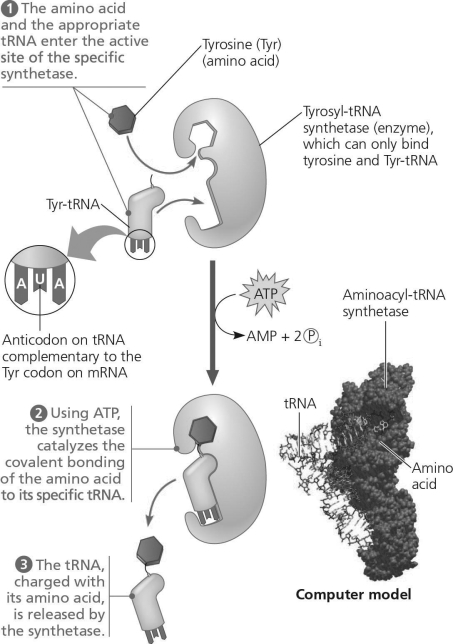 Figure 14.6
 (Multiple Choice)
4.9/5 (71)
(71) Which of the following experimental procedures is most likely to speed up mRNA degradation in a eukaryotic cell?
(Multiple Choice)
4.9/5 (81)
(81) When translating secretory or membrane proteins, ribosomes are directed to the ER membrane by
(Multiple Choice)
4.8/5 (86)
(86) There are 61 mRNA codons that specify an amino acid, but only 45 tRNAs. This is best explained by the fact that
(Multiple Choice)
5.0/5 (85)
(85) 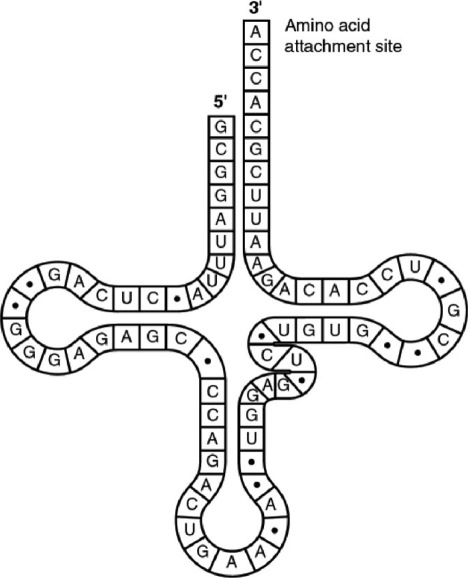 Figure 14.5
-The tRNA shown in Figure 14.5 has its 3' end projecting beyond its 5' end. What will occur at this 3' end?
Figure 14.5
-The tRNA shown in Figure 14.5 has its 3' end projecting beyond its 5' end. What will occur at this 3' end? (Multiple Choice)
4.8/5 (70)
(70) Which of the following is a function of a poly-A tail in mRNA?
(Multiple Choice)
4.8/5 (76)
(76) Garrod hypothesized that inherited diseases such as alkaptonuria, the inability to metabolize the chemical alkapton, occur because
(Multiple Choice)
4.8/5 (73)
(73) Figure 14.5
-What type of bonding is responsible for maintaining the shape of the tRNA molecule in Figure 14.5?
Figure 14.5
-What type of bonding is responsible for maintaining the shape of the tRNA molecule in Figure 14.5? (Multiple Choice)
4.9/5 (80)
(80) Use the following model of a eukaryotic transcript to answer the question. E1-4 refer to the exons and I1-3 refer to the introns in the pre-mRNA transcript.
5' UTR E1 I1 E2 I2 E3 I3 E4 UTR 3'
Suppose that exposure to a chemical mutagen results in a change in the sequence that alters the 5' end of intron 1 (I1). Which of the following results might occur?
(Multiple Choice)
4.8/5 (84)
(84) Which of the following mutations is most likely to cause a phenotypic change?
(Multiple Choice)
4.9/5 (78)
(78) In order for a eukaryotic gene to be engineered into a bacterial colony to be expressed, what must be included in addition to the coding exons of the gene?
(Multiple Choice)
5.0/5 (76)
(76) A particular triplet of bases in the coding sequence of DNA is AAA. The anticodon on the tRNA that binds the mRNA codon is
(Multiple Choice)
4.8/5 (78)
(78)  Figure 14.3
-Given the locally unwound double strand in Figure 14.3, in which direction does the RNA polymerase move?
Figure 14.3
-Given the locally unwound double strand in Figure 14.3, in which direction does the RNA polymerase move? (Multiple Choice)
4.9/5 (65)
(65) Garrod's information about the enzyme alteration resulting in alkaptonuria led to further understanding of these types of metabolic pathways in humans. Phenylketonuria (PKU) occurs when another enzyme in the pathway is altered or missing, resulting in a failure of phenylalanine (phe) to be metabolized to another amino acid: tyrosine. Tyrosine is an earlier substrate in the pathway altered in alkaptonuria. How might PKU affect the presence or absence of alkaptonuria?
(Multiple Choice)
4.9/5 (85)
(85) Which of the following does not occur in prokaryotic gene expression, but does occur in eukaryotic gene expression?
(Multiple Choice)
4.8/5 (74)
(74) 
Filters
- Essay(0)
- Multiple Choice(0)
- Short Answer(0)
- True False(0)
- Matching(0)