



 Chat with AI
Exam 14: Gene Expression: From Gene to Protein

Exam 1: Introduction: Evolution and the Foundations of Biology36 Questions
Exam 2: The Chemical Context of Life137 Questions
Exam 3: Carbon and the Molecular Diversity of Life136 Questions
Exam 4: A Tour of the Cell75 Questions
Exam 5: Membrane Transport and Cell Signaling97 Questions
Exam 6: An Introduction to Metabolism79 Questions
Exam 7: Cellular Respiration and Fermentation100 Questions
Exam 8: Photosynthesis72 Questions
Exam 9: The Cell Cycle56 Questions
Exam 10: Meiosis and Sexual Life Cycles62 Questions
Exam 11: Mendel and the Gene Idea63 Questions
Exam 12: The Chromosomal Basis of Inheritance46 Questions
Exam 13: The Molecular Basis of Inheritance67 Questions
Exam 14: Gene Expression: From Gene to Protein80 Questions
Exam 15: Regulation of Gene Expression50 Questions
Exam 16: Development, Stem Cells, and Cancer34 Questions
Exam 17: Viruses35 Questions
Exam 18: Genomes and Their Evolution29 Questions
Exam 19: Descent With Modification55 Questions
Exam 20: Phylogeny60 Questions
Exam 21: The Evolution of Populations70 Questions
Exam 22: The Origin of Species67 Questions
Exam 23: Broad Patterns of Evolution45 Questions
Exam 24: Early Life and the Diversification of Prokaryotes88 Questions
Exam 25: The Origin and Diversification of Eukaryotes71 Questions
Exam 26: The Colonization of Land by Plants and Fungi126 Questions
Exam 27: The Rise of Animal Diversity88 Questions
Exam 28: Plant Structure and Growth59 Questions
Exam 29: Resource Acquisition, Nutrition, and Transport in Vascular Plants110 Questions
Exam 30: Reproduction and Domestication of Flowering Plants67 Questions
Exam 31: Plant Responses to Internal and External Signals75 Questions
Exam 32: Homeostasis and Endocrine Signaling120 Questions
Exam 33: Animal Nutrition67 Questions
Exam 34: Circulation and Gas Exchange88 Questions
Exam 35: The Immune System91 Questions
Exam 36: Reproduction and Development118 Questions
Exam 37: Neurons, Synapses, and Signaling76 Questions
Exam 38: Nervous and Sensory Systems99 Questions
Exam 39: Motor Mechanisms and Behavior79 Questions
Exam 40: Population Ecology and the Distribution of Organisms93 Questions
Exam 41: Species Interactions60 Questions
Exam 42: Ecosystems and Energy90 Questions
Exam 43: Global Ecology and Conservation Biology72 Questions
Select questions type


When the genome of a particular species is said to include 20,000 protein-coding regions, what does this imply?
(Multiple Choice)
4.9/5  (74)
(74) The genetic code is essentially the same for all organisms. Based on this information, one can logically assume which of the following statements to be correct?
(Multiple Choice)
5.0/5 (94)
(94) Use the following model of a eukaryotic transcript to answer the question. E1-4 refer to the exons and I1-3 refer to the introns in the pre-mRNA transcript.
5' UTR E1 I1 E2 I2 E3 I3 E4 UTR 3'
Suppose that an induced mutation removes most of the 5' end of the 5' UTR. What might be the result of this removal?
(Multiple Choice)
4.9/5 (67)
(67) The "universal" genetic code is now known to have exceptions. Evidence for this can be found if which of the following is true?
(Multiple Choice)
5.0/5 (87)
(87) In an experimental situation, a student researcher inserts an mRNA molecule into a eukaryotic cell after he has removed its 5' cap and poly-A tail. Which of the following would you expect him to find?
(Multiple Choice)
4.9/5 (81)
(81) Which of the following DNA mutations is likely to have the most negative effect on the protein it specifies?
(Multiple Choice)
4.8/5 (88)
(88) RNA polymerase in a prokaryote is composed of several subunits. Most of these subunits are the same for the transcription of any gene, but one, known as sigma, varies considerably. Which of the following is the most probable advantage for the organism in having such variability in RNA polymerase?
(Multiple Choice)
4.8/5 (87)
(87) Which of the following mutations would be most likely to have a harmful effect on an organism?
(Multiple Choice)
4.7/5 (84)
(84) In comparing DNA replication with RNA transcription in the same cell, which of the following is true only of replication?
(Multiple Choice)
4.9/5 (81)
(81) When the spliceosome binds to a pre-mRNA transcript, where does it typically attach?
(Multiple Choice)
5.0/5 (83)
(83) During splicing, which molecular component of the spliceosome catalyzes the excision reaction?
(Multiple Choice)
4.7/5 (80)
(80) Which of the following statements best describes the termination of transcription in prokaryotes?
(Multiple Choice)
4.9/5 (91)
(91) In what way might a point mutation in DNA make a difference in the function of a protein?
(Multiple Choice)
4.8/5 (78)
(78) Transcription in eukaryotes requires which of the following in addition to RNA polymerase?
(Multiple Choice)
4.7/5 (73)
(73) Please use the following information to answer the question(s) below.
A part of an mRNA molecule with the following sequence is being read by a ribosome: 5'-CCG-ACG-3' (mRNA). The charged transfer RNA molecules shown in Figure 14.4 (with their anticodons shown in the 3' to 5' direction) are available. Two of them can correctly match the mRNA so that a dipeptide can form. 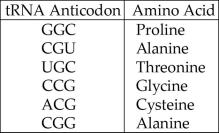 Figure 14.4
-The dipeptide that will form will be
Figure 14.4
-The dipeptide that will form will be (Multiple Choice)
4.7/5 (67)
(67) Suppose that an error in transcription alters the formation of a single tRNA molecule in a cell. The altered tRNA still attaches to the same amino acid (Phe), but its anticodon loop has the sequence AAU, which binds to the mRNA codon UUA (usually specifying the amino acid leucine, Leu). What will be the effect on the translation of polypeptides in this cell?
(Multiple Choice)
4.9/5 (74)
(74) Please use the following information to answer the question(s) below.
A transfer RNA (#1) attached to the amino acid lysine enters the ribosome. The lysine binds to the growing polypeptide on the other tRNA (#2) already in the ribosome.
-Which component of the complex described enters the exit tunnel through the large subunit of the ribosome?
(Multiple Choice)
4.9/5 (86)
(86) Please use the following information to answer the question(s) below.
A transfer RNA (#1) attached to the amino acid lysine enters the ribosome. The lysine binds to the growing polypeptide on the other tRNA (#2) already in the ribosome.
-Where does tRNA #2 move to after this bonding of lysine to the polypeptide?
(Multiple Choice)
4.9/5 (88)
(88)  Figure 14.1
-Examine the simple metabolic pathway in Figure 14.1. According to Beadle and Tatum's hypothesis, how many genes are necessary for this pathway?
Figure 14.1
-Examine the simple metabolic pathway in Figure 14.1. According to Beadle and Tatum's hypothesis, how many genes are necessary for this pathway? (Multiple Choice)
4.9/5 (62)
(62) 
Filters
- Essay(0)
- Multiple Choice(0)
- Short Answer(0)
- True False(0)
- Matching(0)