



 Chat with AI
Exam 34: Circulation and Gas Exchange

Exam 1: Introduction: Evolution and the Foundations of Biology36 Questions
Exam 2: The Chemical Context of Life137 Questions
Exam 3: Carbon and the Molecular Diversity of Life136 Questions
Exam 4: A Tour of the Cell75 Questions
Exam 5: Membrane Transport and Cell Signaling97 Questions
Exam 6: An Introduction to Metabolism79 Questions
Exam 7: Cellular Respiration and Fermentation100 Questions
Exam 8: Photosynthesis72 Questions
Exam 9: The Cell Cycle56 Questions
Exam 10: Meiosis and Sexual Life Cycles62 Questions
Exam 11: Mendel and the Gene Idea63 Questions
Exam 12: The Chromosomal Basis of Inheritance46 Questions
Exam 13: The Molecular Basis of Inheritance67 Questions
Exam 14: Gene Expression: From Gene to Protein80 Questions
Exam 15: Regulation of Gene Expression50 Questions
Exam 16: Development, Stem Cells, and Cancer34 Questions
Exam 17: Viruses35 Questions
Exam 18: Genomes and Their Evolution29 Questions
Exam 19: Descent With Modification55 Questions
Exam 20: Phylogeny60 Questions
Exam 21: The Evolution of Populations70 Questions
Exam 22: The Origin of Species67 Questions
Exam 23: Broad Patterns of Evolution45 Questions
Exam 24: Early Life and the Diversification of Prokaryotes88 Questions
Exam 25: The Origin and Diversification of Eukaryotes71 Questions
Exam 26: The Colonization of Land by Plants and Fungi126 Questions
Exam 27: The Rise of Animal Diversity88 Questions
Exam 28: Plant Structure and Growth59 Questions
Exam 29: Resource Acquisition, Nutrition, and Transport in Vascular Plants110 Questions
Exam 30: Reproduction and Domestication of Flowering Plants67 Questions
Exam 31: Plant Responses to Internal and External Signals75 Questions
Exam 32: Homeostasis and Endocrine Signaling120 Questions
Exam 33: Animal Nutrition67 Questions
Exam 34: Circulation and Gas Exchange88 Questions
Exam 35: The Immune System91 Questions
Exam 36: Reproduction and Development118 Questions
Exam 37: Neurons, Synapses, and Signaling76 Questions
Exam 38: Nervous and Sensory Systems99 Questions
Exam 39: Motor Mechanisms and Behavior79 Questions
Exam 40: Population Ecology and the Distribution of Organisms93 Questions
Exam 41: Species Interactions60 Questions
Exam 42: Ecosystems and Energy90 Questions
Exam 43: Global Ecology and Conservation Biology72 Questions
Select questions type


Air rushes into the lungs of humans during inhalation because
(Multiple Choice)
5.0/5  (69)
(69) Blood returning to the mammalian heart in a pulmonary vein drains first into the
(Multiple Choice)
4.7/5 (87)
(87) Please use the following information to answer the question(s) below.
In the Himalayas, Mount Everest, Earth's highest mountain, reaches over 8,800 meters at its peak. At this altitude the atmospheric pressure is only 254 mm Hg. Although humans cannot survive at this altitude, the bar-headed goose can fly there without any problems. Bar-headed goose hemoglobin can bind the same number of oxygen molecules as human hemoglobin, but their affinities for binding oxygen are different (see graph below). 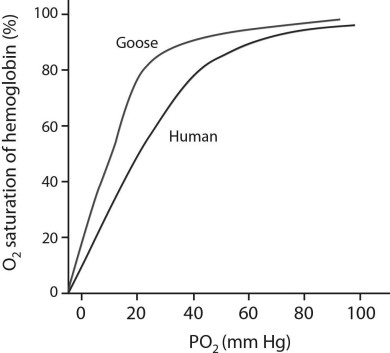 -What is the approximate partial pressure of oxygen on top of Mount Everest?
 (Multiple Choice)
4.8/5 (73)
(73) The set of blood vessels with the lowest blood pressure driving flow is
(Multiple Choice)
4.8/5 (77)
(77) Which of the following respiratory systems is not closely associated with a blood supply?
(Multiple Choice)
4.7/5 (90)
(90) Atmospheric pressure at sea level is equal to a column of 760 mm Hg. Oxygen makes up 21% of the atmosphere by volume. The partial pressure of oxygen in such conditions is
(Multiple Choice)
4.7/5 (75)
(75) To become bound to hemoglobin for transport in a mammal, atmospheric molecules of oxygen must cross
(Multiple Choice)
4.8/5 (77)
(77) At what point in the following figure would blood pressure be highest? 
(Multiple Choice)
4.9/5 (86)
(86) The amount of air inhaled and exhaled in a normal breath is called
(Multiple Choice)
4.9/5 (84)
(84) A species that has a normal resting systolic blood pressure of >260 mm Hg is likely to be
(Multiple Choice)
4.9/5 (93)
(93) An increased concentration of nitric oxide within a vascular bed is associated with
(Multiple Choice)
4.8/5 (84)
(84) A group of students was designing an experiment to test the effect of smoking on grass frogs. They hypothesized that keeping the frogs in a smoke-filled environment for defined periods of time would result in the animals developing lung cancer. However, when they searched for previously published information to support their hypothesis, they discovered they were wrong in their original assessment. Even though they were never going to go ahead with their experiment (so as not to harm frogs needlessly), they knew that a more likely outcome of putting carcinogens in the air would be the development of
(Multiple Choice)
4.8/5 (73)
(73) In an animal species known for endurance running rather than fast sprinting, you would expect to find
(Multiple Choice)
5.0/5 (64)
(64) An anthropologist discovers the fossilized heart of an extinct animal. The evidence indicates that the organism's heart was large, was well formed, and had four chambers, with no connection between the right and left sides. A reasonable conclusion supported by these observations is that the
(Multiple Choice)
4.8/5 (75)
(75) If a molecule of CO₂ released into the blood in your left toe is exhaled from your nose, it must pass through all of the following except
(Multiple Choice)
4.9/5 (76)
(76) 
Filters
- Essay(0)
- Multiple Choice(0)
- Short Answer(0)
- True False(0)
- Matching(0)