



 Chat with AI
Exam 42: Ecosystems and Energy

Exam 1: Introduction: Evolution and the Foundations of Biology36 Questions
Exam 2: The Chemical Context of Life137 Questions
Exam 3: Carbon and the Molecular Diversity of Life136 Questions
Exam 4: A Tour of the Cell75 Questions
Exam 5: Membrane Transport and Cell Signaling97 Questions
Exam 6: An Introduction to Metabolism79 Questions
Exam 7: Cellular Respiration and Fermentation100 Questions
Exam 8: Photosynthesis72 Questions
Exam 9: The Cell Cycle56 Questions
Exam 10: Meiosis and Sexual Life Cycles62 Questions
Exam 11: Mendel and the Gene Idea63 Questions
Exam 12: The Chromosomal Basis of Inheritance46 Questions
Exam 13: The Molecular Basis of Inheritance67 Questions
Exam 14: Gene Expression: From Gene to Protein80 Questions
Exam 15: Regulation of Gene Expression50 Questions
Exam 16: Development, Stem Cells, and Cancer34 Questions
Exam 17: Viruses35 Questions
Exam 18: Genomes and Their Evolution29 Questions
Exam 19: Descent With Modification55 Questions
Exam 20: Phylogeny60 Questions
Exam 21: The Evolution of Populations70 Questions
Exam 22: The Origin of Species67 Questions
Exam 23: Broad Patterns of Evolution45 Questions
Exam 24: Early Life and the Diversification of Prokaryotes88 Questions
Exam 25: The Origin and Diversification of Eukaryotes71 Questions
Exam 26: The Colonization of Land by Plants and Fungi126 Questions
Exam 27: The Rise of Animal Diversity88 Questions
Exam 28: Plant Structure and Growth59 Questions
Exam 29: Resource Acquisition, Nutrition, and Transport in Vascular Plants110 Questions
Exam 30: Reproduction and Domestication of Flowering Plants67 Questions
Exam 31: Plant Responses to Internal and External Signals75 Questions
Exam 32: Homeostasis and Endocrine Signaling120 Questions
Exam 33: Animal Nutrition67 Questions
Exam 34: Circulation and Gas Exchange88 Questions
Exam 35: The Immune System91 Questions
Exam 36: Reproduction and Development118 Questions
Exam 37: Neurons, Synapses, and Signaling76 Questions
Exam 38: Nervous and Sensory Systems99 Questions
Exam 39: Motor Mechanisms and Behavior79 Questions
Exam 40: Population Ecology and the Distribution of Organisms93 Questions
Exam 41: Species Interactions60 Questions
Exam 42: Ecosystems and Energy90 Questions
Exam 43: Global Ecology and Conservation Biology72 Questions
Select questions type


Please use the following information to answer the question(s) below.
The tundra biome is rapidly changing as a result of global warming. Studying the energy budget of the tundra can help scientists to evaluate the magnitude of these changes. In a randomly selected square meter of tundra, the amount of plant biomass is 200 g. The amount of new plant biomass added in a year is 100 g. In the same square meter, the total biomass added in a year is 15 g. A grasshopper that eats 1 g of plant biomass is able to use 0.15 g of that biomass for growth. The grasshopper cannot assimilate 50% of the plant's biomass.
-What is the production efficiency of the grasshopper?
(Multiple Choice)
4.7/5  (86)
(86) 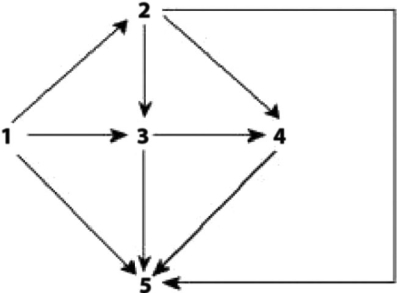 Figure 42.1 Food web for a particular terrestrial ecosystem (arrows represent energy flow and numbers represent species)
-Examine the food web for a particular terrestrial ecosystem in Figure 42.1. Species C is toxic to predators. Which species is most likely to benefit from being a mimic of C?
Figure 42.1 Food web for a particular terrestrial ecosystem (arrows represent energy flow and numbers represent species)
-Examine the food web for a particular terrestrial ecosystem in Figure 42.1. Species C is toxic to predators. Which species is most likely to benefit from being a mimic of C? (Multiple Choice)
4.7/5 (89)
(89) Which of the following has the greatest effect on the rate of chemical cycling in an ecosystem?
(Multiple Choice)
4.9/5 (72)
(72) Which of the following is primarily responsible for limiting the number of trophic levels in most ecosystems?
(Multiple Choice)
4.7/5 (87)
(87) Which of the following locations is the largest reservoir for carbon in the carbon cycle?
(Multiple Choice)
4.8/5 (77)
(77) Please use the following information to answer the question(s) below.
Starting with the European settlers, humans have introduced earthworms from Europe and Asia into North American forests. These introductions continue through the transport of soil that contains non-native earthworms, such as during construction, and through the release of non-native earthworms used for fishing. The effects of non-native earthworms are especially large in forests that did not have any native earthworms. For example, forests of the Great Lakes region did not previously have earthworms until humans introduced them. When non-native earthworms are introduced, the thick layer of leaf litter disappears quickly, thereby altering biogeochemical cycles.
-Which of the following correctly traces a carbon molecule in a Great Lakes forest that is invaded with non-native earthworms?
(Multiple Choice)
4.8/5 (73)
(73) Which of the following organisms is incorrectly paired with its trophic level?
(Multiple Choice)
4.8/5 (63)
(63) Approximately how many kilograms of secondary consumer biomass can be supported by a field plot containing 1,000 kg of plant material?
(Multiple Choice)
4.8/5 (94)
(94) 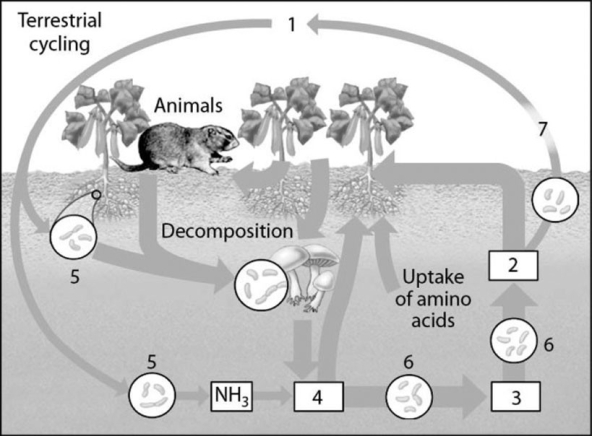 Figure 42.3
-In the diagram of the nitrogen cycle in Figure 42.3, which number represents nitrifying bacteria?
Figure 42.3
-In the diagram of the nitrogen cycle in Figure 42.3, which number represents nitrifying bacteria? (Multiple Choice)
5.0/5 (88)
(88) The amount of chemical energy in a consumer's food that is converted to its own new biomass during a given time period is known as which of the following?
(Multiple Choice)
4.7/5 (86)
(86) If the flow of energy in an arctic ecosystem goes through a simple food chain, perhaps involving humans, moving from phytoplankton to zooplankton to fish to seals to polar bears, then which of the following could be true?
(Multiple Choice)
4.8/5 (81)
(81) To recycle nutrients, an ecosystem must have, at a minimum,
(Multiple Choice)
4.8/5 (73)
(73) What is the first step in the restoration of an extremely degraded ecosystem?
(Multiple Choice)
4.8/5 (77)
(77) The Hubbard Brook watershed deforestation experiment yielded all of the following results except:
(Multiple Choice)
5.0/5 (78)
(78) Please use the following information to answer the question(s) below.
The tundra biome is rapidly changing as a result of global warming. Studying the energy budget of the tundra can help scientists to evaluate the magnitude of these changes. In a randomly selected square meter of tundra, the amount of plant biomass is 200 g. The amount of new plant biomass added in a year is 100 g. In the same square meter, the total biomass added in a year is 15 g. A grasshopper that eats 1 g of plant biomass is able to use 0.15 g of that biomass for growth. The grasshopper cannot assimilate 50% of the plant's biomass.
-What is the maximum biomass of grasshoppers that could be supported by this square meter of tundra (i.e., if grasshoppers ate all of the existing vegetation)?
(Multiple Choice)
4.9/5 (80)
(80) In ecosystems, why is the term cycling used to describe the transfer of chemical elements, whereas the term flow is used for energy exchange?
(Multiple Choice)
4.9/5 (84)
(84) If the sun were to suddenly stop providing energy to Earth, most ecosystems would vanish. Which of the following ecosystems would likely survive the longest after this hypothetical disaster?
(Multiple Choice)
5.0/5 (76)
(76) 
Filters
- Essay(0)
- Multiple Choice(0)
- Short Answer(0)
- True False(0)
- Matching(0)