



 Chat with AI
Exam 42: Ecosystems and Energy

Exam 1: Introduction: Evolution and the Foundations of Biology36 Questions
Exam 2: The Chemical Context of Life137 Questions
Exam 3: Carbon and the Molecular Diversity of Life136 Questions
Exam 4: A Tour of the Cell75 Questions
Exam 5: Membrane Transport and Cell Signaling97 Questions
Exam 6: An Introduction to Metabolism79 Questions
Exam 7: Cellular Respiration and Fermentation100 Questions
Exam 8: Photosynthesis72 Questions
Exam 9: The Cell Cycle56 Questions
Exam 10: Meiosis and Sexual Life Cycles62 Questions
Exam 11: Mendel and the Gene Idea63 Questions
Exam 12: The Chromosomal Basis of Inheritance46 Questions
Exam 13: The Molecular Basis of Inheritance67 Questions
Exam 14: Gene Expression: From Gene to Protein80 Questions
Exam 15: Regulation of Gene Expression50 Questions
Exam 16: Development, Stem Cells, and Cancer34 Questions
Exam 17: Viruses35 Questions
Exam 18: Genomes and Their Evolution29 Questions
Exam 19: Descent With Modification55 Questions
Exam 20: Phylogeny60 Questions
Exam 21: The Evolution of Populations70 Questions
Exam 22: The Origin of Species67 Questions
Exam 23: Broad Patterns of Evolution45 Questions
Exam 24: Early Life and the Diversification of Prokaryotes88 Questions
Exam 25: The Origin and Diversification of Eukaryotes71 Questions
Exam 26: The Colonization of Land by Plants and Fungi126 Questions
Exam 27: The Rise of Animal Diversity88 Questions
Exam 28: Plant Structure and Growth59 Questions
Exam 29: Resource Acquisition, Nutrition, and Transport in Vascular Plants110 Questions
Exam 30: Reproduction and Domestication of Flowering Plants67 Questions
Exam 31: Plant Responses to Internal and External Signals75 Questions
Exam 32: Homeostasis and Endocrine Signaling120 Questions
Exam 33: Animal Nutrition67 Questions
Exam 34: Circulation and Gas Exchange88 Questions
Exam 35: The Immune System91 Questions
Exam 36: Reproduction and Development118 Questions
Exam 37: Neurons, Synapses, and Signaling76 Questions
Exam 38: Nervous and Sensory Systems99 Questions
Exam 39: Motor Mechanisms and Behavior79 Questions
Exam 40: Population Ecology and the Distribution of Organisms93 Questions
Exam 41: Species Interactions60 Questions
Exam 42: Ecosystems and Energy90 Questions
Exam 43: Global Ecology and Conservation Biology72 Questions
Select questions type


A 3-hectare lake in the American Midwest suddenly has succumbed to an algal bloom. What is the likely cause of eutrophication in this lake?
(Multiple Choice)
4.8/5  (73)
(73) Please use the following information to answer the question(s) below.
Starting with the European settlers, humans have introduced earthworms from Europe and Asia into North American forests. These introductions continue through the transport of soil that contains non-native earthworms, such as during construction, and through the release of non-native earthworms used for fishing. The effects of non-native earthworms are especially large in forests that did not have any native earthworms. For example, forests of the Great Lakes region did not previously have earthworms until humans introduced them. When non-native earthworms are introduced, the thick layer of leaf litter disappears quickly, thereby altering biogeochemical cycles.
-You conduct an experiment to compare the nitrogen cycle in soils with and without non-native earthworms. Predict the results of your experiment.
(Multiple Choice)
4.7/5 (78)
(78) Which of these ecosystems accounts for the largest amount of Earth's net primary productivity?
(Multiple Choice)
4.9/5 (77)
(77) Why does a vegetarian leave a smaller ecological footprint than a person who eats meat?
(Multiple Choice)
4.9/5 (78)
(78) How does inefficient transfer of energy among trophic levels result in the typically high endangerment status of many top-level predators?
(Multiple Choice)
4.8/5 (84)
(84) 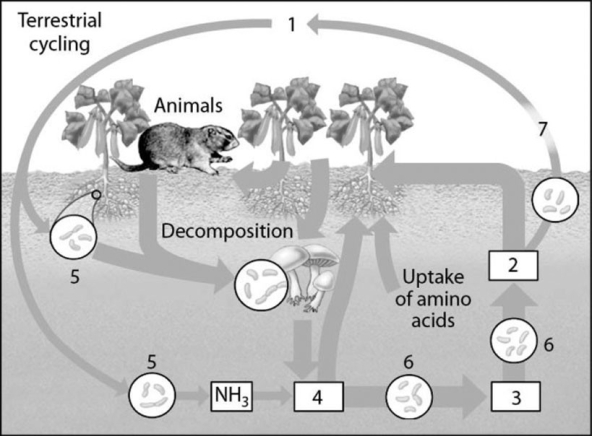 Figure 42.3
-In the diagram of the nitrogen cycle in Figure 42.3, which number represents the ammonium ion (NH4+)?
Figure 42.3
-In the diagram of the nitrogen cycle in Figure 42.3, which number represents the ammonium ion (NH4+)? (Multiple Choice)
4.7/5 (69)
(69) Please use the following information to answer the question(s) below.
The tundra biome is rapidly changing as a result of global warming. Studying the energy budget of the tundra can help scientists to evaluate the magnitude of these changes. In a randomly selected square meter of tundra, the amount of plant biomass is 200 g. The amount of new plant biomass added in a year is 100 g. In the same square meter, the total biomass added in a year is 15 g. A grasshopper that eats 1 g of plant biomass is able to use 0.15 g of that biomass for growth. The grasshopper cannot assimilate 50% of the plant's biomass.
-What is the net ecosystem production of this square meter of tundra?
(Multiple Choice)
4.9/5 (85)
(85) 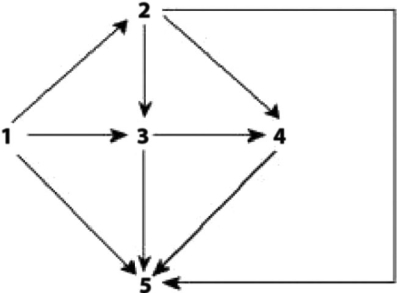 Figure 42.1 Food web for a particular terrestrial ecosystem (arrows represent energy flow and numbers represent species)
-Examine the food web for a particular terrestrial ecosystem in Figure 42.1. Which species is autotrophic?
Figure 42.1 Food web for a particular terrestrial ecosystem (arrows represent energy flow and numbers represent species)
-Examine the food web for a particular terrestrial ecosystem in Figure 42.1. Which species is autotrophic? (Multiple Choice)
4.8/5 (83)
(83) Please use the following information to answer the question(s) below.
A scientist conducts an experiment to quantify the effect of mycorrhizae and soil nitrogen levels on plant growth in a grassland. The experiment has four treatments: (1) Mycorrhizae present and ambient levels of nitrogen, (2) mycorrhizae present and nitrogen added, (3) mycorrhizae absent and ambient levels of nitrogen, and (3) mycorrhizae absent and nitrogen added. After four weeks, the scientist removes the aboveground plant material for weighing. 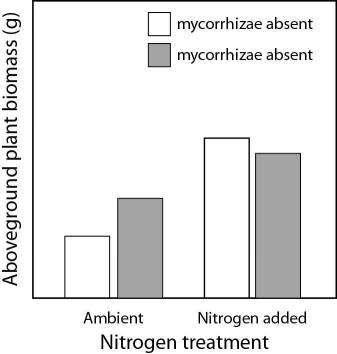 Figure 42.4.
-What conclusion is best supported by Figure 42.4?
Figure 42.4.
-What conclusion is best supported by Figure 42.4? (Multiple Choice)
4.8/5 (65)
(65) Why is net primary production (NPP) a more useful measurement to an ecosystem ecologist than gross primary production (GPP)?
(Multiple Choice)
5.0/5 (57)
(57) Which of these ecosystems has the lowest net primary production per square meter?
(Multiple Choice)
4.9/5 (86)
(86) Approximately 1% of the solar radiation that strikes a plant is converted into the chemical bond energy of sugars. Why is this amount so low?
(Multiple Choice)
4.9/5 (86)
(86) The discipline that applies ecological principles to returning degraded ecosystems to a more natural state is known as
(Multiple Choice)
4.8/5 (83)
(83) If you applied a fungicide to a cornfield, what would you expect to happen to the rate of decomposition and net ecosystem production (NEP)?
(Multiple Choice)
4.7/5 (81)
(81) As big as it is, the ocean is nutrient-limited. If you wanted to investigate this, one reasonable approach would be to
(Multiple Choice)
4.9/5 (77)
(77) Which of the following terms encompasses all of the others?
(Multiple Choice)
4.9/5 (73)
(73) 
Filters
- Essay(0)
- Multiple Choice(0)
- Short Answer(0)
- True False(0)
- Matching(0)