



 Chat with AI
Exam 7: Lymphocyte Receptor Signaling

Exam 1: Basic Concepts in Immunology44 Questions
Exam 2: Innate Immunity: the First Lines of Defense32 Questions
Exam 3: The Induced Responses of Innate Immunity39 Questions
Exam 4: Antigen Recognition by B-Cell and T-Cell Receptors28 Questions
Exam 5: The Generation of Lymphocyte Antigen Receptors33 Questions
Exam 6: Antigen Presentation to T Lymphocytes30 Questions
Exam 7: Lymphocyte Receptor Signaling42 Questions
Exam 8: Development and Survival of Lymphocytes37 Questions
Exam 9: T-Cell-Mediated Immunity37 Questions
Exam 10: The Humoral Immune Response30 Questions
Exam 11: Integrated Dynamics of Innate and Adaptive Immunity28 Questions
Exam 12: The Mucosal Immune System27 Questions
Exam 13: Failures of Host Defense Mechanisms43 Questions
Exam 14: Allergy and Allergic Diseases26 Questions
Exam 15: Autoimmunity and Transplantation31 Questions
Exam 16: Manipulation of the Immune Response34 Questions
Select questions type


BCR signaling on B cells is initiated by antigen binding, leading to mTOR activation. This occurs, for instance, when the antigen is a live microbe that binds to the BCR on the B cells. Which one of the forms of antigen shown below the graph would correctly account for the data shown in Figure.
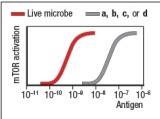
(Multiple Choice)
4.9/5  (88)
(88) Scaffold proteins are often phosphorylated at multiple sites, allowing the recruitment of several different signaling proteins. In antigen receptor signaling pathways, this mechanism is used to bring enzymes in close proximity to their substrates. Termination of this signaling mechanism would be most efficiently accomplished by:
(Multiple Choice)
4.9/5 (81)
(81) The mechanism by which CTLA-4 inhibits T cell activation is by recruiting inhibitory phosphatases.
(True/False)
4.8/5 (74)
(74) The LAT:Gads:SLP-76 complex that assembles following TCR stimulation provides the scaffold for initiating multiple downstream signaling modules, leading to actin polymerization, integrin activation, and gene expression.
(True/False)
4.8/5 (72)
(72) In patients with 'CD40 ligand deficiency', T cell-dependent B cell activation is impaired, leading to poor antibody responses to protein antigens. The signaling pathway missing in these patients' B cells is important for:
(Multiple Choice)
4.9/5 (74)
(74) The only mechanism by which CD28 co-stimulation enhances T cell activation is by recruiting and activating PI 3-kinase, leading to Akt activation.
(True/False)
5.0/5 (96)
(96) Lymphocyte activation leads to robust proliferation and effector cell differentiation. The metabolic demands of these processes are met, in part, by up-regulation of glycolytic enzymes and nutrient transporters on the activated cell membrane. A key intermediate in the signaling pathway leading to enhanced glucose metabolism following antigen receptor stimulation is:
(Multiple Choice)
4.9/5 (84)
(84) Synthesis question: Co-stimulatory and inhibitory receptors modulate antigen receptor signaling in T and B lymphocytes. A new receptor is discovered, expressed on the surface of T cells, and called 'X'. An antibody to X is generated, and used in T cell stimulation experiments. In these experiments, antibodies to the TCR complex (anti-CD3) and to CD28 (anti-CD28) are known to stimulate signaling through those receptors, as does the antibody to X. The data from an experiment measuring IL-2 secretion by the T cells stimulated with different combinations of antibodies are shown in Figure. 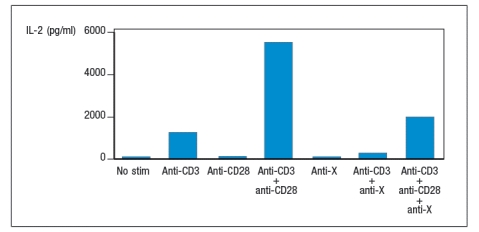 a) Does stimulation of receptor X alone induce IL-2 production by T cells? Does it enhance or inhibit TCR signaling? Indicate the evidence supporting your answers.
b) If you examined the amino acid sequence of the receptor X cytoplasmic tail, what motif would you expect to find?
Biochemical studies show that when receptor X is stimulated, a tyrosine residue in the cytoplasmic tail becomes phosphorylated.
c) From these data, what are the two most likely signaling proteins that might be recruited to receptor X when it is stimulated? Does the T cell stimulation data shown in the graph rule in or out either of your candidate proteins? Why or why not?
d) Describe a biochemical experiment (analysis of proteins) that would indicate which enzyme is recruited to receptor X when it is stimulated.
a) Does stimulation of receptor X alone induce IL-2 production by T cells? Does it enhance or inhibit TCR signaling? Indicate the evidence supporting your answers.
b) If you examined the amino acid sequence of the receptor X cytoplasmic tail, what motif would you expect to find?
Biochemical studies show that when receptor X is stimulated, a tyrosine residue in the cytoplasmic tail becomes phosphorylated.
c) From these data, what are the two most likely signaling proteins that might be recruited to receptor X when it is stimulated? Does the T cell stimulation data shown in the graph rule in or out either of your candidate proteins? Why or why not?
d) Describe a biochemical experiment (analysis of proteins) that would indicate which enzyme is recruited to receptor X when it is stimulated. (Essay)
4.9/5 (86)
(86) Antigen receptors use multiple mechanisms to recruit signaling proteins to the plasma membrane, where they can propagate downstream signals. In some cases, recruitment of proteins to the membrane is induced following antigen receptor stimulation, whereas other proteins are constitutively associated with the membrane.
Name one mechanism that is induced by antigen receptor stimulation, and one that is constitutive, and give an example a protein recruited by each mechanism.
(Essay)
4.8/5 (68)
(68) Phosphorylation of signaling proteins can have activating or inhibitory effects on protein function. In many cases, such as the activation of mTOR, the phosphorylation of an inhibitory protein leads to inactivation of the inhibitor, resulting in downstream signaling. T-cell receptor signaling leads to enhanced integrin-mediated cell adhesion
(True/False)
4.9/5 (76)
(76) TNF-receptor signaling commonly includes several steps that are regulated by ubiquitination. One important step following TNF-receptor stimulation is the:
(Multiple Choice)
5.0/5 (76)
(76) Diacyl-glycerol (DAG) is one of the two products generated when PLC- cleaves the membrane phospholipid, PIP2. This small lipid mediator remains associated with the plasma membrane and functions to inhibit tyrosine phosphatases that remove activating phosphate groups from ZAP-70 and the Tec-family kinase, ITK.
(True/False)
4.7/5 (75)
(75) Antigen receptor signaling pathways are initiated by the action of a Src-family kinase. In T cells, the predominant Src-kinase is Lck. In resting T cells, Lck is maintained in an inactive state by allosteric interactions involving multiple domains of the enzyme. When T cells are treated with a small molecule inhibitor of the tyrosine kinase Csk, TCR signaling is initiated even in the absence of a ligand to stimulate the TCR. This occurs because:
(Multiple Choice)
5.0/5 (75)
(75) Following TCR stimulation, the small GTPase Ras is activated. Ras activation is induced by the Ras GTP-exchange factor (GEF), RasGRP. Both Ras and RasGRP are constitutively expressed in resting T cells. The reason Ras activation is only induced following TCR stimulation is:
(Multiple Choice)
4.7/5 (77)
(77) A new strain of immunodeficient mice has been discovered, and found to have T cells that are unresponsive to TCR stimulation. The T cells from these mice have normal levels of the TCR complex on their surface, but when this TCR is stimulated, the cells fail to secrete IL-2. As a first step in determining the signaling defect responsible for this immunodeficiency, the T cells are stimulated with a phorbol ester (PMA) and Ionomycin. It is found that this treatment elicits IL-2 production by the immunodeficient T cells. Based on this information, candidate genes that could be mutated in these T cells include all of the following EXCEPT:
(Multiple Choice)
4.9/5 (72)
(72) Wiskott-Aldrich syndrome is an immunodeficiency disease due to mutations in the gene encoding WASp. Individuals with this disease make poor antibody responses to protein antigens, due to impaired T cell help for B cells. WASp-deficient T cells are likely impaired in providing adequate help to B cells due to:
(Multiple Choice)
4.7/5 (80)
(80) The B cell co-receptor, composed of CD19/CD21/CD81, is a receptor that binds to complement fragments such as C3dg. When an antigen bound by the BCR on a B cell has also been tagged with C3dg, the B cell co-receptor is stimulated together with the BCR. Signaling through the co-receptor:
(Multiple Choice)
4.8/5 (100)
(100) BCR stimulation and TCR stimulation generally activate similar downstream signaling modules, but do so using related, but not identical, signaling proteins. From the list below, match each B cell protein to its T cell counterpart.
Correct Answer: Verified
Premises:
Responses:
(Matching)
4.8/5 (86)
(86) A mutant B cell line is examined by confocal microscopy after incubation with a microbial pathogen recognized by the BCR on these B cells. The B cells have been stained with antibodies to visualize the localization of polymerized actin and microtubules. As a control, wild-type B cells are examined. The results are shown in Figure, with the numbers indicating the proportion of cells examined that show each pattern of staining. 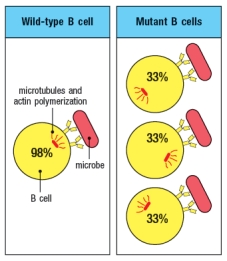 To identify the specific signaling defect in these mutant B cells, a reasonable biochemical assay would be to:
 (Multiple Choice)
4.8/5 (83)
(83) Many receptors of the immune system activate protein kinases as a mechanism of initiating signaling. For antigen receptors on lymphocytes, ligand binding induces receptor clustering, and the enzymes activated are protein tyrosine kinases. Based on this mechanism, predict the outcome of expressing a mutant form of the receptor-associated tyrosine kinase in cells that still express the wild-type version of this enzyme, and explain your reasoning. This mutant is unable to bind ATP and therefore is catalytically inactive; assume the mutant and wild-type forms of the kinase are expressed in equimolar amounts.
(Essay)
4.7/5 (68)
(68) 
Filters
- Essay(0)
- Multiple Choice(0)
- Short Answer(0)
- True False(0)
- Matching(0)