Synthesis Question: Co-Stimulatory and Inhibitory Receptors Modulate Antigen Receptor Signaling
Essay
Synthesis question: Co-stimulatory and inhibitory receptors modulate antigen receptor signaling in T and B lymphocytes. A new receptor is discovered, expressed on the surface of T cells, and called 'X'. An antibody to X is generated, and used in T cell stimulation experiments. In these experiments, antibodies to the TCR complex (anti-CD3) and to CD28 (anti-CD28) are known to stimulate signaling through those receptors, as does the antibody to X. The data from an experiment measuring IL-2 secretion by the T cells stimulated with different combinations of antibodies are shown in Figure. 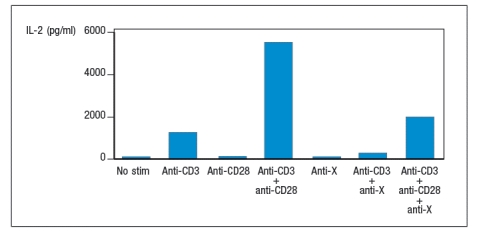
a) Does stimulation of receptor X alone induce IL-2 production by T cells? Does it enhance or inhibit TCR signaling? Indicate the evidence supporting your answers.
b) If you examined the amino acid sequence of the receptor X cytoplasmic tail, what motif would you expect to find?
Biochemical studies show that when receptor X is stimulated, a tyrosine residue in the cytoplasmic tail becomes phosphorylated.
c) From these data, what are the two most likely signaling proteins that might be recruited to receptor X when it is stimulated? Does the T cell stimulation data shown in the graph rule in or out either of your candidate proteins? Why or why not?
d) Describe a biochemical experiment (analysis of proteins) that would indicate which enzyme is recruited to receptor X when it is stimulated.
Correct Answer:

Verified
a) Stimulation of X does not induce IL-2...View Answer
Unlock this answer now
Get Access to more Verified Answers free of charge
Correct Answer:
Verified
View Answer
Unlock this answer now
Get Access to more Verified Answers free of charge
Q23: The mechanism by which CTLA-4 inhibits T
Q24: The LAT:Gads:SLP-76 complex that assembles following TCR
Q25: In patients with 'CD40 ligand deficiency',
Q26: The only mechanism by which CD28 co-stimulation
Q27: Lymphocyte activation leads to robust proliferation and
Q29: Antigen receptors use multiple mechanisms to recruit
Q30: Phosphorylation of signaling proteins can have activating
Q31: TNF-receptor signaling commonly includes several steps
Q32: Diacyl-glycerol (DAG) is one of the
Q33: Antigen receptor signaling pathways are initiated