



 Chat with AI
Exam 7: Alkenes and Alkynes I

Exam 1: The Basics158 Questions
Exam 2: Families of Carbon151 Questions
Exam 3: Acids and Bases149 Questions
Exam 4: Nomenclature and Conformations of Alkanes and Cycloalkanes163 Questions
Exam 5: Stereochemistry179 Questions
Exam 6: Nucleophilic Reactions91 Questions
Exam 7: Alkenes and Alkynes I220 Questions
Exam 8: Alkenes and Alkynes II163 Questions
Exam 9: Nuclear Magnetic Resonance and Mass Spectrometry158 Questions
Exam 10: Radical Reactions148 Questions
Exam 11: Alcohols and Ethers256 Questions
Exam 12: Alcohols From Carbonyl Compounds210 Questions
Exam 13: Conjugated Unsaturated Systems201 Questions
Exam 14: Aromatic Compounds186 Questions
Exam 15: Reactions of Aromatic Compounds207 Questions
Exam 16: Aldehydes and Ketones189 Questions
Exam 17: Carboxylic Acids and Their Derivatives213 Questions
Exam 18: Reactions at the Α Carbon of Carbonyl Compounds190 Questions
Exam 19: Condensation and Conjugate Addition Reactions of Carbonyl Compounds182 Questions
Exam 20: Amines207 Questions
Exam 21: Transition Metal Complexes86 Questions
Exam 22: Carbohydrates124 Questions
Exam 23: Lipids127 Questions
Exam 24: Amino Acids and Proteins135 Questions
Exam 25: Nucleic Acids and Protein Synthesis126 Questions
Select questions type


Which of the following reactions would yield 3,3-dimethyl-1-butene in a reasonable percentage yield (i.e.,greater than 50%)?
(Multiple Choice)
4.9/5  (72)
(72) What would you expect to be the chief organic product(s)when 2-bromo-2-methylpentane react(s)with sodium propynide,i.e., 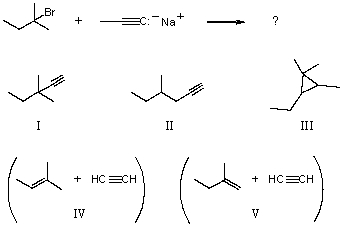
(Multiple Choice)
4.8/5 (79)
(79) Which of these compounds would give the largest E2/SN2 product ratio on reaction with sodium ethoxide in ethanol at 55°C?
(Multiple Choice)
4.8/5 (83)
(83) Which one of the following alcohols would dehydrate most rapidly when treated with sulfuric acid? 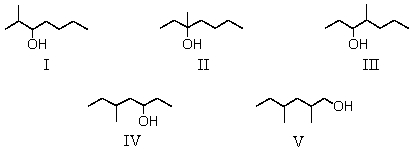
(Multiple Choice)
4.7/5 (81)
(81) Rearrangements are likely to occur in which of the following reaction types?
(Multiple Choice)
4.9/5 (78)
(78) What are the major product(s)formed when trans-1-bromo-2-methylcyclohexane reacts with sodium isopropoxide in isopropanol? 
(Multiple Choice)
4.8/5 (88)
(88) 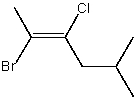
Which of the following methods could be used to synthesize 4,4-dimethyl-2-hexyne?
(Multiple Choice)
4.8/5 (72)
(72) If 0.10 mol of HSCH2CH2OH reacts at 25 C,sequentially,with 0.20 mol of NaH,0.10 mol of CH3CH2Br followed by the addition of H2O,which is the major product?
(Multiple Choice)
4.9/5 (73)
(73) By analyzing the starting material and the product(s),the following reaction is an example of what type of mechanism? 
(Multiple Choice)
4.9/5 (78)
(78) When 0.10 mol of ICH2CH2CH2CH2Cl reacts with 0.10 mol of NaOCH3 in CH3OH at 40 C,the major product is:
(Multiple Choice)
5.0/5 (84)
(84) Predict the major product(s)for the following reaction sequence. 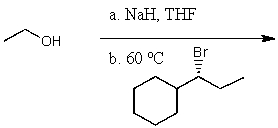
(Multiple Choice)
4.7/5 (84)
(84) Which reaction would not result in alkylation of the acetylide anion as the major products?
(Multiple Choice)
4.9/5 (82)
(82) What would be the major product(s)of the following reaction? 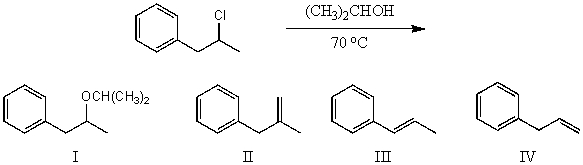
(Multiple Choice)
4.8/5 (83)
(83) Which alkyl halide,when treated with sodium ethoxide in ethanol,would afford a product mixture consisting of more than one elimination product?
(Multiple Choice)
4.8/5 (83)
(83) What are the major product(s)formed when cis-1-bromo-2-methylcyclohexane reacts with sodium isopropoxide in isopropanol? 
(Multiple Choice)
4.8/5 (82)
(82) Elimination reactions are favored over nucleophilic substitution reactions
(Multiple Choice)
4.9/5 (92)
(92) Which of the following compounds could be produced from the following reaction sequence? 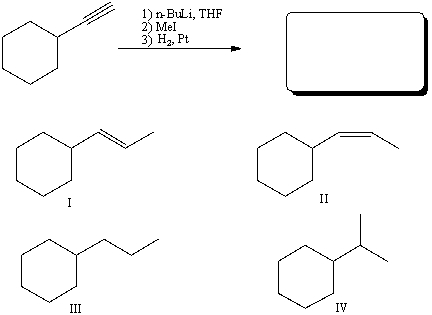
(Multiple Choice)
4.9/5 (68)
(68) What would be the major product(s)of the following reaction? 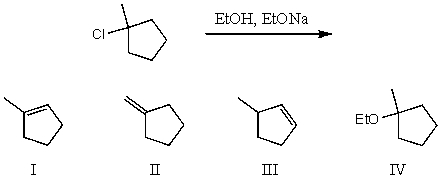
(Multiple Choice)
4.9/5 (64)
(64) 
Filters
- Essay(0)
- Multiple Choice(0)
- Short Answer(0)
- True False(0)
- Matching(0)