



 Chat with AI
Exam 7: Alkenes and Alkynes I

Exam 1: The Basics158 Questions
Exam 2: Families of Carbon151 Questions
Exam 3: Acids and Bases149 Questions
Exam 4: Nomenclature and Conformations of Alkanes and Cycloalkanes163 Questions
Exam 5: Stereochemistry179 Questions
Exam 6: Nucleophilic Reactions91 Questions
Exam 7: Alkenes and Alkynes I220 Questions
Exam 8: Alkenes and Alkynes II163 Questions
Exam 9: Nuclear Magnetic Resonance and Mass Spectrometry158 Questions
Exam 10: Radical Reactions148 Questions
Exam 11: Alcohols and Ethers256 Questions
Exam 12: Alcohols From Carbonyl Compounds210 Questions
Exam 13: Conjugated Unsaturated Systems201 Questions
Exam 14: Aromatic Compounds186 Questions
Exam 15: Reactions of Aromatic Compounds207 Questions
Exam 16: Aldehydes and Ketones189 Questions
Exam 17: Carboxylic Acids and Their Derivatives213 Questions
Exam 18: Reactions at the Α Carbon of Carbonyl Compounds190 Questions
Exam 19: Condensation and Conjugate Addition Reactions of Carbonyl Compounds182 Questions
Exam 20: Amines207 Questions
Exam 21: Transition Metal Complexes86 Questions
Exam 22: Carbohydrates124 Questions
Exam 23: Lipids127 Questions
Exam 24: Amino Acids and Proteins135 Questions
Exam 25: Nucleic Acids and Protein Synthesis126 Questions
Select questions type


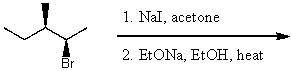

When 1,4-diiodo-2,2-dimethylbutane (0.10 mol)is treated with 0.10 mol of NaCN in dimethyl sulfoxide at 30 C,the product formed is:
(Multiple Choice)
4.8/5  (81)
(81) What is the major product for the following reaction sequence? 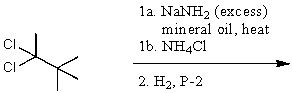
(Multiple Choice)
4.8/5 (78)
(78) 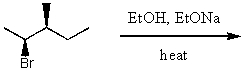
Predict the product(s)for the following reaction sequence. 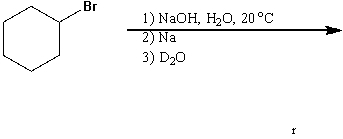
(Multiple Choice)
4.8/5 (75)
(75) What would be the major product of the following reaction? 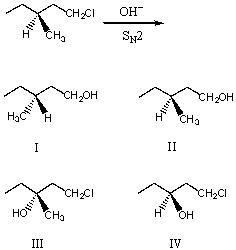
(Multiple Choice)
4.9/5 (69)
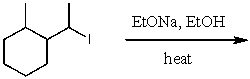
(69) 
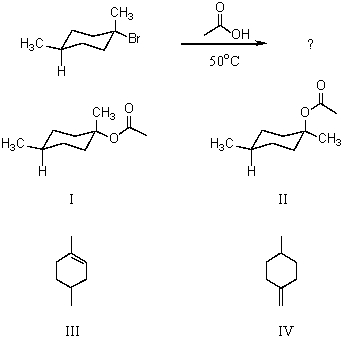
What is the major product for the following reaction sequence? 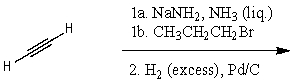
(Multiple Choice)
4.9/5 (77)
(77) A compound X with the formula C7H10 undergoes catalytic hydrogenation to produce a compound Y with the formula C7H14. What could be true of X?
(Multiple Choice)
4.8/5 (80)
(80) The structure of the product,C,of the following sequence of reactions would be: 
(Multiple Choice)
4.8/5 (65)
(65) The IR spectrum of an unknown substance Q,C9H16,is found to have distinct peaks at 3310 cm-1 and 2140 cm-1.Treatment of Q with excess H2 in presence of Raney Ni affords nearly quantitative yields of 2,3-dimethylheptane.Propose a reasonable structure for Q,based on the above information,briefly explaining your rationale.Also give its IUPAC name.
(Essay)
4.9/5 (81)
(81) The process by which one works a synthesis problem backwards to the point where reagentscan be easily acquired is known as ___.
(Short Answer)
4.8/5 (84)
(84) 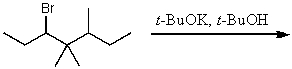
In hydrogenation reactions,both hydrogen atoms add to the pi system from the same face of the molecule.This is an example of a(n)___ addition.
(Short Answer)
4.9/5 (79)
(79) The product(s)for the following reaction would mainly be dictated by which mechanism? 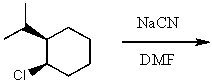
(Multiple Choice)
4.8/5 (78)
(78) By analyzing the starting material and the product(s),the following reaction is possibly an example of what type of mechanism? 
(Multiple Choice)
4.9/5 (77)
(77) Tertiary carbocations will form the fastest because they have a transition state that is the lowest in free energy.
(True/False)
4.9/5 (80)
(80) 
Filters
- Essay(0)
- Multiple Choice(0)
- Short Answer(0)
- True False(0)
- Matching(0)