



 Chat with AI
Exam 7: Alkenes and Alkynes I

Exam 1: The Basics158 Questions
Exam 2: Families of Carbon151 Questions
Exam 3: Acids and Bases149 Questions
Exam 4: Nomenclature and Conformations of Alkanes and Cycloalkanes163 Questions
Exam 5: Stereochemistry179 Questions
Exam 6: Nucleophilic Reactions91 Questions
Exam 7: Alkenes and Alkynes I220 Questions
Exam 8: Alkenes and Alkynes II163 Questions
Exam 9: Nuclear Magnetic Resonance and Mass Spectrometry158 Questions
Exam 10: Radical Reactions148 Questions
Exam 11: Alcohols and Ethers256 Questions
Exam 12: Alcohols From Carbonyl Compounds210 Questions
Exam 13: Conjugated Unsaturated Systems201 Questions
Exam 14: Aromatic Compounds186 Questions
Exam 15: Reactions of Aromatic Compounds207 Questions
Exam 16: Aldehydes and Ketones189 Questions
Exam 17: Carboxylic Acids and Their Derivatives213 Questions
Exam 18: Reactions at the Α Carbon of Carbonyl Compounds190 Questions
Exam 19: Condensation and Conjugate Addition Reactions of Carbonyl Compounds182 Questions
Exam 20: Amines207 Questions
Exam 21: Transition Metal Complexes86 Questions
Exam 22: Carbohydrates124 Questions
Exam 23: Lipids127 Questions
Exam 24: Amino Acids and Proteins135 Questions
Exam 25: Nucleic Acids and Protein Synthesis126 Questions
Select questions type


An unknown compound,B,has the molecular formula C7H12.On catalytic hydrogenation 1 mol of B absorbs 2 mol of hydrogen and yields 2-methylhexane.B has significant IR absorption band at about 3300 and 2200 cm-1.Which compound best represents B?
(Multiple Choice)
4.9/5  (90)
(90) Which mechanism best describes the chemical process shown below? 
(Multiple Choice)
4.8/5 (83)
(83) Which structure represents (Z)-1,4-dichlorohex-3-en-1-yne?
(Multiple Choice)
4.9/5 (80)
(80) When diastereomers I and II undergo an E2 elimination on treatment with sodium ethoxide in ethanol,one of the isomers react 500 times faster than the other one.Also,one isomer gives only A as a product and the other isomer gives a mixture of A and B as products.Determine the products of each isomer and explain your reasoning. 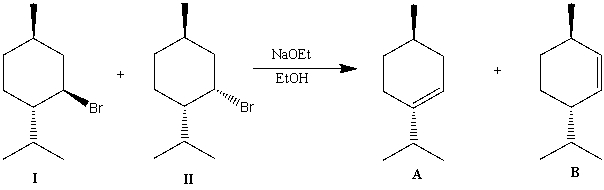
(Essay)
4.8/5 (77)
(77) What would be the major product(s)of the following reaction? 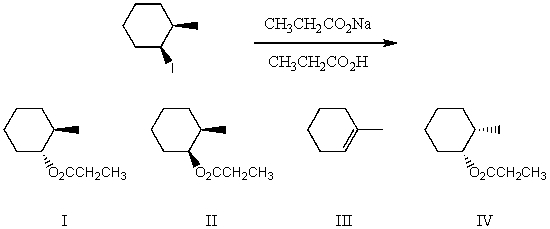
(Multiple Choice)
4.8/5 (85)
(85) Treating (CH3)3C-Cl with a mixture of H2O and CH3OH at room temperature would yield:
(Multiple Choice)
4.8/5 (80)
(80) Which would be the major product of the following reaction? 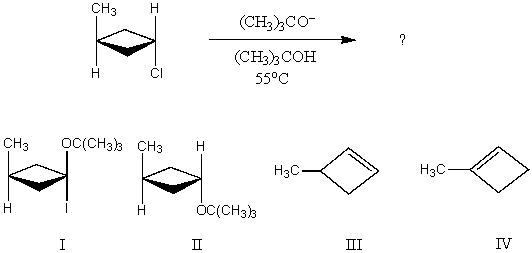
(Multiple Choice)
4.9/5 (79)
(79) 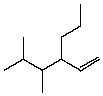
Which would be the major product of the following reaction sequence? 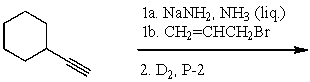
(Multiple Choice)
4.8/5 (86)
(86) Which would be the major product of the following reaction sequence? 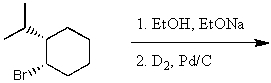
(Multiple Choice)
4.7/5 (70)
(70) Carbocations have three options available for further reaction.These options include reaction with a nucleophile,loss of a beta proton to give an alkene,and ___.
(Short Answer)
4.8/5 (64)
(64) Complete the following reaction sequence,providing a brief rationale for your answer. 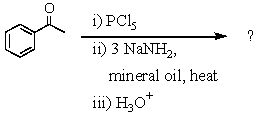
(Essay)
4.9/5 (88)
(88) Give a detailed reaction mechanism for the reaction expected to occur when 2-bromo-2-methylpentane is heated with methanol.Draw clear structural formulas of all relevant species and use curved arrows to represent electron flow.Also indicate which step is likely to be rate-determining.
(Essay)
4.8/5 (78)
(78) Reaction of sodium ethoxide with 1-bromopentane at 30 C yields primarily:
(Multiple Choice)
5.0/5 (68)
(68) Treating 1-bromo-1-methylcyclohexane with CH3OH at room temperature would yield:
(Multiple Choice)
4.9/5 (82)
(82) Which mechanistic step in the acid-catalyzed dehydration of 3,3-dimethyl-2-butanol is the rate determining step?
(Multiple Choice)
4.8/5 (77)
(77) What is the major product of the reaction of the following reaction? 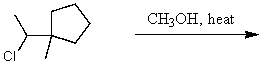
(Multiple Choice)
4.8/5 (79)
(79) Concerning the relative stabilities of alkenes,which is a false statement?
(Multiple Choice)
4.8/5 (83)
(83) What would be the major product(s)of the following reaction? 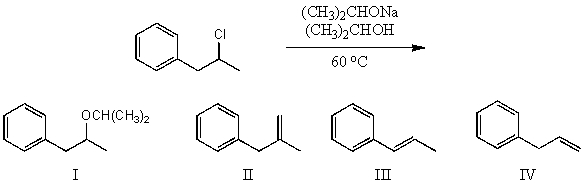
(Multiple Choice)
4.8/5 (76)
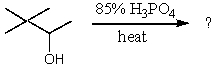
(76) 

Filters
- Essay(0)
- Multiple Choice(0)
- Short Answer(0)
- True False(0)
- Matching(0)