



 Chat with AI
Exam 14: Oscillations

Exam 1: Systems of Measurement86 Questions
Exam 2: Motion in One Dimension103 Questions
Exam 3: Motion in Two and Three Dimensions67 Questions
Exam 4: Newtons Laws117 Questions
Exam 5: Applications of Newtons Laws75 Questions
Exam 6: Work and Energy71 Questions
Exam 7: Conservation of Energy73 Questions
Exam 8: Systems of Particles and Conservation of Linear Momentum107 Questions
Exam 9: Rotation119 Questions
Exam 10: Conservation of Angular Momentum67 Questions
Exam 11: Gravity90 Questions
Exam 12: Static Equilibrium and Elasticity65 Questions
Exam 13: Fluids91 Questions
Exam 14: Oscillations138 Questions
Exam 15: Wave Motion122 Questions
Exam 16: Superposition and Standing Waves125 Questions
Exam 17: Temperature and the Kinetic Theory of Gases85 Questions
Exam 18: Heat and the First Law of Thermodynamics114 Questions
Exam 19: The Second Law of Thermodynamics61 Questions
Exam 20: Thermal Properties and Processes54 Questions
Select questions type


What is the length L of a simple pendulum with the same period as a physical pendulum consisting of a hoop suspended at its rim? 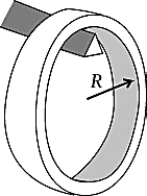
(Multiple Choice)
4.9/5  (66)
(66) A body of mass 5.0 kg moves in simple harmonic motion according to the equation
X = 0.040 sin(30t + /6)
Where the units are SI. The maximum speed of this body is approximately
(Multiple Choice)
4.8/5 (83)
(83) The energy of an oscillator decreases by 3% each cycle. The quality factor of this oscillator is approximately
(Multiple Choice)
4.9/5 (73)
(73) In simple harmonic motion, the magnitude of the acceleration of a body is always directly proportional to its
(Multiple Choice)
4.8/5 (73)
(73) A clock keeps accurate time when the length of its simple pendulum is L. If the length of the pendulum is increased a small amount, which of the following is true?
(Multiple Choice)
4.7/5 (74)
(74) A particle is oscillating with simple harmonic motion. The frequency of the motion is
10 Hz and the amplitude of the motion is 5.0 cm. As the particle passes its central equilibrium position, the acceleration of the particle is
(Multiple Choice)
4.8/5 (95)
(95) The mass on the end of the spring (which stretches linearly) is in equilibrium as shown. It is pulled down so that the pointer is opposite the 11-cm mark and then released. The mass experiences its maximum upward velocity at which of the following positions? 
(Multiple Choice)
4.9/5 (68)
(68) 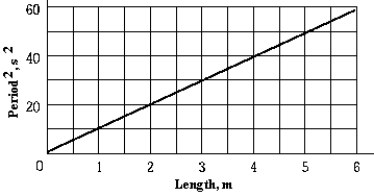 The graph shows the square of the period versus the length of a simple pendulum on a certain planet. The acceleration due to gravity on that planet is approximately
 (Multiple Choice)
4.7/5 (83)
(83) Use the following to answer question :  -The graph shows the average power delivered to an oscillating system as a function of the driving frequency. According to these data
 (Multiple Choice)
4.9/5 (72)
(72) A thin test tube is partially filled with lead pellets so that it floats vertically in a fluid. Use Archimedes' Principle to calculate that if displaced slightly from its equilibrium position the test tube will undergo SHM in the vertical direction and derive how the time period is related to the density of the fluid.
(Multiple Choice)
4.9/5 (81)
(81) Use the following to answer question : 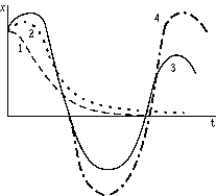 -The graph shows the displacement of an oscillator as a function of time. The oscillator that is critically damped is
 (Multiple Choice)
4.8/5 (84)
(84) A simple pendulum on Earth has a period T. The period of this pendulum could be decreased by
(Multiple Choice)
4.7/5 (90)
(90) If F is the force, x the displacement, and k a particular constant, for simple harmonic motion we must have
(Multiple Choice)
5.0/5 (76)
(76) A light spring stretches 0.13 m when a 0.35-kg mass is hung from it. The mass is pulled down from this equilibrium position an additional 0.12 m and is released. Determine the spring constant k and the amplitude of vibration.
(Multiple Choice)
4.9/5 (82)
(82) The equation for the period T of a mass m oscillating with simple harmonic motion at the end of a spring with a force constant k is  . A mass m that is oscillating on a spring with a force constant of 0.52 N/m has a period of 2.1 s. On a second spring, the same mass has a period of 3.5 s. The force constant of the second spring is
 (Multiple Choice)
4.9/5 (67)
(67) 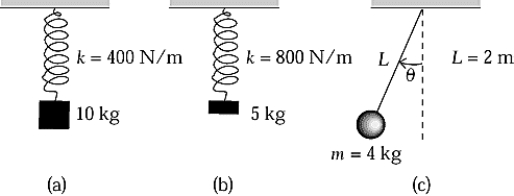 The order, from shortest to longest, of the periods of the oscillatory systems shown in the figure above is
 (Multiple Choice)
4.9/5 (76)
(76) You have landed your spaceship on the moon and want to determine the acceleration due to gravity using a simple pendulum of length 1.0 m. If the period of this pendulum is
5)0 s, what is the value of g on the moon?
(Multiple Choice)
4.7/5 (78)
(78) A 1.0-kg mass oscillates along the x axis with simple harmonic motion. Its position as a function of time is given by X = 2 cos( t/6 + /3)
Where the units are SI. When t = 2 s, the kinetic energy of the mass is
(Multiple Choice)
4.9/5 (83)
(83) 
Filters
- Essay(0)
- Multiple Choice(0)
- Short Answer(0)
- True False(0)
- Matching(0)