



 Chat with AI
Exam 14: Oscillations

Exam 1: Systems of Measurement86 Questions
Exam 2: Motion in One Dimension103 Questions
Exam 3: Motion in Two and Three Dimensions67 Questions
Exam 4: Newtons Laws117 Questions
Exam 5: Applications of Newtons Laws75 Questions
Exam 6: Work and Energy71 Questions
Exam 7: Conservation of Energy73 Questions
Exam 8: Systems of Particles and Conservation of Linear Momentum107 Questions
Exam 9: Rotation119 Questions
Exam 10: Conservation of Angular Momentum67 Questions
Exam 11: Gravity90 Questions
Exam 12: Static Equilibrium and Elasticity65 Questions
Exam 13: Fluids91 Questions
Exam 14: Oscillations138 Questions
Exam 15: Wave Motion122 Questions
Exam 16: Superposition and Standing Waves125 Questions
Exam 17: Temperature and the Kinetic Theory of Gases85 Questions
Exam 18: Heat and the First Law of Thermodynamics114 Questions
Exam 19: The Second Law of Thermodynamics61 Questions
Exam 20: Thermal Properties and Processes54 Questions
Select questions type


 A mass of 0.50 kg is attached to a massless spring with a spring constant k = 600 N/m (see figure above). The system rests on a level, friction-free surface and is initially at rest. A second mass of 0.20 kg makes an elastic head-on collision with the mass attached to the spring; thereafter, the oscillating system vibrates with an amplitude of 0.25 m. What was the incident speed of the second mass?
 (Multiple Choice)
4.8/5  (85)
(85) An object is moving with simple harmonic motion. When the object is displaced 5 cm from its equilibrium point, its velocity is 15.0 cm/s. Calculate the amplitude of motion if its period of motion is 3.0 s.
(Multiple Choice)
4.8/5 (79)
(79) An oscillator has a quality factor of 100. By what percentage does its energy decrease in each cycle?
(Multiple Choice)
4.7/5 (77)
(77) A particle moving with simple harmonic motion has a maximum displacement of
+12)0 cm. The particle moves from its maximum positive to its maximum negative displacement in 2.25 s. The motion starts when the displacement is x = +12.0 cm. The time for the particle to move to x = -6.00 cm is
(Multiple Choice)
4.9/5 (80)
(80) A giant simple pendulum has a time period of 5.00 s at a particular place. If the time period is changed to 4.65 s by shortening the string by 1.0 m, calculate the acceleration due to gravity at this place.
(Multiple Choice)
4.9/5 (88)
(88) For a simple pendulum to have a period of 1 s it must have a length of
(Multiple Choice)
5.0/5 (73)
(73) Use the following to answer question : 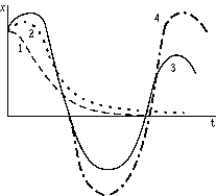 -The graph shows the displacement of an oscillator as a function of time. The oscillator that is undamped is
 (Multiple Choice)
4.8/5 (80)
(80) The acceleration of a particle moving with simple harmonic motion is given by
A = -16.0x,
Where x is in meters and a is in meters per second squared. The period of the motion is
(Multiple Choice)
4.9/5 (79)
(79) The solution to the differential equation of a damped oscillator, for the case in which the damping is small, is
X = A0e-(b/2m)t cos( 't + )
The phase constant is determined by the
(Multiple Choice)
4.9/5 (88)
(88) Use the following to answer question :  -The object in the diagram is in circular motion with frequency f. At t = 0 it was at (A, 0). The y component of its velocity is given by
 (Multiple Choice)
4.9/5 (81)
(81) A 2-kg mass oscillates in one dimension with simple harmonic motion on the end of a massless spring on a horizontal frictionless table according to
X = (6/ ) cos(  t + 3 )
Where the units are SI. The total mechanical energy of this system is
t + 3 )
Where the units are SI. The total mechanical energy of this system is (Multiple Choice)
4.9/5 (93)
(93) The force constant for a simple harmonic motion is k and the amplitude of the motion is A. The maximum value of the potential energy of a mass m oscillating with simple harmonic motion is
(Multiple Choice)
4.8/5 (82)
(82) A spring vibrates in simple harmonic motion according to the equation
X = 15 cos t.
Where x is in centimeters and t is in seconds. The total number of vibrations this body makes in 10 s is
(Multiple Choice)
4.8/5 (70)
(70) A body oscillates with simple harmonic motion according to the equation
X = 6.0 cos(3t + /3)
Where the units are SI. The speed of the body when it has a displacement of
3 m is
(Multiple Choice)
4.9/5 (67)
(67) Use the figure to answer the problem. A spring of negligible mass and spring constant k is attached to the wall on one end, and the other end is attached to the center of mass axis of a solid sphere of mass m and radius r. The spring is stretched a distance A from equilibrium and let go. The sphere rolls freely on a smooth surface.  -What is the rotational kinetic energy when the sphere is at the equilibrium position?
 (Multiple Choice)
4.7/5 (76)
(76) A 0.5-kg mass is suspended from a massless spring that has a force constant of 79 N/m. The mass is displaced 0.1m down from its equilibrium position and released. If the downward direction is negative, the displacement of the mass as a function of time is given by
(Multiple Choice)
4.9/5 (76)
(76) In the laboratory, a stick 1 m long is pivoted at various points to illustrate the motion of a physical pendulum. A plot of the period versus the distance of the pivot point from the center of mass is shown. The data presented demonstrate which of the following? 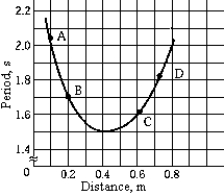
(Multiple Choice)
4.7/5 (73)
(73) 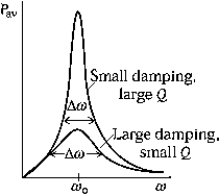 Near resonance, if the damping is small (large Q), the oscillator
 (Multiple Choice)
4.9/5 (81)
(81) The instantaneous speed of a mass undergoing simple harmonic motion on the end of a spring depends on
(Multiple Choice)
4.8/5 (77)
(77) 
Filters
- Essay(0)
- Multiple Choice(0)
- Short Answer(0)
- True False(0)
- Matching(0)