



 Chat with AI
Exam 4: Newtons Laws

Exam 1: Systems of Measurement86 Questions
Exam 2: Motion in One Dimension103 Questions
Exam 3: Motion in Two and Three Dimensions67 Questions
Exam 4: Newtons Laws117 Questions
Exam 5: Applications of Newtons Laws75 Questions
Exam 6: Work and Energy71 Questions
Exam 7: Conservation of Energy73 Questions
Exam 8: Systems of Particles and Conservation of Linear Momentum107 Questions
Exam 9: Rotation119 Questions
Exam 10: Conservation of Angular Momentum67 Questions
Exam 11: Gravity90 Questions
Exam 12: Static Equilibrium and Elasticity65 Questions
Exam 13: Fluids91 Questions
Exam 14: Oscillations138 Questions
Exam 15: Wave Motion122 Questions
Exam 16: Superposition and Standing Waves125 Questions
Exam 17: Temperature and the Kinetic Theory of Gases85 Questions
Exam 18: Heat and the First Law of Thermodynamics114 Questions
Exam 19: The Second Law of Thermodynamics61 Questions
Exam 20: Thermal Properties and Processes54 Questions
Select questions type


If a force F is required to extend a spring by 20 cm, what force is required to extend it by 30 cm?

Free
(Multiple Choice)
4.8/5  (92)
(92) Correct Answer: Verified
C
Two springs with different spring constants, k1 and k2, are connected as shown in the figure below. 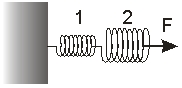 A force F is applied to one end. The force exerted by the wall on the spring is (take + to the right)
Free
(Multiple Choice)
4.8/5 (94)
(94) Correct Answer:Verified
VerifiedE
A horse harnessed to a wagon refuses to pull, citing Newton's third law, which states that for every force there is an equal but opposite reaction force. The horse, incorrect in its reasoning, can pull the wagon because
Free
(Multiple Choice)
4.9/5 (82)
(82) Correct Answer:Verified
VerifiedD
A body of weight w rests on the surface of Earth. What force does the body exert on Earth? (ignore Earth's rotation)
(Multiple Choice)
4.9/5 (81)
(81) 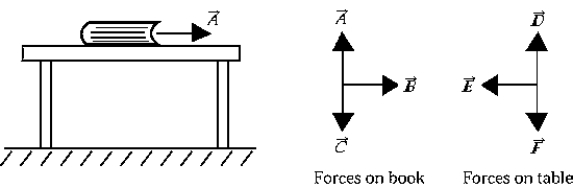 A man pushes horizontally on the book with force
 and moves it at constant speed along the table. Three "agents" exert forces on the book, shown as
 ,
 , and
 in the second diagram, and three "agents" exert forces on the table, shown as
 ,
 , and
 in the third diagram. The "action-reaction" forces of Newton's third law are
A man pushes horizontally on the book with force and moves it at constant speed along the table. Three "agents" exert forces on the book, shown as , , and in the second diagram, and three "agents" exert forces on the table, shown as , , and in the third diagram. The "action-reaction" forces of Newton's third law are (Multiple Choice)
4.9/5 (64)
(64) A force accelerates a body of mass M. A second body requires twice as much force to produce the same acceleration. What is the mass of the second body?
(Multiple Choice)
4.9/5 (88)
(88)  Which of the following free-body diagrams represents the block sliding down a frictionless inclined plane?

Which of the following free-body diagrams represents the block sliding down a frictionless inclined plane? (Multiple Choice)
4.9/5 (76)
(76) In a crash test the strapped-in, 75-kg dummy moves a distance of 0.80 m when the test car is slammed straight into a wall at 11.2 m/s (~25 mph). The average force acting on the dummy during the collision is how many times his own weight?
(Multiple Choice)
4.9/5 (74)
(74) A fat cat, ever conscious of its weight, walks into an elevator and steps on a scale. The elevator begins to accelerate downward. While the elevator is accelerating, the scale reads
(Multiple Choice)
4.8/5 (80)
(80) A force of F = 90 N is exerted on mass m1 as shown. Both m1 and m2 accelerate to the right at 3 m/s along the frictionless surface. The force F makes an angle of 25 degrees to the horizontal. If m2 = 10 kg, calculate the mass m1. 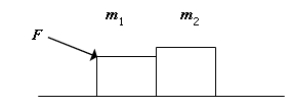
(Multiple Choice)
4.7/5 (79)
(79) Spiral springs A and B are identical. When a weight of 12 N is fastened to the hook on A, the hook is lowered 2 cm. If a weight of 18 N is fastened to the hook on B, that hook is lowered
(Multiple Choice)
4.8/5 (81)
(81) A 6-kg block sitting on a smooth table is connected to a free-hanging 2-kg mass by a stretchless, massless cord that passes over a small frictionless pulley. The acceleration of the two-block system is
(Multiple Choice)
4.8/5 (82)
(82) A 15-kg block sitting on a smooth table is connected to a free-hanging 5-kg mass by a stretchless, massless cord that passes over a small frictionless pulley. The acceleration of the two-block system is
(Multiple Choice)
4.9/5 (76)
(76)  Which of the following free-body diagrams represents the car going downhill without acceleration?

Which of the following free-body diagrams represents the car going downhill without acceleration? (Multiple Choice)
4.8/5 (88)
(88) Which fundamental force holds the atoms together in a block of wood?
(Multiple Choice)
4.9/5 (78)
(78) A lamp with a mass m is suspended from the ceiling by two cords as shown. The ratio of the magnitude of the vertical component of the tension in  2 to that in
 3 is

2 to that in 3 is (Multiple Choice)
4.9/5 (82)
(82) You are riding an elevator that is accelerating upward at 2.20 m/s2. You have a spring balance accurately calibrated in newtons. When you hang a mass of 10.0 kg on the balance, the reading of the balance is
(Multiple Choice)
4.8/5 (80)
(80) 
Filters
- Essay(0)
- Multiple Choice(0)
- Short Answer(0)
- True False(0)
- Matching(0)