



 Chat with AI
Exam 4: Newtons Laws

Exam 1: Systems of Measurement86 Questions
Exam 2: Motion in One Dimension103 Questions
Exam 3: Motion in Two and Three Dimensions67 Questions
Exam 4: Newtons Laws117 Questions
Exam 5: Applications of Newtons Laws75 Questions
Exam 6: Work and Energy71 Questions
Exam 7: Conservation of Energy73 Questions
Exam 8: Systems of Particles and Conservation of Linear Momentum107 Questions
Exam 9: Rotation119 Questions
Exam 10: Conservation of Angular Momentum67 Questions
Exam 11: Gravity90 Questions
Exam 12: Static Equilibrium and Elasticity65 Questions
Exam 13: Fluids91 Questions
Exam 14: Oscillations138 Questions
Exam 15: Wave Motion122 Questions
Exam 16: Superposition and Standing Waves125 Questions
Exam 17: Temperature and the Kinetic Theory of Gases85 Questions
Exam 18: Heat and the First Law of Thermodynamics114 Questions
Exam 19: The Second Law of Thermodynamics61 Questions
Exam 20: Thermal Properties and Processes54 Questions
Select questions type


A boy holds a bird in his hand. The reaction force to the weight of the bird is the force of the:
(Multiple Choice)
4.9/5  (76)
(76) The acceleration due to gravity on the moon is only about 1/6 of that on Earth. An astronaut whose weight on Earth is 600 N travels to the lunar surface. His mass as measured on the moon is
(Multiple Choice)
4.8/5 (71)
(71) A vertical rope is attached to an object that has a mass of 40.0 kg and is at rest. The tension in the rope needed to give the object an upward speed of 3.50 m/s in 0.700 s is
(Multiple Choice)
4.8/5 (76)
(76) A physical quantity that is sometimes described as the measure of the resistance of a body to a change in motion is
(Multiple Choice)
4.8/5 (79)
(79) An 80-kg man on ice skates pushes a 40-kg boy, also on skates, with a force of 100 N. The force exerted by the boy on the man is
(Multiple Choice)
4.9/5 (84)
(84) An object is moving to the right at a constant speed. Which one of the following statements must be correct?
(Multiple Choice)
4.9/5 (90)
(90) 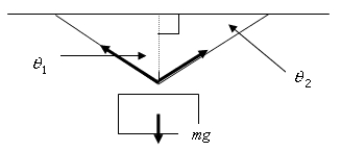 The tension in the left-hand string in terms of 1, 2, and m is
 (Multiple Choice)
4.9/5 (77)
(77) If you apply the same force to objects with masses M and 4M, the acceleration of the mass M is
(Multiple Choice)
4.7/5 (86)
(86) You want to elope by sliding down a nylon rope made by tying stockings together. The rope will withstand a maximum tension of 300 N without breaking. Your mass is 61.2 kg. The magnitude of the smallest acceleration a with which you can slide down the rope is
(Multiple Choice)
4.7/5 (92)
(92)  Three blocks are connected by massless cords and rest on a frictionless horizontal surface. The blocks are pulled to the right. Mass m1 = 2 m2 = 3 m3, with m1 on the left and m3 on the right. If the pulling force is equal to 90 N, then the tension in the cord between m1 and m2 is
 (Multiple Choice)
4.9/5 (64)
(64) A mass of 25 kg is acted on by two forces:  1 is 15 N due east, and
 2 is 10 N due north. The acceleration of the mass is
1 is 15 N due east, and 2 is 10 N due north. The acceleration of the mass is (Multiple Choice)
4.8/5 (68)
(68) Two masses m1 = 12 kg and m2 = 35 kg are held connected by a massless rope hung over a frictionless light pulley. If the masses are released then the magnitude of the tension in the string is 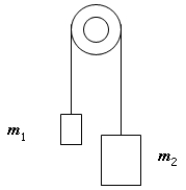
(Multiple Choice)
4.9/5 (71)
(71) A body moves with constant speed in a straight line. Which of the following statements must be true?
(Multiple Choice)
4.9/5 (65)
(65) For this problem, assume no friction. A mass m2 = 3.5 kg rests on a horizontal table and is attached by strings to masses m1 = 1.5 kg and m3 = 2.5 kg as shown. The masses m1 and m3 hang freely. The system is initially held at rest. After it is released, the acceleration of mass m2 will be 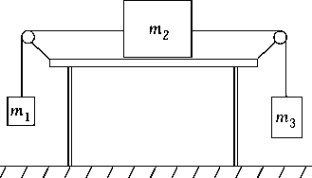
(Multiple Choice)
4.9/5 (86)
(86) A force F produces an acceleration a on an object of mass m. A force 3F is exerted on a second object, and an acceleration 8a results. What is the mass of the second object?
(Multiple Choice)
4.9/5 (77)
(77) We all know it makes sense to bend one's knees when dropping from a height.
Suppose a very silly 70-kg person were instead to drop down from a height of 1.4 m onto the ground and stop stiffly within a distance of only 0.60 cm. Calculate how many times his own weight is the average force his body feels.
(Multiple Choice)
4.8/5 (77)
(77) A ball of mass 2.0 kg is acted on by two forces,  and
 . At t = 0 s, the particle is at rest at the origin. The position vector at t = 2 s is
and . At t = 0 s, the particle is at rest at the origin. The position vector at t = 2 s is (Multiple Choice)
4.8/5 (78)
(78) When Newton's first law of motion is mentioned, you should immediately think of
(Multiple Choice)
4.9/5 (85)
(85) 
Filters
- Essay(0)
- Multiple Choice(0)
- Short Answer(0)
- True False(0)
- Matching(0)