



 Chat with AI
Exam 14: Oscillations

Exam 1: Systems of Measurement86 Questions
Exam 2: Motion in One Dimension103 Questions
Exam 3: Motion in Two and Three Dimensions67 Questions
Exam 4: Newtons Laws117 Questions
Exam 5: Applications of Newtons Laws75 Questions
Exam 6: Work and Energy71 Questions
Exam 7: Conservation of Energy73 Questions
Exam 8: Systems of Particles and Conservation of Linear Momentum107 Questions
Exam 9: Rotation119 Questions
Exam 10: Conservation of Angular Momentum67 Questions
Exam 11: Gravity90 Questions
Exam 12: Static Equilibrium and Elasticity65 Questions
Exam 13: Fluids91 Questions
Exam 14: Oscillations138 Questions
Exam 15: Wave Motion122 Questions
Exam 16: Superposition and Standing Waves125 Questions
Exam 17: Temperature and the Kinetic Theory of Gases85 Questions
Exam 18: Heat and the First Law of Thermodynamics114 Questions
Exam 19: The Second Law of Thermodynamics61 Questions
Exam 20: Thermal Properties and Processes54 Questions
Select questions type


A uniform disk (Icm =  MR2) of mass M and radius R is suspended from a point on its rim. If it oscillates as a physical pendulum its period is
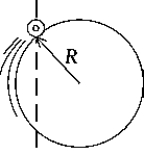
MR2) of mass M and radius R is suspended from a point on its rim. If it oscillates as a physical pendulum its period is (Multiple Choice)
5.0/5  (94)
(94) Which of the following statements is true of a particle that is moving in simple harmonic motion?
(Multiple Choice)
4.9/5 (84)
(84) A ball moves back and forth in simple harmonic motion along a line 12 cm long. When the ball is 4 cm from the left-hand end of its path, it has an acceleration of 24 cm/s2. When the ball is 1 cm from the right-hand end of its path the magnitude of its acceleration is
(Multiple Choice)
4.8/5 (75)
(75) Use the figure to the right to answer the next problems.
A ball of mass m = 100 g and radius r = 10 cm is suspended from a light spring with spring constant k = 4 N/m. The ball is then immersed in oil with viscosity = 0.2 Pa.s and driven at the resonant frequency by a variable force F = Fo cos ( t) at an amplitude of A = 10 cm.  -How much energy is dissipated per cycle?
 (Multiple Choice)
4.9/5 (92)
(92) A mass on a spring oscillates with an amplitude of 5.0 cm. What is the position of the mass when the kinetic and potential energies are equal?
(Multiple Choice)
4.7/5 (86)
(86) A particle moves in one dimension with simple harmonic motion according to the equation
D 2x/dt2 = - 4 2x
Where the units are SI. Its period is
(Multiple Choice)
4.9/5 (84)
(84) A physical pendulum oscillates with small amplitude and a frequency of 2.00 Hz at a place where g is equal to 9.81 m/s2. The length of a simple pendulum that would oscillate with small amplitude at the same frequency is approximately
(Multiple Choice)
4.8/5 (86)
(86) A body of mass 5.0 kg moves in simple harmonic motion according to the equation
X = 0.040 sin(30t + /6)
Where the units are SI. The period of this motion is
(Multiple Choice)
4.9/5 (71)
(71) 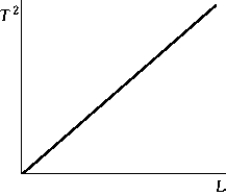 The graph shows the period squared versus the length for a simple pendulum. The slope of the graph corresponds to
 (Multiple Choice)
4.8/5 (82)
(82) A particle is moving with SHM. If it has velocities of v1 and v2 when it is at positions x1 and x2 from the equilibrium position respectively, then the square of the frequency of vibration (f 2) is given by:
(Multiple Choice)
4.9/5 (81)
(81) A pendulum is oscillating with a total mechanical energy E0. When the pendulum is at its maximum displacement, the kinetic energy K and the potential energy U are
(Multiple Choice)
4.9/5 (70)
(70) A long homogeneous rod can be pivoted as a physical pendulum at each of the points shown. Points at which the periods would be about the same are 
(Multiple Choice)
4.7/5 (76)
(76) When driving over a washboard speed bumps, certain speeds make the bumps less "bumpy." Suppose your car has mass of 1000 kg and the critical damping constant of the shock absorbers is 12000 kg/s, what is the "ideal speed" to drive across the bumps assuming that the bumps are 0.3 m apart? Hint: Find the decay time for the critically damped shock absorbers. 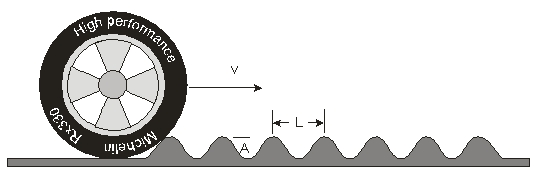
(Multiple Choice)
4.9/5 (87)
(87) An object is moving with simple harmonic motion. When the object is displaced 4 cm from its equilibrium point, its acceleration is 20 cm/s2. Calculate the period T.
(Multiple Choice)
4.8/5 (75)
(75) A damped oscillator has a decay time constant . After time t = has passed, the fraction of the amount of energy remaining is
(Multiple Choice)
4.7/5 (83)
(83) A particle moving in simple harmonic motion with a period T = 1.5 s passes through the equilibrium point at time t0 = 0 with a velocity of 1.00 m/s to the right. A time t later, the particle is observed to move to the left with a velocity of 0.50 m/s. (Note the change in direction of the velocity.) The smallest possible value of the time t is
(Multiple Choice)
4.7/5 (71)
(71) Use the figure to answer the problem. A spring of negligible mass and spring constant k is attached to the wall on one end, and the other end is attached to the center of mass axis of a solid sphere of mass m and radius r. The spring is stretched a distance A from equilibrium and let go. The sphere rolls freely on a smooth surface.  -The angular frequency of the oscillation is
 (Multiple Choice)
4.8/5 (93)
(93) A particle is moving with SHM. If it has velocities of 6 cm/s and 2 cm/s when it is at positions 4 cm and 7 cm respectively from the equilibrium position, then calculate its period of oscillation.
(Multiple Choice)
4.8/5 (69)
(69) 
Filters
- Essay(0)
- Multiple Choice(0)
- Short Answer(0)
- True False(0)
- Matching(0)