



 Chat with AI
Exam 14: Oscillations

Exam 1: Systems of Measurement86 Questions
Exam 2: Motion in One Dimension103 Questions
Exam 3: Motion in Two and Three Dimensions67 Questions
Exam 4: Newtons Laws117 Questions
Exam 5: Applications of Newtons Laws75 Questions
Exam 6: Work and Energy71 Questions
Exam 7: Conservation of Energy73 Questions
Exam 8: Systems of Particles and Conservation of Linear Momentum107 Questions
Exam 9: Rotation119 Questions
Exam 10: Conservation of Angular Momentum67 Questions
Exam 11: Gravity90 Questions
Exam 12: Static Equilibrium and Elasticity65 Questions
Exam 13: Fluids91 Questions
Exam 14: Oscillations138 Questions
Exam 15: Wave Motion122 Questions
Exam 16: Superposition and Standing Waves125 Questions
Exam 17: Temperature and the Kinetic Theory of Gases85 Questions
Exam 18: Heat and the First Law of Thermodynamics114 Questions
Exam 19: The Second Law of Thermodynamics61 Questions
Exam 20: Thermal Properties and Processes54 Questions
Select questions type


When the compression of a spring is doubled, the potential energy stored in the spring is
(Multiple Choice)
4.9/5  (84)
(84) A mass attached to a spring has simple harmonic motion with an amplitude of 4.0 cm. When the mass is 2.0 cm from the equilibrium position, what fraction of its total energy is potential energy?
(Multiple Choice)
4.8/5 (88)
(88) A 10-kg block starts from rest at a vertical height of 1 m on a 30º frictionless inclined plane. If the block slides down the incline and then 20 m along a frictionless horizontal surface into a fixed spring with a force constant of 100 N/m, the spring is compressed approximately
(Multiple Choice)
4.9/5 (87)
(87) A body moves in simple harmonic motion with amplitude A and period T. The minimum time for the body to move from a displacement of A to A/2 is
(Multiple Choice)
4.8/5 (86)
(86) If the length of a simple pendulum is increased by 4% and the mass is decreased by 4%, the period is
(Multiple Choice)
4.8/5 (88)
(88) A mass of 2.00 kg suspended from a spring 100 cm long is pulled down 4.00 cm from its equilibrium position and released. The amplitude of vibration of the resulting simple harmonic motion is 
(Multiple Choice)
4.9/5 (83)
(83) Which of the following statements is true for a simple harmonic oscillator that is not subject to dissipative forces?
(Multiple Choice)
4.9/5 (84)
(84) A mass m hanging on a spring with a spring constant k executes simple harmonic motion with a period T. If the same mass is hung from a spring with a spring constant of 2k, the period of oscillation
(Multiple Choice)
4.8/5 (70)
(70) A giant simple pendulum has a time period of 5.0 s. If the time period is changed to 4.5 s, calculate the change in the length of the string if g is constant at 9.81 m/s2.
(Multiple Choice)
4.9/5 (89)
(89) 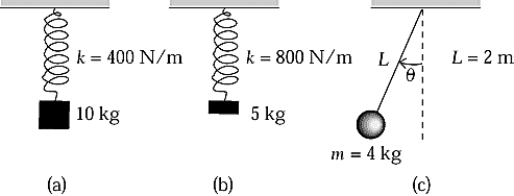 The order, from highest to lowest, of the frequencies of the oscillatory systems shown in the figure is
 (Multiple Choice)
4.8/5 (82)
(82) A mass m hanging on a spring with a spring constant k has simple harmonic motion with a period T. If the mass is doubled to 2m, the period of oscillation
(Multiple Choice)
4.8/5 (88)
(88) Two clocks with basic timekeeping mechanisms consisting of (1) a mass on a spring and (2) a simple pendulum are taken to the top of a mountain. At the base of the mountain, they both keep perfect time. At the top of the mountain,
(Multiple Choice)
4.9/5 (90)
(90) The shattering of a crystal glass by an intense sound is an example of
(Multiple Choice)
4.8/5 (91)
(91) When an object is oscillating in simple harmonic motion in the vertical direction, its maximum speed occurs when the object
(Multiple Choice)
4.9/5 (79)
(79) Use the figure to answer the problem. A spring of negligible mass and spring constant k is attached to the wall on one end, and the other end is attached to the center of mass axis of a solid sphere of mass m and radius r. The spring is stretched a distance A from equilibrium and let go. The sphere rolls freely on a smooth surface.  -What is the linear kinetic energy when the sphere is at the equilibrium position?
 (Multiple Choice)
4.9/5 (60)
(60) Use the following to answer question : 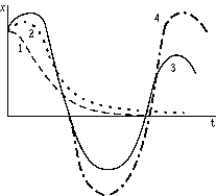 -The graph shows the displacement of an oscillator as a function of time. The oscillator that is overdamped is
 (Multiple Choice)
4.9/5 (78)
(78) The differential equation for a damped oscillator is 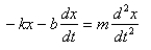 If the damping is not too large, the time constant for the motion of this oscillator is determined by the
 (Multiple Choice)
4.7/5 (82)
(82) In the following equations, a is acceleration, r is a fixed distance, s is displacement, and m is mass. Which equation describes simple harmonic motion?
(Multiple Choice)
4.9/5 (78)
(78)  A ball moves with simple harmonic motion between points A and B. The magnitude of the acceleration of the ball at point C is 5.00 m/s2. The magnitude of the acceleration of the ball at point D is
 (Multiple Choice)
4.9/5 (90)
(90) 
Filters
- Essay(0)
- Multiple Choice(0)
- Short Answer(0)
- True False(0)
- Matching(0)