



 Chat with AI
Exam 14: Oscillations

Exam 1: Systems of Measurement86 Questions
Exam 2: Motion in One Dimension103 Questions
Exam 3: Motion in Two and Three Dimensions67 Questions
Exam 4: Newtons Laws117 Questions
Exam 5: Applications of Newtons Laws75 Questions
Exam 6: Work and Energy71 Questions
Exam 7: Conservation of Energy73 Questions
Exam 8: Systems of Particles and Conservation of Linear Momentum107 Questions
Exam 9: Rotation119 Questions
Exam 10: Conservation of Angular Momentum67 Questions
Exam 11: Gravity90 Questions
Exam 12: Static Equilibrium and Elasticity65 Questions
Exam 13: Fluids91 Questions
Exam 14: Oscillations138 Questions
Exam 15: Wave Motion122 Questions
Exam 16: Superposition and Standing Waves125 Questions
Exam 17: Temperature and the Kinetic Theory of Gases85 Questions
Exam 18: Heat and the First Law of Thermodynamics114 Questions
Exam 19: The Second Law of Thermodynamics61 Questions
Exam 20: Thermal Properties and Processes54 Questions
Select questions type


A thin test tube is partially filled with lead pellets so that it floats vertically in a fluid. When displaced slightly in the vertical direction, the tube undergoes SHM. In water the period is found to be 1.25 s, and when in an unknown fluid its period is 1.40 s. Use Archimedes' Principle to help you determine the density of the unknown liquid. (Density of water = 1 g/cm3)
(Multiple Choice)
4.8/5  (87)
(87) The period of oscillation of a simple pendulum of length 9.8 m and mass 5.0 kg is approximately
(Multiple Choice)
4.8/5 (67)
(67) The top graph represents the variation of displacement with time for a particle executing simple harmonic motion. Which curve in the bottom graph represents the variation of acceleration with time for the same particle? 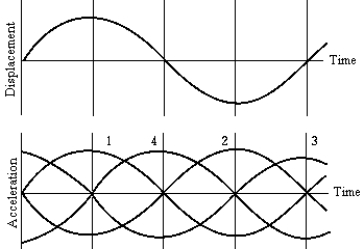
(Multiple Choice)
4.7/5 (79)
(79) The frequency of a simple harmonic motion is 2.6 10-4 s-1. The oscillation starts (t = 0) when the displacement has its maximum positive value of 6.5 10-3 cm. The earliest possible time at which the particle can be found at x = -2.6 10-3 cm is
(Multiple Choice)
4.9/5 (75)
(75) An oscillator has a quality factor of 300. By what percentage does its energy decrease in each cycle?
(Multiple Choice)
4.9/5 (80)
(80) Use the figure to the right to answer the next problems.
A ball of mass m = 100 g and radius r = 10 cm is suspended from a light spring with spring constant k = 4 N/m. The ball is then immersed in oil with viscosity = 0.2 Pa.s, and set into oscillation with an initial amplitude of A = 2 cm. 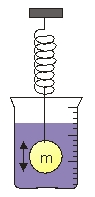 -What is the amplitude after 1 s?
 (Multiple Choice)
4.7/5 (64)
(64) 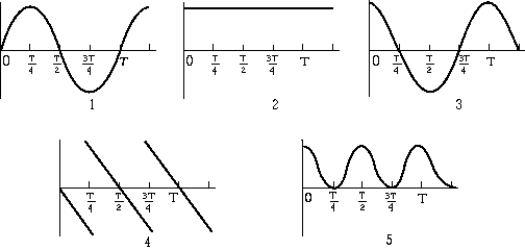 The kinetic energy of a body executing simple harmonic motion is plotted against time expressed in terms of the period T. At t = 0, the displacement is zero. Which of the graphs most closely represents these conditions?
 (Multiple Choice)
4.9/5 (81)
(81) What must be the length of a simple pendulum with a period of 2.0 s if g = 9.8 m/s2?
(Multiple Choice)
4.9/5 (79)
(79) The displacement of a body moving with simple harmonic motion is given by the equation
Y = A sin(2 t +  )
After one-quarter of a period has elapsed since t = 0, which of the following statements is correct?
)
After one-quarter of a period has elapsed since t = 0, which of the following statements is correct? (Multiple Choice)
4.8/5 (98)
(98) A spring is cut in half. The ratio of the force constant of one of the halves to the force constant of the original spring is
(Multiple Choice)
5.0/5 (77)
(77) Use the figure to the right to answer the next problems.
A ball of mass m = 100 g and radius r = 10 cm is suspended from a light spring with spring constant k = 4 N/m. The ball is then immersed in oil with viscosity = 0.2 Pa.s, and set into oscillation with an initial amplitude of A = 2 cm.
-The oscillation is
-The oscillation is (Multiple Choice)
4.7/5 (80)
(80) A body of mass 0.50 kg moves in simple harmonic motion with a period of 1.5 s and an amplitude of 20 mm. Which of the following equations correctly represents this motion?
(Multiple Choice)
5.0/5 (75)
(75) A 2.5-kg object is attached to a spring of force constant k = 4.5 kN/m. The spring is stretched 10 cm from equilibrium and released. What is the kinetic energy of the mass-spring system when the mass is 5.0 cm from its equilibrium position?
(Multiple Choice)
4.9/5 (83)
(83) A light spring stretches 0.13 m when a 0.35 kg mass is hung from it. The mass is pulled down from this equilibrium position an additional 0.15 m and then released. Determine the maximum speed of the mass.
(Multiple Choice)
4.9/5 (82)
(82) A body of mass M suspended from a spring oscillates with a period T. If the mass of the spring can be neglected, a body of mass 2M, suspended from the same spring, oscillates with a period of
(Multiple Choice)
4.7/5 (85)
(85) You want a mass that, when hung on the end of a spring, oscillates with a period of 1 s. If the spring has a spring constant of 10 N/m, the mass should be
(Multiple Choice)
4.8/5 (84)
(84) The energy of a simple harmonic oscillator could be doubled by increasing the amplitude by a factor of
(Multiple Choice)
4.8/5 (69)
(69) The energy of an oscillator decreases by 10% each cycle. The quality factor of this oscillator is approximately
(Multiple Choice)
4.8/5 (74)
(74) Any body moving with simple harmonic motion is being acted on by a force that is
(Multiple Choice)
4.7/5 (79)
(79) Use the following to answer question : 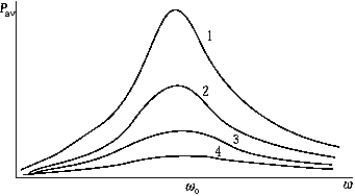 -The graph shows the average power delivered to an oscillating system as a function of the driving frequency. According to these data
 (Multiple Choice)
4.8/5 (73)
(73) 
Filters
- Essay(0)
- Multiple Choice(0)
- Short Answer(0)
- True False(0)
- Matching(0)