



 Chat with AI
Exam 20: Nuclear Physics

Exam 1: The Electric Field I: Discrete Charge Distributions87 Questions
Exam 2: The Electric Field II: Continuous Charge Distributions75 Questions
Exam 3: Electric Potential108 Questions
Exam 4: Capacitance73 Questions
Exam 5: Electric Current and Direct-Current Circuits160 Questions
Exam 6: The Magnetic Field71 Questions
Exam 7: Sources of the Magnetic Field115 Questions
Exam 8: Magnetic Induction84 Questions
Exam 9: Alternating-Current Circuits119 Questions
Exam 10: Maxwells Equations and Electromagnetic Waves61 Questions
Exam 11: Properties of Light116 Questions
Exam 12: Optical Images143 Questions
Exam 13: Interference and Diffraction116 Questions
Exam 14: Wave Particle Duality and Quantum Physics153 Questions
Exam 15: Applications of the Schrodinger Equation54 Questions
Exam 16: Atoms128 Questions
Exam 17: Molecules44 Questions
Exam 18: Solids and the Theory of Conduction83 Questions
Exam 19: Relativity83 Questions
Exam 20: Nuclear Physics135 Questions
Exam 21: Elementary Particles and the Beginning of the Universe68 Questions
Select questions type



 decays into
 by proton emission. The Q of the reaction is 2.26 MeV. The mass of
 is
decays into by proton emission. The Q of the reaction is 2.26 MeV. The mass of is (Multiple Choice)
4.8/5  (66)
(66) How many times larger is the volume of the nucleus 208Pb (Z=82) compared to the nucleus 40Ca (Z=20)?
(Multiple Choice)
4.9/5 (72)
(72) The emission of one beta particle (an electron) from the nucleus of an atom produces a change of
(Multiple Choice)
5.0/5 (90)
(90) Calculate the Q-value for the following reaction,  . Use the following atomic masses.
 14)003 24
. Use the following atomic masses.
14)003 24 (Multiple Choice)
5.0/5 (92)
(92) The volume of a nucleus is directly proportional to the number of _______ it contains.
(Multiple Choice)
4.8/5 (93)
(93) Many famous artifacts have been dated using 14C dating techniques. One of these were the Dead Sea Scrolls or manuscripts. An activity level of 0.20 Bq per gram of carbon was measured. If the half-life of 14C is 5730 years and there are about 15 decays per minute per gram of carbon in a living organism, then calculate the age of the famous manuscripts.
(Multiple Choice)
4.8/5 (79)
(79) 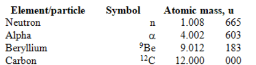 The discovery of the neutron came as a result of the reaction
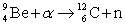 For this reaction,
The discovery of the neutron came as a result of the reaction For this reaction, (Multiple Choice)
4.9/5 (80)
(80) About 200 MeV of energy is released in the average fission reaction. Most of this energy is
(Multiple Choice)
4.8/5 (84)
(84) 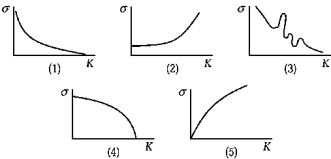 The graph that best represents the cross section for a nuclear reaction involving protons versus the energy of an incident proton is
 (Multiple Choice)
4.8/5 (71)
(71) At a particular time, a radioactive source A has a strength of 1.60 * 1011 Bq and a half-life of 15.0 d, and a second source B has a strength of 8.50 * 1011 Bq. Sources A and B have the same strength 45.0 d later. The half-life of B is
(Multiple Choice)
4.7/5 (81)
(81) The activity of a radioactive sample is defined as the number of decays per second. For a sample with N particles and a decay constant , the activity is
(Multiple Choice)
4.9/5 (70)
(70) 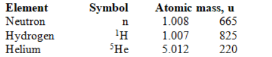 The total binding energy of
 is approximately
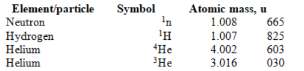 The energy required to remove one neutron
 from
 is

Filters
- Essay(0)
- Multiple Choice(0)
- Short Answer(0)
- True False(0)
- Matching(0)