



 Chat with AI
Exam 20: Nuclear Physics

Exam 1: The Electric Field I: Discrete Charge Distributions87 Questions
Exam 2: The Electric Field II: Continuous Charge Distributions75 Questions
Exam 3: Electric Potential108 Questions
Exam 4: Capacitance73 Questions
Exam 5: Electric Current and Direct-Current Circuits160 Questions
Exam 6: The Magnetic Field71 Questions
Exam 7: Sources of the Magnetic Field115 Questions
Exam 8: Magnetic Induction84 Questions
Exam 9: Alternating-Current Circuits119 Questions
Exam 10: Maxwells Equations and Electromagnetic Waves61 Questions
Exam 11: Properties of Light116 Questions
Exam 12: Optical Images143 Questions
Exam 13: Interference and Diffraction116 Questions
Exam 14: Wave Particle Duality and Quantum Physics153 Questions
Exam 15: Applications of the Schrodinger Equation54 Questions
Exam 16: Atoms128 Questions
Exam 17: Molecules44 Questions
Exam 18: Solids and the Theory of Conduction83 Questions
Exam 19: Relativity83 Questions
Exam 20: Nuclear Physics135 Questions
Exam 21: Elementary Particles and the Beginning of the Universe68 Questions
Select questions type


The energy at which the  endothermic reaction takes place is
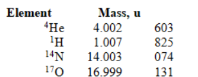
endothermic reaction takes place is
(Multiple Choice)
5.0/5  (70)
(70) A radioactive source has a half-life of 2 min. At time t = 0 it is placed near a detector and the counting rate is observed to be 3000 counts/s. If the detection efficiency is 25%, how many radioactive nuclei are there at time t = 2 min?
(Multiple Choice)
4.7/5 (88)
(88)  After a star fuses most its hydrogen into helium, it begins to fuse the helium into carbon. The energy released in fusing helium nuclei ( particles) into carbon is approximately
 (Multiple Choice)
4.8/5 (85)
(85)  the blanks should contain
A cubical tray, one meter along the edge, contains 10,000 small hard spheres, each 0.0010 m in radius. Assume that no sphere is in front of another. If you shoot 108 small bullets (very small compared with the spheres) randomly into the broad face of the tray, the number of bullets that you can expect to be scattered by collisions with these spheres is
(Multiple Choice)
4.9/5 (79)
(79) Many elements show resonances in neutron capture. What are these resonances?
(Multiple Choice)
4.9/5 (77)
(77) 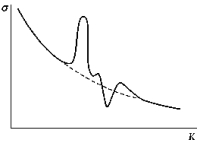 Although the neutron-capture cross section curve is generally proportional to 1/v, where v is the velocity of the incident neutrons, it has several pronounced peaks. These peaks are an indication of
 (Multiple Choice)
4.7/5 (70)
(70) Which of the following radioactive decay products has the largest electric charge?
(Multiple Choice)
4.9/5 (77)
(77) The nuclear reaction process in which a heavy nucleus splits into two roughly equal parts is known as
(Multiple Choice)
4.9/5 (84)
(84) A radioactive nucleus with Z = 92 and A = 235 decays through a series of alpha, beta, and gamma emissions to a stable nucleus with Z = 82 and A = 207. The number of alpha particles and the number of beta particles emitted during the entire process are
(Multiple Choice)
4.9/5 (82)
(82)  What is the available energy EA for the
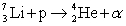 reaction if the kinetic energy of the proton is 10.0 MeV?
What is the available energy EA for the reaction if the kinetic energy of the proton is 10.0 MeV? (Multiple Choice)
4.9/5 (72)
(72) Atoms of an element that have different atomic masses are called
(Multiple Choice)
4.8/5 (77)
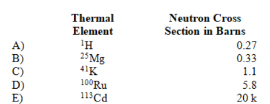
(77) The element that would best serve as a control rod in a nuclear reactor is
(Short Answer)
4.7/5 (77)
(77) The subscript before the symbol for an element represents the number of
(Multiple Choice)
4.9/5 (74)
(74) 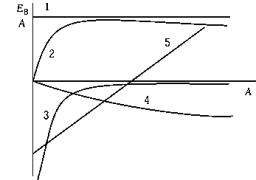 Curve 2 is the binding energy per nucleon as a function of the mass number A. The other curves represent the contributions of various forms of energy that contribute to the binding energy. The curve that best represents the contribution of the Coulomb force is
 (Multiple Choice)
4.8/5 (76)
(76) 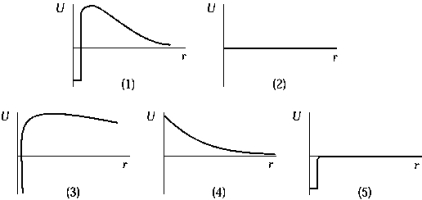 The graph that represents the interaction of the proton and neutron is
 (Multiple Choice)
4.9/5 (85)
(85) A radioactive source has a half-life of 2 min. At time t = 0 it is placed near a detector and the counting rate is observed to be 3000 counts/s. The counting rate at t = 4 min will be
(Multiple Choice)
4.8/5 (71)
(71) If, on the average, each fission reaction of 235U releases 200 MeV of energy, how many nuclei of 235U fission every second in a 200-MW reactor?
(Multiple Choice)
4.8/5 (84)
(84) The intensity of gamma rays passing through a material as a function of thickness, x is given by 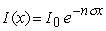 where n is the number of atoms per cm3 and is the absorption cross section. It is observed that the intensity of gamma rays of a particular energy is reduced by half when they passed through 1 cm of lead. What is the thickness of lead needed to reduce the intensity to a quarter?
 (Multiple Choice)
4.9/5 (89)
(89) 
Filters
- Essay(0)
- Multiple Choice(0)
- Short Answer(0)
- True False(0)
- Matching(0)