



 Chat with AI
Exam 16: Atoms

Exam 1: The Electric Field I: Discrete Charge Distributions87 Questions
Exam 2: The Electric Field II: Continuous Charge Distributions75 Questions
Exam 3: Electric Potential108 Questions
Exam 4: Capacitance73 Questions
Exam 5: Electric Current and Direct-Current Circuits160 Questions
Exam 6: The Magnetic Field71 Questions
Exam 7: Sources of the Magnetic Field115 Questions
Exam 8: Magnetic Induction84 Questions
Exam 9: Alternating-Current Circuits119 Questions
Exam 10: Maxwells Equations and Electromagnetic Waves61 Questions
Exam 11: Properties of Light116 Questions
Exam 12: Optical Images143 Questions
Exam 13: Interference and Diffraction116 Questions
Exam 14: Wave Particle Duality and Quantum Physics153 Questions
Exam 15: Applications of the Schrodinger Equation54 Questions
Exam 16: Atoms128 Questions
Exam 17: Molecules44 Questions
Exam 18: Solids and the Theory of Conduction83 Questions
Exam 19: Relativity83 Questions
Exam 20: Nuclear Physics135 Questions
Exam 21: Elementary Particles and the Beginning of the Universe68 Questions
Select questions type


For the hydrogen atom in the state n = 2, l = 0, m = 0, the radial probability density is 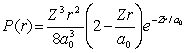 The probability of finding the electron in the range r = 0.04a0 at r = 2a0 is
Free
(Multiple Choice)
4.7/5  (90)
(90) Correct Answer: Verified
E
The kinetic energy of an electron moving in a circular orbit of radius r about a positive charge Ze varies
Free
(Multiple Choice)
4.9/5 (77)
(77) Correct Answer:Verified
VerifiedC
The energy of an electron in an atom is determined primarily by the quantum numbers
Free
(Multiple Choice)
4.9/5 (72)
(72) Correct Answer:Verified
VerifiedB
If you measure the angular momentum of an electron in units of  , you find that the angular momentum is quantized to the value _______ units and that its component along any direction can have only the _______ values ranging from -
 to +
 units.
, you find that the angular momentum is quantized to the value _______ units and that its component along any direction can have only the _______ values ranging from - to + units. (Multiple Choice)
4.7/5 (74)
(74) For the hydrogen atom in the ground state, the wave function is 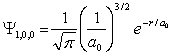 The probability of finding the electron from r = 0 to r = 2a0 is approximately
Note:
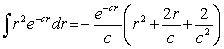
The probability of finding the electron from r = 0 to r = 2a0 is approximately
Note: (Multiple Choice)
4.9/5 (83)
(83) The binding energy of hydrogen is 13.6 eV. The wavelength of the emission line corresponding to the transition from n = 4 to n = 3 is
(Multiple Choice)
4.9/5 (74)
(74) A hydrogen atom is in an excited state having a binding energy of 0.85 eV in this state. The atom makes a transition to a state whose excitation energy is 10.2 eV. The energy of the photon emitted in this transition is approximately
(Multiple Choice)
5.0/5 (78)
(78) 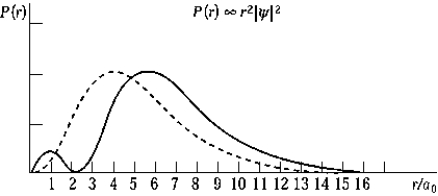 The dashed curve on the graph shows the probability of finding the electron at a distance r for
 (Multiple Choice)
4.9/5 (85)
(85) Use the following figure for the next two problems. 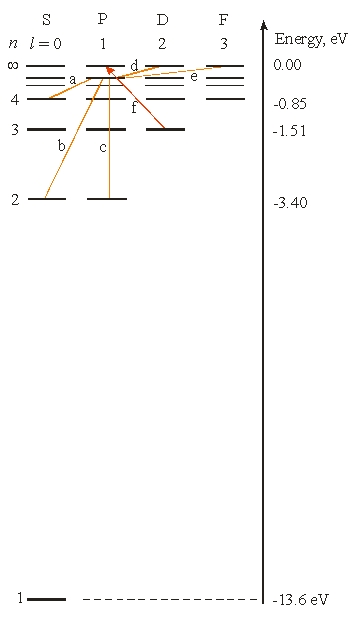 -What is the longest wavelength needed for an electron to make the transition labeled (f)?
 (Multiple Choice)
4.7/5 (88)
(88) 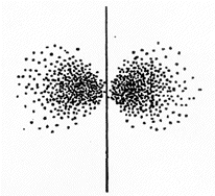 The set of quantum numbers for the probability density shown is
 (Multiple Choice)
4.8/5 (72)
(72) Z for the element whose electronic configuration is
1s22s22p63s23p2
Must be
(Multiple Choice)
4.7/5 (79)
(79) Consider a beryllium (Z = 4) ion with all but one of its electrons removed. What is the kinetic energy of the electron in the n = 1 orbit. (The radius of the 1st Bohr orbit in Be3+ is 0.0132 nm.)
(Multiple Choice)
4.9/5 (68)
(68) A hydrogen atom is in the state n = 4,  = 3. The two spectral states due to spin-orbit coupling are
 (Multiple Choice)
4.9/5 (84)
(84) 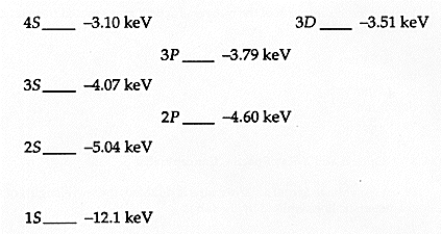 The figure shows the energy-level diagram of an X-ray machine with a nickel target that is being operated at a potential of 50 keV. The photon wavelength of the allowed K emission X rays is approximately
 (Multiple Choice)
4.8/5 (82)
(82) 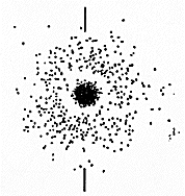 The set of quantum numbers for the probability density shown is
 (Multiple Choice)
4.8/5 (75)
(75) Using Bohr's model, the speed of an electron in the first orbit is
(Multiple Choice)
4.9/5 (82)
(82) The number of oxygen's eight electrons that are found in the p state is
(Multiple Choice)
4.8/5 (85)
(85) A compact disc of a CD player has a moment of inertia I = 2.5 *10-5 kg · m2 and rotates at 500 rev/min. Taking L = I and using the quantization of angular momentum, the approximate value of L is (  = 1.055* 10-34 J · s)
 (Multiple Choice)
5.0/5 (80)
(80) The first Bohr radius, r0, is 0.0529 nm and the corresponding energy, E0, is 13.6 eV. The wavelength of the light emitted as a hydrogen atom undergoes a transition from state n = 4 to n = 2 is
(Multiple Choice)
4.8/5 (90)
(90) 
Filters
- Essay(0)
- Multiple Choice(0)
- Short Answer(0)
- True False(0)
- Matching(0)