



 Chat with AI
Exam 16: Atoms

Exam 1: The Electric Field I: Discrete Charge Distributions87 Questions
Exam 2: The Electric Field II: Continuous Charge Distributions75 Questions
Exam 3: Electric Potential108 Questions
Exam 4: Capacitance73 Questions
Exam 5: Electric Current and Direct-Current Circuits160 Questions
Exam 6: The Magnetic Field71 Questions
Exam 7: Sources of the Magnetic Field115 Questions
Exam 8: Magnetic Induction84 Questions
Exam 9: Alternating-Current Circuits119 Questions
Exam 10: Maxwells Equations and Electromagnetic Waves61 Questions
Exam 11: Properties of Light116 Questions
Exam 12: Optical Images143 Questions
Exam 13: Interference and Diffraction116 Questions
Exam 14: Wave Particle Duality and Quantum Physics153 Questions
Exam 15: Applications of the Schrodinger Equation54 Questions
Exam 16: Atoms128 Questions
Exam 17: Molecules44 Questions
Exam 18: Solids and the Theory of Conduction83 Questions
Exam 19: Relativity83 Questions
Exam 20: Nuclear Physics135 Questions
Exam 21: Elementary Particles and the Beginning of the Universe68 Questions
Select questions type


In the Bohr Model of the hydrogen atom, what is the potential energy of the electron in the n = 11 orbit? (The radius of the 1st Bohr orbit is 0.0529 nm.)
(Multiple Choice)
4.9/5  (80)
(80) 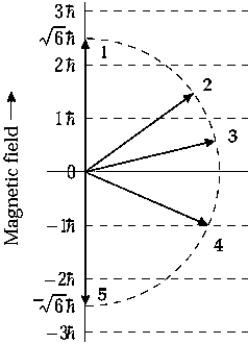 The orbital angular momentum of an electron in a D state has a magnitude of
 . The figure shows orientations of the angular momentum vector or an electron placed in a magnetic field in the positive z direction. The vector that represents a correct orientation when the field is applied is
The orbital angular momentum of an electron in a D state has a magnitude of . The figure shows orientations of the angular momentum vector or an electron placed in a magnetic field in the positive z direction. The vector that represents a correct orientation when the field is applied is (Multiple Choice)
4.9/5 (66)
(66) The radius of the n = 1 Bohr orbit in the hydrogen atom is 0.053 nm. What is the radius of the n = 5 Bohr orbit?
(Multiple Choice)
4.9/5 (61)
(61) A possible value of the orbital angular momentum of an electron in the n = 2 state is
(Multiple Choice)
5.0/5 (82)
(82) The radius of the n = 1 orbit in the hydrogen atom is 0.053 nm. What is the radius of the n = 3 orbit of lithium, which has three protons in its nucleus?
(Multiple Choice)
4.9/5 (78)
(78) If the angular momentum is characterized by the quantum number  = 3, what is the smallest possible angle between
 and the z axis?
= 3, what is the smallest possible angle between and the z axis? (Multiple Choice)
4.7/5 (84)
(84) The possible orbital quantum numbers of an electron are 0, 1, 3, 4, and 5. Its principal quantum number, n, and the largest magnetic quantum number, ml are
(Multiple Choice)
4.8/5 (81)
(81) The wavelength of the photon emitted when a hydrogen atom undergoes a transition from the n = 5 state to the n = 1 state is approximately
(Multiple Choice)
4.8/5 (74)
(74) The binding energy of a hydrogen atom is inversely proportional to the square of the principal quantum number n. The binding energy of the ground level of atomic hydrogen is 13.6 eV. The binding energy of the second (n = 2) level of the hydrogen atom is
(Multiple Choice)
4.8/5 (62)
(62) For the hydrogen atom in the ground state, the radial probability density is 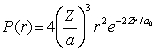 The probability of finding the electron in range r = 0.08a0 at r = a0 is approximately
 (Multiple Choice)
4.9/5 (69)
(69) An electron in the n = 3 state of a hydrogen atom falls into the n = 2 state. The Rydberg constant R is 1.097 * 10-2/nm. The wavelength of the photon emitted is approximately
(Multiple Choice)
4.9/5 (76)
(76) 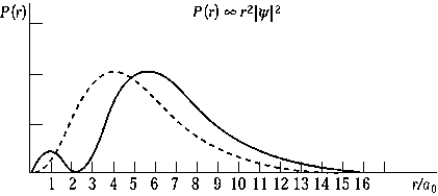 The solid curve on the graph shows the probability of finding the electron at a distance r for
 (Multiple Choice)
4.8/5 (75)
(75) The order-of-magnitude of the diameter of an atom is closest to
(Multiple Choice)
4.9/5 (80)
(80) When the voltage across an X-ray tube is doubled, the minimum wavelength of the bremsstrahlung radiation
(Multiple Choice)
4.8/5 (69)
(69) For the principal quantum number n = 4, the number of values the orbital quantum number l can have is
(Multiple Choice)
4.8/5 (76)
(76) The wavelength of the photon emitted when a hydrogen atom undergoes a transition from the n = 10 state to the n = 1 state is approximately
(Multiple Choice)
4.8/5 (76)
(76) 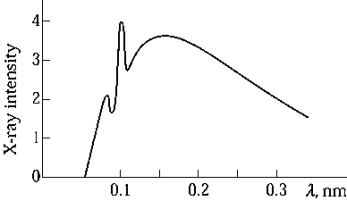 An X-ray spectrum of a particular metal, which is a plot of X-ray intensity (arbitrary units) versus wavelength (nm), is shown in the graph. The energy of the monoenergetic electrons producing this spectrum is
 (Multiple Choice)
4.8/5 (79)
(79) If the potential energy of an electron in the Bohr's model is -U0, then the kinetic energy and the total energy of the electron are, respectively,
(Multiple Choice)
4.7/5 (77)
(77) 
Filters
- Essay(0)
- Multiple Choice(0)
- Short Answer(0)
- True False(0)
- Matching(0)