



 Chat with AI
Exam 16: Atoms

Exam 1: The Electric Field I: Discrete Charge Distributions87 Questions
Exam 2: The Electric Field II: Continuous Charge Distributions75 Questions
Exam 3: Electric Potential108 Questions
Exam 4: Capacitance73 Questions
Exam 5: Electric Current and Direct-Current Circuits160 Questions
Exam 6: The Magnetic Field71 Questions
Exam 7: Sources of the Magnetic Field115 Questions
Exam 8: Magnetic Induction84 Questions
Exam 9: Alternating-Current Circuits119 Questions
Exam 10: Maxwells Equations and Electromagnetic Waves61 Questions
Exam 11: Properties of Light116 Questions
Exam 12: Optical Images143 Questions
Exam 13: Interference and Diffraction116 Questions
Exam 14: Wave Particle Duality and Quantum Physics153 Questions
Exam 15: Applications of the Schrodinger Equation54 Questions
Exam 16: Atoms128 Questions
Exam 17: Molecules44 Questions
Exam 18: Solids and the Theory of Conduction83 Questions
Exam 19: Relativity83 Questions
Exam 20: Nuclear Physics135 Questions
Exam 21: Elementary Particles and the Beginning of the Universe68 Questions
Select questions type


Evidence of electron capture by a nucleus would be the emission of
(Multiple Choice)
4.8/5  (78)
(78) Which of the following atomic numbers (which are the same as the number of electrons in a neutral atom) correspond to an electronic ground-state configuration which ends in "..p3"?
(Multiple Choice)
4.9/5 (78)
(78) The group of symbols that could represent the set of quantum numbers for a particular electron is
(Multiple Choice)
4.8/5 (92)
(92) The hydrogen-like elements (valence +1) exhibit a splitting of the energy states without an external magnetic field; this is due to
(Multiple Choice)
4.8/5 (81)
(81) For the hydrogen atom in the state n = 2, l = 0, m = 0, the radial probability density is 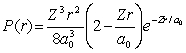 The probability of finding the electron in the range r = 0.04a0 at r = 1.5a0 is
 (Multiple Choice)
4.8/5 (75)
(75) The number of electrons in the L shell for the element whose electronic configuration is
1s22s22p63s23p2
Must be
(Multiple Choice)
5.0/5 (85)
(85) The total angular momentum of a hydrogen atom in a given excited state has the quantum number j = 5/2. The orbital angular-momentum quantum number  must have the values
 (Multiple Choice)
4.9/5 (78)
(78) The electron in a hydrogen atom has an orbital radius of 0.0500 nm. To avoid being pulled into the nucleus by electrostatic attraction, the electron must have an orbital speed of
(Multiple Choice)
4.8/5 (76)
(76) When the voltage across an X-ray tube is doubled, the wavelengths of the characteristic lines emitted by the tube
(Multiple Choice)
4.8/5 (66)
(66) Which of the following transitions are allowed in the H atom?
(i) 5S to 4P, (ii) 4D to 3D, (iii) 4D to 3S, (iv) 4P to 3S, (v) 1S to 2P
(Multiple Choice)
4.8/5 (98)
(98) Use the following figure for the next two problems. 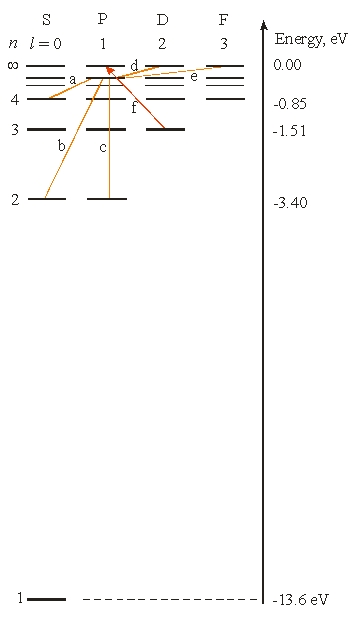 -Which of the following transitions from (a) to (e) is(are) not allowed?
 (Multiple Choice)
4.8/5 (78)
(78) The wavelength of the K X-ray line for an element is 0.0794 nm. The atomic number of the element is
(Multiple Choice)
5.0/5 (81)
(81) 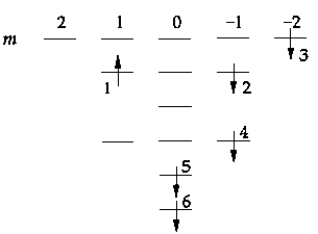 The figure shows electron 6 of the hydrogen atom in the 1S state. What number electron is in the three-dimensional state?
 (Multiple Choice)
4.9/5 (93)
(93) Which of the following atomic numbers (which are the same as the number of electrons in a neutral atom) correspond to a Group 2 metal, i.e. their ground-state electronic configuration ends in "..s2"?
(Multiple Choice)
4.9/5 (75)
(75) An electron undergoes a transition from n = 2 to n = 5. According to Bohr's model, the change in angular momentum of the electron is
(Multiple Choice)
4.8/5 (77)
(77) What is the difference in wavelength between the longest wavelength in the Lyman series and that of the longest wavelength in the Paschen series?
(Multiple Choice)
4.9/5 (95)
(95) What is the ratio of the radius of the n = 3 orbit to that of the n = 2 orbit?
(Multiple Choice)
5.0/5 (79)
(79) 
Filters
- Essay(0)
- Multiple Choice(0)
- Short Answer(0)
- True False(0)
- Matching(0)