



 Chat with AI
Exam 16: Atoms

Exam 1: The Electric Field I: Discrete Charge Distributions87 Questions
Exam 2: The Electric Field II: Continuous Charge Distributions75 Questions
Exam 3: Electric Potential108 Questions
Exam 4: Capacitance73 Questions
Exam 5: Electric Current and Direct-Current Circuits160 Questions
Exam 6: The Magnetic Field71 Questions
Exam 7: Sources of the Magnetic Field115 Questions
Exam 8: Magnetic Induction84 Questions
Exam 9: Alternating-Current Circuits119 Questions
Exam 10: Maxwells Equations and Electromagnetic Waves61 Questions
Exam 11: Properties of Light116 Questions
Exam 12: Optical Images143 Questions
Exam 13: Interference and Diffraction116 Questions
Exam 14: Wave Particle Duality and Quantum Physics153 Questions
Exam 15: Applications of the Schrodinger Equation54 Questions
Exam 16: Atoms128 Questions
Exam 17: Molecules44 Questions
Exam 18: Solids and the Theory of Conduction83 Questions
Exam 19: Relativity83 Questions
Exam 20: Nuclear Physics135 Questions
Exam 21: Elementary Particles and the Beginning of the Universe68 Questions
Select questions type


When a gold foil is bombarded with alpha particles, a small fraction of the alpha particles were scattered at large angles. The large scattering angles
(Multiple Choice)
4.9/5  (96)
(96) The energy of the nth level in a one-electron atom is En = -13.6(Z2/n2) eV. Consider a beryllium ion with all but one of its electrons removed (a beryllium atom normally has four electrons). What is the wavelength of a photon emitted when the electron makes the transition from the third-lowest to the lowest energy state?
(Multiple Choice)
4.8/5 (86)
(86) 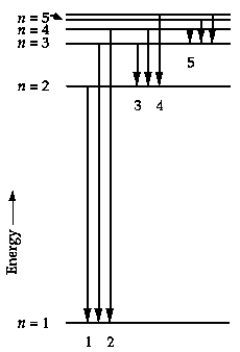 In the energy-level diagram, the line that corresponds to the longest wavelength in the Balmer series is
 (Multiple Choice)
4.8/5 (80)
(80) A hydrogen atom is in the state n = 4,  = 3. The possible values of j are
 (Multiple Choice)
4.8/5 (81)
(81) A photon of wavelength 80 nm is absorbed by the electron in the ground-state level of the hydrogen atom. Is this enough energy to ionize the atom? If so calculate the kinetic energy of the free electron.
(Multiple Choice)
4.8/5 (86)
(86) What is the energy difference between the transition with the longest wavelength in the Lyman series and the transition with the shortest wavelength in the Paschen series?
(Multiple Choice)
4.9/5 (75)
(75) 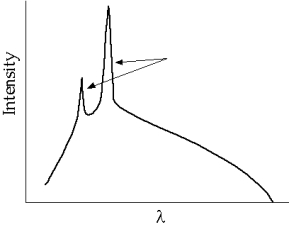 The portion of the graph indicated by the arrows corresponds to
 (Multiple Choice)
4.9/5 (79)
(79) It was _______ who showed that the periodic table of the elements can be understood in terms of the principle that "no two electrons in the same atomic system can have the same unique set of quantum numbers."
(Multiple Choice)
4.8/5 (81)
(81) For the hydrogen atom in the ground state, the radial probability density is 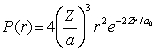 The probability of finding the electron in the range r = 0.04a0 at r = 2a0 is
 (Multiple Choice)
4.7/5 (89)
(89) An electron has a wave function given by 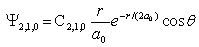 The probability of finding the electron when = 90 and = 0.5 10, and from r = a0 to 1.06a0 is approximately
 (Multiple Choice)
4.8/5 (80)
(80) A gas-discharge tube filled with hydrogen gas is placed in an external magnetic field and the spectrum is observed. Which of the following is found?
(Multiple Choice)
4.9/5 (78)
(78) For an X-ray tube to produce X rays with a wavelength as short as 0.025 nm, the electrons must be accelerated by a potential difference of
(Multiple Choice)
4.9/5 (64)
(64) What is the difference in energy of the K X-ray lines of carbon (Z = 6) and silicon
(Z = 14)?
(Multiple Choice)
4.8/5 (67)
(67) For the hydrogen atom in the ground state, the wave function is 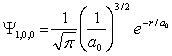 The probability of finding the electron from r = 0 to r = a0 is approximately
Note:
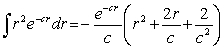
The probability of finding the electron from r = 0 to r = a0 is approximately
Note: (Multiple Choice)
4.9/5 (80)
(80) The radii of the Bohr orbits in atomic hydrogen are given by  .
If the radius of the first Bohr orbit (n = 1) is 0.053 nm, the radius of the third Bohr orbit (n = 3) is
.
If the radius of the first Bohr orbit (n = 1) is 0.053 nm, the radius of the third Bohr orbit (n = 3) is (Multiple Choice)
4.8/5 (79)
(79) A hydrogen atom that has an electron with an orbital angular momentum  is placed in a magnetic field oriented in the z direction. The component of L in the z direction could be
 (Multiple Choice)
4.9/5 (91)
(91) The Pauli exclusion principle states that no two electrons in the same atom can have the same set of quantum numbers. This set of quantum numbers is
(Multiple Choice)
4.9/5 (76)
(76) The total angular momentum is  , the orbital angular momentum is
 , and the spin angular momentum is
 . The relationship between these three quantities is
, the orbital angular momentum is , and the spin angular momentum is . The relationship between these three quantities is (Multiple Choice)
4.7/5 (70)
(70) 
Filters
- Essay(0)
- Multiple Choice(0)
- Short Answer(0)
- True False(0)
- Matching(0)