



 Chat with AI
Exam 16: Atoms

Exam 1: The Electric Field I: Discrete Charge Distributions87 Questions
Exam 2: The Electric Field II: Continuous Charge Distributions75 Questions
Exam 3: Electric Potential108 Questions
Exam 4: Capacitance73 Questions
Exam 5: Electric Current and Direct-Current Circuits160 Questions
Exam 6: The Magnetic Field71 Questions
Exam 7: Sources of the Magnetic Field115 Questions
Exam 8: Magnetic Induction84 Questions
Exam 9: Alternating-Current Circuits119 Questions
Exam 10: Maxwells Equations and Electromagnetic Waves61 Questions
Exam 11: Properties of Light116 Questions
Exam 12: Optical Images143 Questions
Exam 13: Interference and Diffraction116 Questions
Exam 14: Wave Particle Duality and Quantum Physics153 Questions
Exam 15: Applications of the Schrodinger Equation54 Questions
Exam 16: Atoms128 Questions
Exam 17: Molecules44 Questions
Exam 18: Solids and the Theory of Conduction83 Questions
Exam 19: Relativity83 Questions
Exam 20: Nuclear Physics135 Questions
Exam 21: Elementary Particles and the Beginning of the Universe68 Questions
Select questions type


The energy of a quantum of radiation in a vacuum that has a wavelength of 447 nm is approximately
(Multiple Choice)
5.0/5  (78)
(78) What is the magnitude of the change in potential energy for the electron in the hydrogen atom as it moves from the n = 2 to n = 3 orbit? (The radius of the 1st Bohr orbit is 0.0529 nm.)
(Multiple Choice)
4.8/5 (60)
(60) What is the energy difference between the transition with the longest wavelength and the transition with the shortest wavelength in the Balmer series?
(Multiple Choice)
4.9/5 (78)
(78) The wavelength of the visible line in the hydrogen spectrum that corresponds to m = 4 in the Balmer equation is
(Multiple Choice)
4.8/5 (75)
(75) The critical experiments that established the nuclear nature of atoms were performed by
(Multiple Choice)
4.7/5 (83)
(83) An electron in a hydrogen atom jumps from the n = 5 to n = 3 level. Is a photon absorbed or emitted in this process? What is the wavelength of the photon? State whether the photon is in the visible, ultraviolet, or infrared range of the electro-magnetic spectrum.
(Multiple Choice)
4.8/5 (87)
(87) What is the wavelength of the most energetic X rays emitted from an X-ray tube operated at 40 kV?
(Multiple Choice)
4.8/5 (72)
(72) The constant in the Rydberg-Ritz formula is RH = 10.96776 µm-1. The wavelength predicted by this formula for n1 = 5 and n2 = 3 is
(Multiple Choice)
4.8/5 (75)
(75) According to the Bohr theory, the allowed energy states for the hydrogen atom are given by the relation 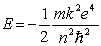 .
This formula can be readily extended to other hydrogenic (one-electron) systems. The energy of the second level (n = 2) for the doubly ionized lithium atom is
.
This formula can be readily extended to other hydrogenic (one-electron) systems. The energy of the second level (n = 2) for the doubly ionized lithium atom is (Multiple Choice)
5.0/5 (87)
(87) If the angular momentum is characterized by the quantum number  = 3, what is the largest possible angle between
 and the +z axis?
= 3, what is the largest possible angle between and the +z axis? (Multiple Choice)
4.8/5 (78)
(78) The wavelength of the visible line in the hydrogen spectrum that corresponds to m = 5 in the Balmer equation is
(Multiple Choice)
4.8/5 (80)
(80) The order-of-magnitude of the diameter of the nucleus is closest to
(Multiple Choice)
4.9/5 (67)
(67) For the principal quantum number n = 4, the number of values the magnetic quantum number m can have is
(Multiple Choice)
4.8/5 (83)
(83) The principle quantum number of an electron is 3. The possible magnitudes of the orbital angular momentum, L, are
(Multiple Choice)
4.8/5 (83)
(83) Use the following figure for the next two problems. 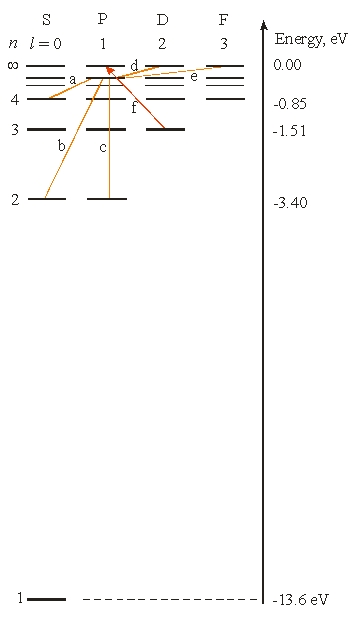 -The energy of a hydrogen atom in the n = 5 state is approximately
 (Multiple Choice)
4.9/5 (80)
(80) The limit (n = ) of a particular spectral series is the line of
(Multiple Choice)
4.9/5 (79)
(79) 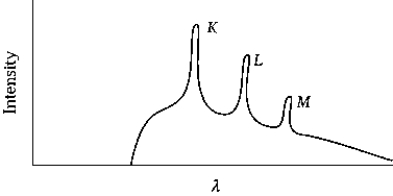 The X-ray spectrum of an X-ray tube with a molybdenum target is shown. The K edge (K-electron binding energy) is 0.0617 nm. The lowest voltage that could produce the spectrum shown is
 (Multiple Choice)
4.9/5 (85)
(85) For the hydrogen atom in the ground state, the radial probability density is 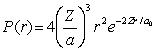 The probability of finding the electron in the range r = 0.04a0 at r = a0 is
 (Multiple Choice)
4.9/5 (70)
(70) 
Filters
- Essay(0)
- Multiple Choice(0)
- Short Answer(0)
- True False(0)
- Matching(0)