



 Chat with AI
Exam 20: Nuclear Physics

Exam 1: The Electric Field I: Discrete Charge Distributions87 Questions
Exam 2: The Electric Field II: Continuous Charge Distributions75 Questions
Exam 3: Electric Potential108 Questions
Exam 4: Capacitance73 Questions
Exam 5: Electric Current and Direct-Current Circuits160 Questions
Exam 6: The Magnetic Field71 Questions
Exam 7: Sources of the Magnetic Field115 Questions
Exam 8: Magnetic Induction84 Questions
Exam 9: Alternating-Current Circuits119 Questions
Exam 10: Maxwells Equations and Electromagnetic Waves61 Questions
Exam 11: Properties of Light116 Questions
Exam 12: Optical Images143 Questions
Exam 13: Interference and Diffraction116 Questions
Exam 14: Wave Particle Duality and Quantum Physics153 Questions
Exam 15: Applications of the Schrodinger Equation54 Questions
Exam 16: Atoms128 Questions
Exam 17: Molecules44 Questions
Exam 18: Solids and the Theory of Conduction83 Questions
Exam 19: Relativity83 Questions
Exam 20: Nuclear Physics135 Questions
Exam 21: Elementary Particles and the Beginning of the Universe68 Questions
Select questions type


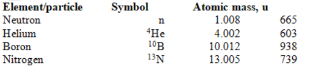 The Q of the reaction
 is approximately

For most nuclei, the total binding energy is proportional to the number of nucleons. This leads to the conclusion that nuclear forces show the property of
(Multiple Choice)
4.8/5  (77)
(77) A certain radioactive element has a half-life of 20 d. The time it will take for 7/8 of the atoms originally present to disintegrate is
(Multiple Choice)
4.7/5 (81)
(81) The unifying concepts in physics are the conservation laws. To preserve these laws in nuclear processes, it became necessary to postulate the existence of
(Multiple Choice)
4.7/5 (71)
(71) Initially a mixture of two radioactive sources contains the same number of nuclei of source A and source B. The half-life of A is 2 hours, and the half-life of B is 3 hours. What will be the ratio of remaining nuclei of A divided by remaining nuclei B after 12 hours? (Assume A does not decay into B or vice-versa.)
(Multiple Choice)
4.9/5 (92)
(92) 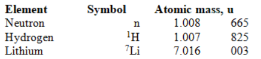 The total binding energy per nucleon of
 is approximately
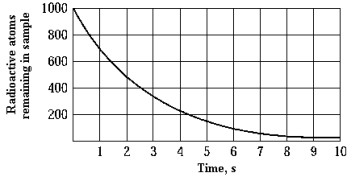 The graph shows the number of undecayed atoms as a function of time. The half-life of this radioactive element is approximately
 (Multiple Choice)
4.8/5 (78)
(78) The speed of alpha particles from 210Po is 1.6 * 107 m/s. The recoil atom will have a speed of approximately
(Multiple Choice)
4.8/5 (73)
(73) The chemical characteristics of an atom (what element it is) are determined by
(Multiple Choice)
4.8/5 (83)
(83) The half-life of phosphorus-32 is 14.3 d. If you have 1.00 g of phosphorous-32 today, the amount remaining in 10 d will be approximately
(Multiple Choice)
4.8/5 (82)
(82) In gamma-decay a nucleus in an excited state decays to a lower energy state by the emission of a high energy photon called a gamma-ray.
(Multiple Choice)
4.8/5 (74)
(74) 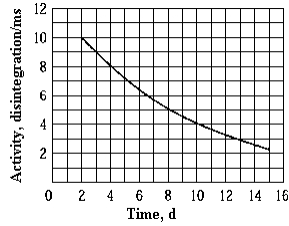 The graph shows the activity as a function of time for a radioactive sample. The decay constant for this sample is approximately
 (Multiple Choice)
4.7/5 (94)
(94) How many times larger is the radius of the nucleus 208Pb (Z=82) compared to the nucleus 40Ca (Z=20)?
(Multiple Choice)
4.9/5 (89)
(89) A light-water reactor uses _______ as fuel, and a heavy-water reactor uses _______ as fuel.
(Multiple Choice)
4.7/5 (73)
(73) 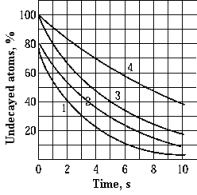 The graph shows the decay curves of four radioactive elements. The half-life is the same for elements
 (Multiple Choice)
4.9/5 (70)
(70) 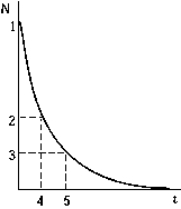 The graph shows the number of nuclei N remaining as a function of time. The point on the graph that corresponds to the number of nuclei remaining after two half-lives have elapsed is
 (Multiple Choice)
4.8/5 (78)
(78) 
Filters
- Essay(0)
- Multiple Choice(0)
- Short Answer(0)
- True False(0)
- Matching(0)