



 Chat with AI
Exam 20: Nuclear Physics

Exam 1: The Electric Field I: Discrete Charge Distributions87 Questions
Exam 2: The Electric Field II: Continuous Charge Distributions75 Questions
Exam 3: Electric Potential108 Questions
Exam 4: Capacitance73 Questions
Exam 5: Electric Current and Direct-Current Circuits160 Questions
Exam 6: The Magnetic Field71 Questions
Exam 7: Sources of the Magnetic Field115 Questions
Exam 8: Magnetic Induction84 Questions
Exam 9: Alternating-Current Circuits119 Questions
Exam 10: Maxwells Equations and Electromagnetic Waves61 Questions
Exam 11: Properties of Light116 Questions
Exam 12: Optical Images143 Questions
Exam 13: Interference and Diffraction116 Questions
Exam 14: Wave Particle Duality and Quantum Physics153 Questions
Exam 15: Applications of the Schrodinger Equation54 Questions
Exam 16: Atoms128 Questions
Exam 17: Molecules44 Questions
Exam 18: Solids and the Theory of Conduction83 Questions
Exam 19: Relativity83 Questions
Exam 20: Nuclear Physics135 Questions
Exam 21: Elementary Particles and the Beginning of the Universe68 Questions
Select questions type


A nuclear explosion produces (among a lot of other things) 7.9 * 1023 Bq of iodine-131, which has a half-life of 8.05 d, and 5.7 * 1021 Bq of barium-140, which has a half-life of 12.8 d. The total activity that remains after 145 d is
(Multiple Choice)
4.7/5  (65)
(65) The half-life of a radioactive substance is 5 min. Which of the following statements is true of the decay of this substance?
(Multiple Choice)
4.9/5 (81)
(81) The sodium atom has an atomic number of 11 and an atomic weight of 23. The neutral atom contains
(Multiple Choice)
4.8/5 (82)
(82) Which of the following common isotopes has the highest binding energy per nucleon, 4He, 12C, 16O, or 24Mg?
(Multiple Choice)
4.8/5 (82)
(82) Uranium decomposes radioactively to form thorium (atomic number 90) by emitting an particle from its nucleus. The force of repulsion between the thorium nucleus and the particle when the distance between them is 9.0 fm is approximately
(Multiple Choice)
4.7/5 (81)
(81) The half-life of radium is about 1600 y. If you have 1.00 g of radium today, the amount remaining in 1000 y will be approximately
(Multiple Choice)
4.9/5 (83)
(83)  decays to stable
 , you expect to observe
Radon (Rn) is a gas. Its nucleus decays with the emission of an alpha particle to form an isotope of polonium (Po):  The masses of the particles are:

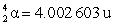
 The rest energy of a unified mass unit is 931.5 MeV. The kinetic energy of the ejected particles is
The masses of the particles are: The rest energy of a unified mass unit is 931.5 MeV. The kinetic energy of the ejected particles is (Multiple Choice)
4.9/5 (87)
(87) Neutrons produced in the fission of uranium are rapidly moving projectiles and must be slowed before they can produce more fission. If the neutrons collide elastically, hydrogen is effective in slowing them down because
(Multiple Choice)
4.9/5 (75)
(75) In an experimental inertial-confinement fusion reactor, inertial confinement has a useful duration of = 2.0 * 10-10 s. What must the density of the fusible material be in order to meet Lawson's criterion?
(Multiple Choice)
4.8/5 (82)
(82) Two alpha particles approach each other until they are 10-8 cm apart. The force exerted by one of the particles on the other is approximately
(Multiple Choice)
5.0/5 (91)
(91) The strong nuclear force acts between which of the following?
(Multiple Choice)
4.8/5 (74)
(74) In what type of radioactive decay are the mass numbers of the parent and daughter nuclei different?
(Multiple Choice)
4.9/5 (84)
(84) In what type of radioactive decay are the mass numbers of the parent and daughter nuclei the same?
(Multiple Choice)
4.9/5 (79)
(79) A flux of 1010 n/cm2 · s is incident on an  foil that is 0.10 cm thick. The density of aluminum is 2.7 g/cm3. The number of neutrons reacting with the aluminum is
104 n/cm2 · s. The cross section for this reaction is approximately
foil that is 0.10 cm thick. The density of aluminum is 2.7 g/cm3. The number of neutrons reacting with the aluminum is
104 n/cm2 · s. The cross section for this reaction is approximately (Multiple Choice)
4.8/5 (66)
(66) 
Filters
- Essay(0)
- Multiple Choice(0)
- Short Answer(0)
- True False(0)
- Matching(0)