



 Chat with AI
Exam 20: Nuclear Physics

Exam 1: The Electric Field I: Discrete Charge Distributions87 Questions
Exam 2: The Electric Field II: Continuous Charge Distributions75 Questions
Exam 3: Electric Potential108 Questions
Exam 4: Capacitance73 Questions
Exam 5: Electric Current and Direct-Current Circuits160 Questions
Exam 6: The Magnetic Field71 Questions
Exam 7: Sources of the Magnetic Field115 Questions
Exam 8: Magnetic Induction84 Questions
Exam 9: Alternating-Current Circuits119 Questions
Exam 10: Maxwells Equations and Electromagnetic Waves61 Questions
Exam 11: Properties of Light116 Questions
Exam 12: Optical Images143 Questions
Exam 13: Interference and Diffraction116 Questions
Exam 14: Wave Particle Duality and Quantum Physics153 Questions
Exam 15: Applications of the Schrodinger Equation54 Questions
Exam 16: Atoms128 Questions
Exam 17: Molecules44 Questions
Exam 18: Solids and the Theory of Conduction83 Questions
Exam 19: Relativity83 Questions
Exam 20: Nuclear Physics135 Questions
Exam 21: Elementary Particles and the Beginning of the Universe68 Questions
Select questions type


Assuming that 200 MeV of energy is released per fission, the mass of 235U that undergoes fission to operate a 250-MW reactor for 1 y is approximately
(Multiple Choice)
5.0/5  (78)
(78) 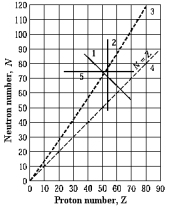 Two nuclides that are isotopes could lie on curve
A reactor that produces more fuel than it uses is called a
(Multiple Choice)
4.8/5 (81)
(81) Fission occurs because the average binding energy per nucleon for the fission fragments is higher than that for the original nucleus. The change in binding energy per nucleon is approximately
(Multiple Choice)
4.9/5 (80)
(80) 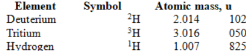 A fusion reaction that is highly probable is
 The amount of fusion energy released in this reaction is approximately
A fusion reaction that is highly probable is The amount of fusion energy released in this reaction is approximately (Multiple Choice)
4.9/5 (90)
(90) In this problem, Z is the atomic number, N is the neutron number, and A is the mass number. For stable isotopes with A greater than 44, as A increases, the ratio Z/N
(Multiple Choice)
5.0/5 (80)
(80) The following fusion reaction occurs in the Sun: 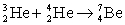 The masses of the nuclei are
3He = 3.016 049 u
4He = 4.002 604 u
7Be = 7.016 930 u
The energy released or absorbed by the reaction is
The masses of the nuclei are
3He = 3.016 049 u
4He = 4.002 604 u
7Be = 7.016 930 u
The energy released or absorbed by the reaction is (Multiple Choice)
4.9/5 (81)
(81) The superscript before the symbol for an element represents the number of
(Multiple Choice)
4.9/5 (87)
(87) How much energy (in MeV) is released in the beta decay of a free neutron? Assume mass(proton) = 938.272 MeV/c2, mass(neutron) = 939.566 MeV/c2, mass(electron) = 0.511 MeV/c2, and mass(neutrino) = 0.000 MeV/c2.
(Multiple Choice)
4.8/5 (86)
(86) 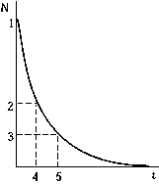 The graph shows the number of radioactive nuclei N remaining as a function of time. The point on the graph that corresponds to the half-life of the decay process is
 (Multiple Choice)
4.9/5 (79)
(79)  The reaction,
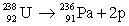 , cannot occur spontaneously because
The alpha particles from a naturally radioactive decay have a kinetic energy of
4)25 MeV. How close does an alpha particle come within a gold nucleus if the particle is heading directly towards the nucleus? Give your answer in terms of number of radii of the gold atom, r = 7.0 fm.
(Multiple Choice)
4.8/5 (75)
(75) A sample of  (which decays by -emission) has an activity of 14.7 mCi. After
26)1 d it has an activity of 4.25 mCi. The half-life of 32P is approximately
(which decays by -emission) has an activity of 14.7 mCi. After
26)1 d it has an activity of 4.25 mCi. The half-life of 32P is approximately (Multiple Choice)
4.8/5 (89)
(89) A 2000-year-old piece of dead wood gives 1400 counts per week in our detector system. How many counts per week would our system detect if the wood were living? (The half-life of 14C is 5730 years.)
(Multiple Choice)
4.9/5 (86)
(86) The main purpose of a moderator in a nuclear reactor is to
(Multiple Choice)
4.8/5 (86)
(86) Oxygen-15 is a + emitter that is often used in PET scans. It has a half-life of 122 seconds. Calculate how long it takes for the patient's initial activity to be reduced by a factor of 100.
(Multiple Choice)
4.7/5 (74)
(74) 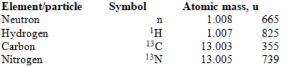 The Q of the reaction
 is approximately
Cesium-137 has a half-life of 31.0 y. The time required for the cesium-137 now present to decrease to 1/30 its present value is
(Multiple Choice)
4.8/5 (79)
(79) 
Filters
- Essay(0)
- Multiple Choice(0)
- Short Answer(0)
- True False(0)
- Matching(0)