



 Chat with AI
Exam 9: Audit Sampling

Exam 1: The Role of the Public Accountant in the American Economy45 Questions
Exam 2: Professional Standards62 Questions
Exam 3: Professional Ethics62 Questions
Exam 4: Legal Liability of Cpas56 Questions
Exam 5: Audit Evidence and Documentation82 Questions
Exam 6: Planning the Audit; Linking Audit Procedures to Risk78 Questions
Exam 7: Internal Control92 Questions
Exam 8: Consideration of Internal Control in an Information Technology Environment63 Questions
Exam 9: Audit Sampling83 Questions
Exam 10: Cash and Financial Investments61 Questions
Exam 11: Accounts Receivable, Notes Receivable, and Revenue64 Questions
Exam 12: Inventories and Cost of Goods Sold59 Questions
Exam 13: Property, Plant, and Equipment: Depreciation and Depletion39 Questions
Exam 14: Accounts Payable and Other Liabilities50 Questions
Exam 15: Debt and Equity Capital40 Questions
Exam 16: Auditing Operations and Completing the Audit69 Questions
Exam 17: Auditors Report62 Questions
Exam 18: Integrated Audits of Public Companies43 Questions
Exam 19: Additional Assurance Services: Historical Financial Information60 Questions
Exam 20: Additional Assurance Services: Other Information51 Questions
Exam 21: Internal, Operational, and Compliance Auditing48 Questions
Select questions type


The auditor using nonstatistical attributes sampling, but who nevertheless has chosen the sample in conformity with random selection procedures:

Free
(Multiple Choice)
4.8/5  (90)
(90) Correct Answer: Verified
D
Which of the following best illustrates the concept of sampling risk?
Free
(Multiple Choice)
4.7/5 (77)
(77) Correct Answer:Verified
VerifiedA
Which of the following is a correct statement with respect to evaluating results when using nonstatistical sampling for substantive tests?
Free
(Multiple Choice)
4.7/5 (84)
(84) Correct Answer:Verified
VerifiedB
To determine sample size in an attribute sampling application, what must be specified?
(Multiple Choice)
4.9/5 (100)
(100) When using statistical sampling, which of the following need not be known to evaluate the results of an attributes sample?
(Multiple Choice)
4.8/5 (79)
(79) When performing a test of a control over cash disbursements, a CPA may use a systematic sampling technique with a start at any randomly selected item. The biggest disadvantage of this type of sampling is that the items in the population:
(Multiple Choice)
4.9/5 (82)
(82) If all other factors specified in an attributes sampling plan remain constant, decreasing the tolerable rate and decreasing the risk of assessing control risk too low would have what effect on sample size?
(Multiple Choice)
5.0/5 (83)
(83) The 3,000 accounts receivable of DEF Company have a total book value of $60,000. Bob Smith, CPA, has selected and audited a sample of 100 accounts with a total book value of $2,100. Using the difference estimation technique, Smith has properly estimated a projected misstatement of an overstatement of $6,000 for the entire population. The audited value of Smith's sample is:
(Multiple Choice)
4.9/5 (75)
(75) During the final planning of the accounts receivable plan a CPA specified a tolerable misstatement of $30,000, instead of the $20,000 contained in the preliminary audit plan. What would be the impact of this change?
(Multiple Choice)
5.0/5 (72)
(72) An important statistic to consider when using a statistical sampling audit plan is the population variability. The population variability is measured by the:
(Multiple Choice)
4.8/5 (76)
(76) If all other factors specified in an attributes sampling plan remain constant, changing the specified tolerable rate from 6% to 10%, and changing the specified risk of assessing control risk too low from 3% to 7% would cause the required sample size to:
(Multiple Choice)
4.8/5 (86)
(86) In variables estimation sampling, the sample standard deviation is used to calculate the:
(Multiple Choice)
4.7/5 (95)
(95) Using the mean-per-unit estimation technique, Rotter's estimate (to the nearest dollar) of year-end accounts receivable balance would be:
(Multiple Choice)
4.9/5 (86)
(86) The auditors expect a population deviation rate of billing errors of two percent, and have established a tolerable rate of five percent. The sampling approach most likely to be used is:
(Multiple Choice)
4.8/5 (69)
(69) Statistical sampling generally may be applied to test internal control when the client's internal control procedures:
(Multiple Choice)
4.8/5 (76)
(76) Using the mean-per-unit estimation technique, the estimated total audited value of the population is:
(Multiple Choice)
4.8/5 (83)
(83) What effect does obtaining a sample with a standard deviation larger than that estimated during planning have on the adjusted allowance for sampling risk?
(Multiple Choice)
4.9/5 (81)
(81) Increases in the number of deviations in an attributes sample results in an increase in the achieved upper deviation rate of the attributes sample.
(True/False)
4.9/5 (92)
(92) Which of the following types of risk is of critical importance to auditors in performing tests of controls?
(Multiple Choice)
4.8/5 (78)
(78) Auditors have a variety of sampling approaches available. For each approach in the first column, identify the correct statement in the second column. Each statement may be used once, more than once, or not at all. 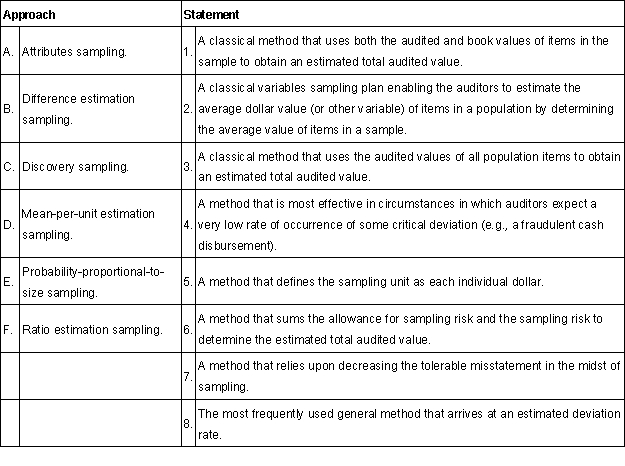
(Short Answer)
4.7/5 (67)
(67) 
Filters
- Essay(0)
- Multiple Choice(0)
- Short Answer(0)
- True False(0)
- Matching(0)