



 Chat with AI
Exam 3: Professional Ethics

Exam 1: The Role of the Public Accountant in the American Economy45 Questions
Exam 2: Professional Standards62 Questions
Exam 3: Professional Ethics62 Questions
Exam 4: Legal Liability of Cpas56 Questions
Exam 5: Audit Evidence and Documentation82 Questions
Exam 6: Planning the Audit; Linking Audit Procedures to Risk78 Questions
Exam 7: Internal Control92 Questions
Exam 8: Consideration of Internal Control in an Information Technology Environment63 Questions
Exam 9: Audit Sampling83 Questions
Exam 10: Cash and Financial Investments61 Questions
Exam 11: Accounts Receivable, Notes Receivable, and Revenue64 Questions
Exam 12: Inventories and Cost of Goods Sold59 Questions
Exam 13: Property, Plant, and Equipment: Depreciation and Depletion39 Questions
Exam 14: Accounts Payable and Other Liabilities50 Questions
Exam 15: Debt and Equity Capital40 Questions
Exam 16: Auditing Operations and Completing the Audit69 Questions
Exam 17: Auditors Report62 Questions
Exam 18: Integrated Audits of Public Companies43 Questions
Exam 19: Additional Assurance Services: Historical Financial Information60 Questions
Exam 20: Additional Assurance Services: Other Information51 Questions
Exam 21: Internal, Operational, and Compliance Auditing48 Questions
Select questions type


Which of the following is least likely to impair a CPA firm's independence with respect to a nonpublic audit client in the Oklahoma City office of a national CPA firm?

Free
(Multiple Choice)
4.9/5  (74)
(74) Correct Answer: Verified
C
The AICPA Conceptual Framework for Independence requires that CPAs evaluate whether a particular threat would lead which type of person to conclude that an unacceptable risk of non-independence exists?
Free
(Multiple Choice)
4.7/5 (73)
(73) Correct Answer:Verified
VerifiedD
Which of the following statements is true with respect to the PCAOB and SEC's concept of independence when an auditor both prepares financial statements and audits those financial statements for a client?
Free
(Multiple Choice)
4.8/5 (87)
(87) Correct Answer:Verified
VerifiedA
Auditors are periodically punished for holding an investment in a client. This violates which ethical rule?
(Multiple Choice)
4.9/5 (74)
(74) When a threat to independence arises, an auditor should consider:
(Multiple Choice)
4.8/5 (76)
(76) AICPA independence requirements suggest that a CPA should evaluate whether a particular threat to independence would lead a reasonable person, aware of all the relevant facts, to conclude that:
(Multiple Choice)
4.9/5 (83)
(83) CPAs may not advertise as to any special expertise other than in accounting, auditing, and tax.
(True/False)
4.8/5 (82)
(82) The AICPA Code of Professional Conduct derives its authority from the Bylaws of the AICPA.
(True/False)
4.7/5 (74)
(74) Competence as a certified public accountant includes all of the following except:
(Multiple Choice)
4.9/5 (62)
(62) The communications between CPAs and their clients are privileged under federal law.
(True/False)
4.9/5 (84)
(84) As compared to the AICPA Code of Professional Conduct, IFAC's International Code of Ethics for Professional Accountants:
(Multiple Choice)
4.9/5 (78)
(78) The AICPA Code of Professional Conduct states that a CPA shall not disclose any confidential information obtained in the course of a professional engagement except with the consent of the client. This rule should be understood to preclude a CPA from responding to an inquiry made by:
(Multiple Choice)
4.8/5 (71)
(71) While performing an audit of a public company, the auditors discovered material illegal acts and resigned due to the client's refusal to disclose them. The auditors' reason for resignation should be disclosed through: Item CPA Direct Communication With Shareholders The Process of Filing a Fom 8-K A. Yes Yes B. Yes No C. No Yes D. No No
(Multiple Choice)
5.0/5 (72)
(72) A client company has not paid its 20X3 audit fees. According to the AICPA Code of Professional Conduct, in order for the auditor to be considered independent with respect to the 20X4 audit, the 20X3 audit fees must be paid before the:
(Multiple Choice)
5.0/5 (81)
(81) The following is a list of circumstances that might be faced by a public accounting firm. Select the rule violated of the AICPA Code of Professional Conduct in the second column. If no rule is violated select 10-no violation (this may be used once, more than once, or not at all). Rules 1 through 9 may be used either once, or not at all. 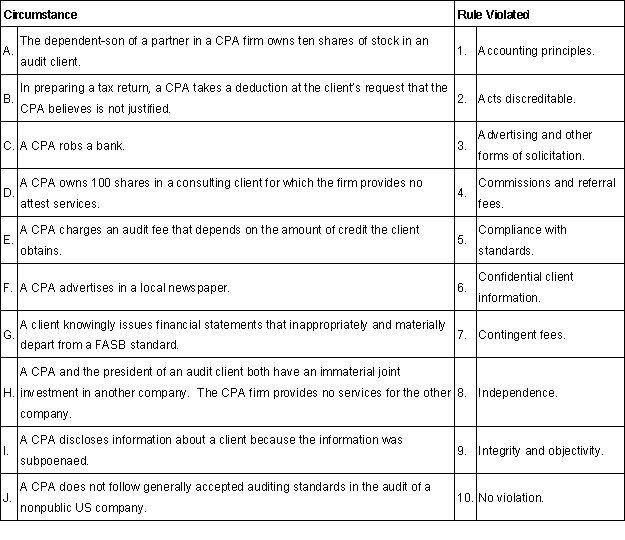
(Essay)
4.7/5 (81)
(81) CPAs are allowed to advertise under the Rules of the AICPA Code of Professional Conduct.
a. List the general guidelines regarding the nature of acceptable advertising.
b. Describe two specific forms of unacceptable advertising.
(Essay)
4.7/5 (84)
(84) Which of the following forms of organization is most likely to protect the personal assets of any partner or shareholder who has not been involved on an engagement resulting in litigation?
(Multiple Choice)
4.9/5 (84)
(84) Which of the following types of employees must be independent of an audit client?
(Multiple Choice)
4.8/5 (75)
(75) Which of the following is not a broad category of threat to auditor independence?
(Multiple Choice)
4.9/5 (85)
(85) 
Filters
- Essay(0)
- Multiple Choice(0)
- Short Answer(0)
- True False(0)
- Matching(0)