



 Chat with AI
Exam 13: Property, Plant, and Equipment: Depreciation and Depletion

Exam 1: The Role of the Public Accountant in the American Economy45 Questions
Exam 2: Professional Standards62 Questions
Exam 3: Professional Ethics62 Questions
Exam 4: Legal Liability of Cpas56 Questions
Exam 5: Audit Evidence and Documentation82 Questions
Exam 6: Planning the Audit; Linking Audit Procedures to Risk78 Questions
Exam 7: Internal Control92 Questions
Exam 8: Consideration of Internal Control in an Information Technology Environment63 Questions
Exam 9: Audit Sampling83 Questions
Exam 10: Cash and Financial Investments61 Questions
Exam 11: Accounts Receivable, Notes Receivable, and Revenue64 Questions
Exam 12: Inventories and Cost of Goods Sold59 Questions
Exam 13: Property, Plant, and Equipment: Depreciation and Depletion39 Questions
Exam 14: Accounts Payable and Other Liabilities50 Questions
Exam 15: Debt and Equity Capital40 Questions
Exam 16: Auditing Operations and Completing the Audit69 Questions
Exam 17: Auditors Report62 Questions
Exam 18: Integrated Audits of Public Companies43 Questions
Exam 19: Additional Assurance Services: Historical Financial Information60 Questions
Exam 20: Additional Assurance Services: Other Information51 Questions
Exam 21: Internal, Operational, and Compliance Auditing48 Questions
Select questions type


A typical procedure in the audit of property is examination of public records to verify the ownership of the property.

Free
(True/False)
4.7/5  (89)
(89) Correct Answer: Verified
False
The auditors typically observe all major items of property, plant, and equipment every year.
Free
(True/False)
4.9/5 (78)
(78) Correct Answer:Verified
VerifiedFalse
A continuing audit client's property, plant, and equipment and accounts receivable accounts have approximately the same year-end balance. In this circumstance, when compared to property, plant and equipment, one would normally expect the audit of accounts receivable to require:
Free
(Multiple Choice)
4.9/5 (76)
(76) Correct Answer:Verified
VerifiedA
Which of the following is a customary audit procedure for the verification of the legal ownership of real property?
(Multiple Choice)
4.9/5 (81)
(81) The primary purpose of internal control over plant and equipment is to safeguard the assets from theft.
(True/False)
4.8/5 (73)
(73) During the audit of Zing Company, Bill Jones, a staff member on the audit, identified a number of items that have been included as additions to property, plant, and equipment. Jones has indicated to you that he believes the following items should not be capitalized. Indicate with an "X" whether you believe the item should be capitalized or expensed. 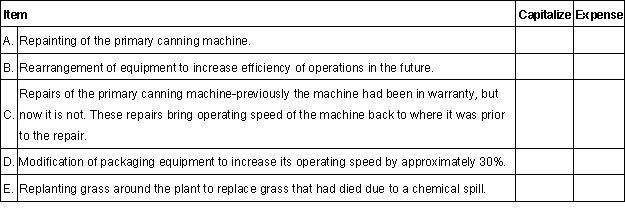
(Essay)
4.8/5 (75)
(75) Even when internal control is weak, a significant portion of the audit work on property, plant, and equipment may be performed at an interim date.
(True/False)
4.9/5 (81)
(81) An auditor has identified numerous debits to accumulated depreciation of equipment. Which of the following is most likely?
(Multiple Choice)
4.9/5 (82)
(82) Idle equipment will generally need to be reclassified as a current asset.
(True/False)
4.8/5 (73)
(73) Which of the following best describes the independent auditors' approach to obtaining satisfaction concerning depreciation expense in the income statement?
(Multiple Choice)
4.9/5 (80)
(80) Which of the following is not a test primarily used to test property, plant and equipment accounts for overstatement?
(Multiple Choice)
4.9/5 (76)
(76) Which of the following is not one of the auditors' objectives in auditing depreciation?
(Multiple Choice)
4.8/5 (78)
(78) Material purchases of assets from an affiliated company should be disclosed in the financial statements.
(True/False)
4.8/5 (58)
(58) A major control procedure related to plant and equipment is a budget for depreciation.
(True/False)
4.9/5 (71)
(71) For which of the following ledger accounts would the auditor be most likely to analyze the details to identify understatements of equipment acquisitions?
(Multiple Choice)
4.8/5 (65)
(65) Which of the following is used to obtain evidence that the client's equipment accounts are not understated?
(Multiple Choice)
4.9/5 (72)
(72) In the audit of depletion the auditors must often rely on the work of specialists.
(True/False)
4.9/5 (78)
(78) When there are numerous property and equipment transactions during the year, an auditor who plans to assess control risk at a low level usually performs:
(Multiple Choice)
4.9/5 (71)
(71) Plant and equipment are not as inherently risky as are other assets, such as inventories and accounts receivable. However, a company should still endeavor to maintain effective internal control over plant and equipment.
a. Describe the principal purpose of internal controls relating to plant and equipment.
b. List and describe four major controls applicable to plant and equipment.
(Essay)
4.9/5 (76)
(76) Which of the following best describes the auditors' typical observation of plant and equipment?
(Multiple Choice)
4.8/5 (85)
(85) 
Filters
- Essay(0)
- Multiple Choice(0)
- Short Answer(0)
- True False(0)
- Matching(0)