



 Chat with AI
Exam 6: Ionic Reactions - Nucleophilic Substitution and Elimination Reactions of Alkyl Halides

Exam 1: Carbon Compounds and Chemical Bonds134 Questions
Exam 2: Representative Carbon Compounds: Functional Groups, Intermolecular Forces, and Infrared Ir Spectroscopy114 Questions
Exam 3: An Introduction to Organic Reactions: Acids and Bases47 Questions
Exam 4: Alkanes: Nomenclature, Conformational Analysis, and an Introduction to Synthesis125 Questions
Exam 5: Stereochemistry: Chiral Molecules150 Questions
Exam 6: Ionic Reactions - Nucleophilic Substitution and Elimination Reactions of Alkyl Halides146 Questions
Exam 7: Alkenes and Alkynes I: Properties and Synthesis, Elimination Reactions of Alkyl Halides99 Questions
Exam 8: Alkenes and Alkynes Ii: Addition Reactions140 Questions
Exam 9: Nuclear Magnetic Resonance and Mass Spectrometry: Tools for Structure Determination94 Questions
Exam 10: Radical Reactions114 Questions
Exam 11: Alcohols and Ethers172 Questions
Exam 12: Alcohols From Carbonyl Compounds Oxidation-Reduction and Organometallic Compounds147 Questions
Exam 13: Conjugated Unsaturated Systems166 Questions
Exam 14: Aromatic Compounds151 Questions
Exam 15: Reactions of Aromatic Compounds173 Questions
Exam 16: Aldehydes and Ketones I Nucleophilic Addition to the Carbonyl Group165 Questions
Exam 17: Aldehydes and Ketones Ii Aldol Reactions131 Questions
Exam 18: Carboxylic Acids and Their Derivatives Nucleophilic Addition - Elimination at the Acyl Carbon124 Questions
Exam 19: Synthesis and Reactions of Beta-Dicarbonyl Compounds: More Chemistry of Enolate Ions131 Questions
Exam 20: Amines148 Questions
Exam 21: Phenols and Aryl Halides: Nucleophilic Aromatic Substitution87 Questions
Exam 22: Carbohydrates104 Questions
Exam 23: Lipids99 Questions
Exam 24: Amino Acids and Proteins94 Questions
Exam 25: Nucleic Acids and Protein Synthesis89 Questions
Select questions type


The p orbital of the charged carbon in the isopropyl cation, (CH3)2CH+,contains how many electrons?
(Multiple Choice)
4.7/5  (73)
(73) What final product is likely to be obtained through the following series of reactions? 
(Essay)
4.8/5 (72)
(72) The product(s)for the following reaction would mainly be dictated by which mechanism? 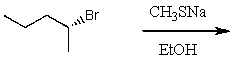
(Multiple Choice)
4.8/5 (74)
(74) What final product is likely to be obtained through the following series of reactions? 
(Essay)
4.9/5 (82)
(82) Consider the SN2 reaction of 1-chloro-5-methylhexane with CN-ion.  Assuming no other changes,what effect on the rate would result from simultaneously doubling the concentrations of both 1-chloro-5-methylhexane and CN- ion?
 (Multiple Choice)
4.8/5 (91)
(91) The product(s)for the following reaction would mainly be dictated by which mechanism? 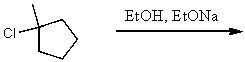
(Multiple Choice)
5.0/5 (71)
(71) What would be the major product(s)of the following reaction? 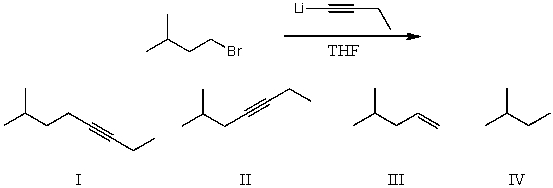
(Multiple Choice)
4.7/5 (88)
(88) Consider the SN2 reaction of 2-iodopentane with CH3CO2- ion.  Assuming no other changes,what effect on the rate would result from simultaneously doubling the concentrations of both 2-iodopentane and CH3CO2- ion?
 (Multiple Choice)
4.9/5 (92)
(92) Increasing the temperature of a chemical reaction usually increases greatly the rate of the reaction.The most important reason for this is that increasing the temperature:
(Multiple Choice)
4.8/5 (69)
(69) Which of the following is a feasible substitution reaction?
(Multiple Choice)
4.7/5 (83)
(83) The product(s)for the following reaction would mainly be dictated by which mechanism? 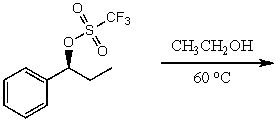
(Multiple Choice)
4.7/5 (82)
(82) Treating 1-bromo-1-methylcyclohexane with CH3OH at room temperature would yield:
(Multiple Choice)
4.9/5 (67)
(67) Increasing the temperature of a chemical reaction usually increases greatly the rate of the reaction.The primary reason for this is that increasing the temperature:
(Multiple Choice)
4.7/5 (84)
(84) Which nucleophilic substitution reaction is not likely to occur?
(Multiple Choice)
4.9/5 (72)
(72) What would be the major product(s)of the following reaction? 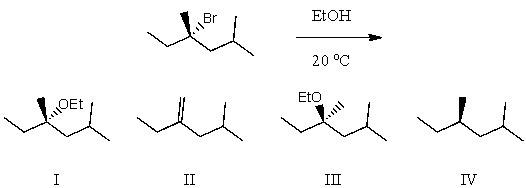
(Multiple Choice)
4.8/5 (81)
(81) What would be the major product(s)of the following reaction? 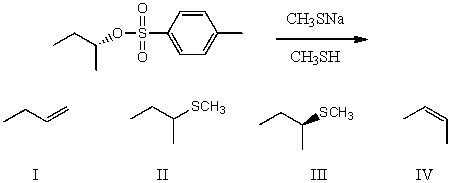
(Multiple Choice)
4.8/5 (83)
(83) Consider the substitution reaction that takes place when (R)-3-iodo-3-methylheptane is treated with sodium acetate (CH3CO2Na).Which of the following would be true?
(Multiple Choice)
4.8/5 (78)
(78) By analyzing the starting material and the product(s),the following reaction is an example of what type of mechanism? 
(Multiple Choice)
4.9/5 (68)
(68) 
Filters
- Essay(0)
- Multiple Choice(0)
- Short Answer(0)
- True False(0)
- Matching(0)