



 Chat with AI
Exam 41: Animal Nutrition

Exam 1: Biology and the Tree of Life37 Questions
Exam 2: Water and Carbon: the Chemical Basis of Life59 Questions
Exam 3: Protein Structure and Function59 Questions
Exam 4: Nucleic Acids and the Rna World43 Questions
Exam 5: An Introduction to Carbohydrates44 Questions
Exam 53: Ecosystems and Global Ecology57 Questions
Exam 6: Lipids, Membranes, and the First Cells59 Questions
Exam 7: Inside the Cell60 Questions
Exam 8: Energy and Enzymes: an Introduction to Metabolism60 Questions
Exam 9: Cellular Respiration and Fermentation61 Questions
Exam 10: Photosynthesis58 Questions
Exam 11: Cellcell Interactions52 Questions
Exam 12: The Cell Cycle59 Questions
Exam 13: Meiosis63 Questions
Exam 14: Mendel and the Gene60 Questions
Exam 15: Dna and the Gene: Synthesis and Repair51 Questions
Exam 16: How Genes Work48 Questions
Exam 17: Transcription, Rna Processing, and Translation58 Questions
Exam 18: Control of Gene Expression in Bacteria29 Questions
Exam 19: Control of Gene Expression in Eukaryotes56 Questions
Exam 20: The Molecular Revolution: Biotechnology and Beyond70 Questions
Exam 21: Genes, Development, and Evolution38 Questions
Exam 22: Evolution by Natural Selection38 Questions
Exam 23: Evolutionary Processes37 Questions
Exam 24: Speciation56 Questions
Exam 25: Phylogenies and the History of Life63 Questions
Exam 26: Bacteria and Archaea38 Questions
Exam 27: Protists37 Questions
Exam 28: Green Algae and Land Plants59 Questions
Exam 29: Fungi47 Questions
Exam 30: An Introduction to Animals48 Questions
Exam 31: Protostome Animals54 Questions
Exam 32: Deuterostome Animals60 Questions
Exam 33: Viruses44 Questions
Exam 34: Plant Form and Function46 Questions
Exam 35: Water and Sugar Transport in Plants47 Questions
Exam 36: Plant Nutrition54 Questions
Exam 37: Plant Sensory Systems, Signals, and Responses48 Questions
Exam 38: Plant Reproduction and Development51 Questions
Exam 39: Animal Form and Function53 Questions
Exam 40: Water and Electrolyte Balance in Animals60 Questions
Exam 41: Animal Nutrition94 Questions
Exam 42: Gas Exchange and Circulation93 Questions
Exam 43: Animal Nervous Systems100 Questions
Exam 44: Animal Sensory Systems50 Questions
Exam 45: Animal Movement40 Questions
Exam 46: Chemical Signals in Animals59 Questions
Exam 47: Animal Reproduction and Development104 Questions
Exam 48: The Immune System in Animals77 Questions
Exam 49: An Introduction to Ecology40 Questions
Exam 50: Behavioral Ecology40 Questions
Exam 51: Population Ecology57 Questions
Exam 52: Community Ecology55 Questions
Exam 54: Biodiversity and Conservation Biology43 Questions
Select questions type


In a well-fed human eating a Western diet, the richest source of stored chemical energy in the body is ________.
(Multiple Choice)
4.9/5  (91)
(91) The molar teeth of herbivorous mammals are especially effective at ________.
(Multiple Choice)
4.8/5 (86)
(86) 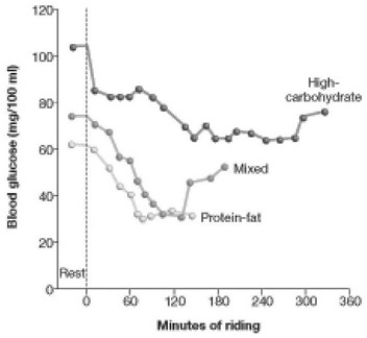 Three groups of cyclists consumed three different types of diets: high-carbohydrate; a diet mixed in carbohydrates, fat, and protein; or a diet higher in protein and fat. The average time each group could spend cycling over a six-hour period is shown in the accompanying graph. What conclusion from the data would help an athlete or trainer improve performance?
 (Multiple Choice)
4.9/5 (89)
(89) A relatively long cecum is characteristic of animals that are ________.
(Multiple Choice)
4.9/5 (85)
(85) Which of the following molecules are absorbed from the lumen of the small intestine into epithelial cells through simple diffusion?
(Multiple Choice)
4.9/5 (88)
(88) The pharyngeal jaws of different cichlid fishes function for
(Multiple Choice)
4.8/5 (81)
(81) Refer to the following nutrition label to answer the question(s) below.
-From the nutrition information contained on the label shown, you can infer that apple juice would be useful in the treatment of which of the following conditions caused by vitamin deficiencies?
(Multiple Choice)
4.8/5 (74)
(74)  -Examine the digestive system structures in the accompanying figure. The highest rate of nutrient absorption occurs at location ________.
 (Multiple Choice)
4.8/5 (74)
(74) Coprophagy is important for the nutritional balance of ________.
(Multiple Choice)
4.9/5 (80)
(80) When a woman has her gallbladder removed, she should probably reduce her consumption of ________.
(Multiple Choice)
4.8/5 (73)
(73) Animals that migrate great distances would obtain the greatest energetic benefit from storing chemical energy as ________.
(Multiple Choice)
4.8/5 (90)
(90) When partially digested food enters the small intestine from the stomach, several events must occur to protect the intestine and allow for the continued digestion of the food. One hormone in particular performs two of these functions. What intestinal hormone is responsible for causing the pancreas to release digestive enzymes and the gallbladder to release bile salts into the intestine?
(Multiple Choice)
5.0/5 (70)
(70) If there is a strong genetic link for type II diabetes mellitus in your family, how might you minimize your risk of developing the disorder?
(Multiple Choice)
4.9/5 (73)
(73) 
Filters
- Essay(0)
- Multiple Choice(0)
- Short Answer(0)
- True False(0)
- Matching(0)