



 Chat with AI
Exam 3: Protein Structure and Function

Exam 1: Biology and the Tree of Life37 Questions
Exam 2: Water and Carbon: the Chemical Basis of Life59 Questions
Exam 3: Protein Structure and Function59 Questions
Exam 4: Nucleic Acids and the Rna World43 Questions
Exam 5: An Introduction to Carbohydrates44 Questions
Exam 53: Ecosystems and Global Ecology57 Questions
Exam 6: Lipids, Membranes, and the First Cells59 Questions
Exam 7: Inside the Cell60 Questions
Exam 8: Energy and Enzymes: an Introduction to Metabolism60 Questions
Exam 9: Cellular Respiration and Fermentation61 Questions
Exam 10: Photosynthesis58 Questions
Exam 11: Cellcell Interactions52 Questions
Exam 12: The Cell Cycle59 Questions
Exam 13: Meiosis63 Questions
Exam 14: Mendel and the Gene60 Questions
Exam 15: Dna and the Gene: Synthesis and Repair51 Questions
Exam 16: How Genes Work48 Questions
Exam 17: Transcription, Rna Processing, and Translation58 Questions
Exam 18: Control of Gene Expression in Bacteria29 Questions
Exam 19: Control of Gene Expression in Eukaryotes56 Questions
Exam 20: The Molecular Revolution: Biotechnology and Beyond70 Questions
Exam 21: Genes, Development, and Evolution38 Questions
Exam 22: Evolution by Natural Selection38 Questions
Exam 23: Evolutionary Processes37 Questions
Exam 24: Speciation56 Questions
Exam 25: Phylogenies and the History of Life63 Questions
Exam 26: Bacteria and Archaea38 Questions
Exam 27: Protists37 Questions
Exam 28: Green Algae and Land Plants59 Questions
Exam 29: Fungi47 Questions
Exam 30: An Introduction to Animals48 Questions
Exam 31: Protostome Animals54 Questions
Exam 32: Deuterostome Animals60 Questions
Exam 33: Viruses44 Questions
Exam 34: Plant Form and Function46 Questions
Exam 35: Water and Sugar Transport in Plants47 Questions
Exam 36: Plant Nutrition54 Questions
Exam 37: Plant Sensory Systems, Signals, and Responses48 Questions
Exam 38: Plant Reproduction and Development51 Questions
Exam 39: Animal Form and Function53 Questions
Exam 40: Water and Electrolyte Balance in Animals60 Questions
Exam 41: Animal Nutrition94 Questions
Exam 42: Gas Exchange and Circulation93 Questions
Exam 43: Animal Nervous Systems100 Questions
Exam 44: Animal Sensory Systems50 Questions
Exam 45: Animal Movement40 Questions
Exam 46: Chemical Signals in Animals59 Questions
Exam 47: Animal Reproduction and Development104 Questions
Exam 48: The Immune System in Animals77 Questions
Exam 49: An Introduction to Ecology40 Questions
Exam 50: Behavioral Ecology40 Questions
Exam 51: Population Ecology57 Questions
Exam 52: Community Ecology55 Questions
Exam 54: Biodiversity and Conservation Biology43 Questions
Select questions type


Van der Waals interactions may result when ________.

Free
(Multiple Choice)
4.8/5  (72)
(72) Correct Answer: Verified
B
A series of hydrophobic side chains will congregate together as a protein folds in an aqueous solution and be stabilized by ________.
Free
(Multiple Choice)
4.8/5 (88)
(88) Correct Answer:Verified
VerifiedB
At which level of protein structure are interactions between the side chains (R-groups) most important?
Free
(Multiple Choice)
4.9/5 (82)
(82) Correct Answer:Verified
VerifiedC
The following question(s) are based on the 15 molecules illustrated in the accompanying figure. Each molecule may be used once, more than once, or not at all. 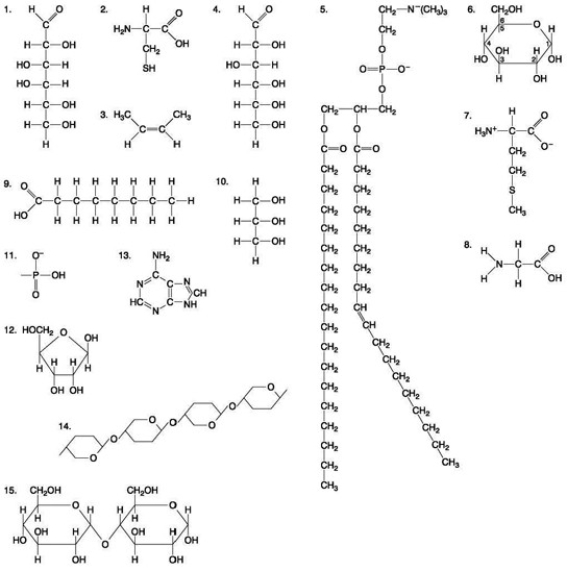 -Which of the following molecules is an amino acid with a hydrophobic R-group or side chain?
 (Multiple Choice)
4.8/5 (87)
(87) Aquaporins are proteins that control the passage of water molecules across a cell membrane. The protein forms a pore, or opening, in the membrane. You isolate what you think are two different molecules of aquaporin and determine that one of the proteins has a larger pore diameter than the second. Which of the following do you conclude?
(Multiple Choice)
4.9/5 (75)
(75) You are studying a protein that is shaped like a doughnut. The shape is a function of which level(s) of protein structure?
(Multiple Choice)
4.8/5 (93)
(93) Upon chemical analysis, a particular polypeptide was found to contain 100 amino acids. How many peptide bonds are present in this protein?
(Multiple Choice)
4.9/5 (86)
(86) 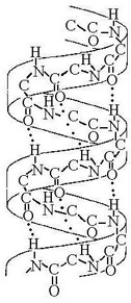 -The structural level of a protein LEAST affected by a disruption in hydrogen bonding is the ________.
 (Multiple Choice)
4.8/5 (85)
(85) There are 20 different amino acids. What makes one amino acid different from another?
(Multiple Choice)
4.9/5 (87)
(87) Normal hemoglobin is a tetramer, consisting of two molecules of β hemoglobin and two molecules of α hemoglobin. In sickle-cell disease, as a result of a single amino acid change, the mutant hemoglobin tetramers associate with each other and assemble into large fibers. Based on this information alone, we can conclude that sickle-cell hemoglobin exhibits ________.
(Multiple Choice)
4.8/5 (84)
(84) The amino acids of the protein keratin are arranged predominantly in an α-helix. This secondary structure is stabilized by ________.
(Multiple Choice)
5.0/5 (71)
(71) What type of interaction is directly responsible for the formation of secondary structure?
(Multiple Choice)
4.7/5 (83)
(83) At about pH 7 in most cells, what happens to the amino R-group on an amino acid?
(Multiple Choice)
4.8/5 (68)
(68) What component of amino acid structure varies among different amino acids?
(Multiple Choice)
4.9/5 (83)
(83) Misfolding of polypeptides is a serious problem in cells. Which of the following diseases are associated with an accumulation of misfolded polypeptides?
(Multiple Choice)
4.8/5 (87)
(87) The following question(s) are based on the 15 molecules illustrated in the accompanying figure. Each molecule may be used once, more than once, or not at all.
-Which bonds are created during the formation of the primary structure of a protein?
-Which bonds are created during the formation of the primary structure of a protein? (Multiple Choice)
4.7/5 (89)
(89) Which of the following is the strongest evidence that protein structure and function are correlated?
(Multiple Choice)
4.9/5 (76)
(76) A hydrocarbon skeleton is covalently bonded to an amino group at one end and a carboxyl group at the other end. When placed in water this molecule would function ________.
(Multiple Choice)
4.9/5 (77)
(77) Which two functional groups are always found in amino acids?
(Multiple Choice)
4.7/5 (73)
(73) 
Filters
- Essay(0)
- Multiple Choice(0)
- Short Answer(0)
- True False(0)
- Matching(0)