



 Chat with AI
Exam 3: Protein Structure and Function

Exam 1: Biology and the Tree of Life37 Questions
Exam 2: Water and Carbon: the Chemical Basis of Life59 Questions
Exam 3: Protein Structure and Function59 Questions
Exam 4: Nucleic Acids and the Rna World43 Questions
Exam 5: An Introduction to Carbohydrates44 Questions
Exam 53: Ecosystems and Global Ecology57 Questions
Exam 6: Lipids, Membranes, and the First Cells59 Questions
Exam 7: Inside the Cell60 Questions
Exam 8: Energy and Enzymes: an Introduction to Metabolism60 Questions
Exam 9: Cellular Respiration and Fermentation61 Questions
Exam 10: Photosynthesis58 Questions
Exam 11: Cellcell Interactions52 Questions
Exam 12: The Cell Cycle59 Questions
Exam 13: Meiosis63 Questions
Exam 14: Mendel and the Gene60 Questions
Exam 15: Dna and the Gene: Synthesis and Repair51 Questions
Exam 16: How Genes Work48 Questions
Exam 17: Transcription, Rna Processing, and Translation58 Questions
Exam 18: Control of Gene Expression in Bacteria29 Questions
Exam 19: Control of Gene Expression in Eukaryotes56 Questions
Exam 20: The Molecular Revolution: Biotechnology and Beyond70 Questions
Exam 21: Genes, Development, and Evolution38 Questions
Exam 22: Evolution by Natural Selection38 Questions
Exam 23: Evolutionary Processes37 Questions
Exam 24: Speciation56 Questions
Exam 25: Phylogenies and the History of Life63 Questions
Exam 26: Bacteria and Archaea38 Questions
Exam 27: Protists37 Questions
Exam 28: Green Algae and Land Plants59 Questions
Exam 29: Fungi47 Questions
Exam 30: An Introduction to Animals48 Questions
Exam 31: Protostome Animals54 Questions
Exam 32: Deuterostome Animals60 Questions
Exam 33: Viruses44 Questions
Exam 34: Plant Form and Function46 Questions
Exam 35: Water and Sugar Transport in Plants47 Questions
Exam 36: Plant Nutrition54 Questions
Exam 37: Plant Sensory Systems, Signals, and Responses48 Questions
Exam 38: Plant Reproduction and Development51 Questions
Exam 39: Animal Form and Function53 Questions
Exam 40: Water and Electrolyte Balance in Animals60 Questions
Exam 41: Animal Nutrition94 Questions
Exam 42: Gas Exchange and Circulation93 Questions
Exam 43: Animal Nervous Systems100 Questions
Exam 44: Animal Sensory Systems50 Questions
Exam 45: Animal Movement40 Questions
Exam 46: Chemical Signals in Animals59 Questions
Exam 47: Animal Reproduction and Development104 Questions
Exam 48: The Immune System in Animals77 Questions
Exam 49: An Introduction to Ecology40 Questions
Exam 50: Behavioral Ecology40 Questions
Exam 51: Population Ecology57 Questions
Exam 52: Community Ecology55 Questions
Exam 54: Biodiversity and Conservation Biology43 Questions
Select questions type


The R-group, or side chain, of the amino acid serine is -CH2-OH. The R-group, or side chain, of the amino acid leucine is -CH2-CH-(CH3)2. Where would you expect to find these amino acids in a globular protein in aqueous solution?
(Multiple Choice)
5.0/5  (88)
(88) At about pH 7 in most cells, what happens to the carboxyl R-group on an amino acid?
(Multiple Choice)
4.8/5 (87)
(87) Amino acids are acids because they always possess which functional group?
(Multiple Choice)
4.8/5 (99)
(99) The following question(s) are based on the 15 molecules illustrated in the accompanying figure. Each molecule may be used once, more than once, or not at all. 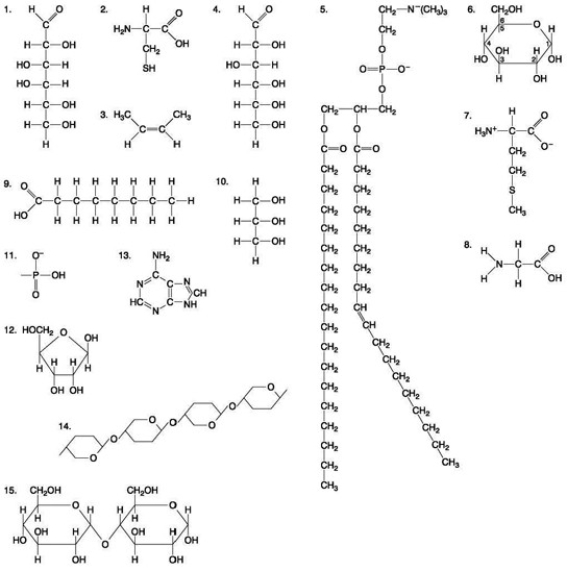 -Which of the following pairs of molecules could be joined together by a peptide bond in a dehydration reaction?
 (Multiple Choice)
4.9/5 (93)
(93) 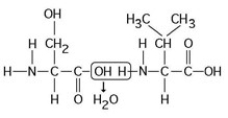 The chemical reaction illustrated in the accompanying figure ________.
 (Multiple Choice)
4.8/5 (86)
(86) Refer to the accompanying figure to answer the following question(s). 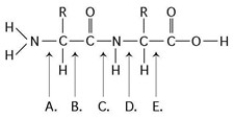 -Which bond is closest to the amino group of the molecule?
 (Multiple Choice)
4.8/5 (76)
(76) The bonding of two amino acid molecules to form a larger molecule requires the ________.
(Multiple Choice)
4.8/5 (87)
(87) Refer to the figure. Which level of structure is maintained by the disulfide bond?
(Multiple Choice)
4.7/5 (65)
(65) An enzyme has a total of four active sites. When you denature the molecule and study its composition, you find that each active site occurs on a different polypeptide. Which of the following hypotheses does this observation support?
(Multiple Choice)
4.8/5 (79)
(79) Refer to the accompanying figure to answer the following question(s).
-At which bond would water need to be added to achieve hydrolysis of the peptide, back to its component amino acids?
-At which bond would water need to be added to achieve hydrolysis of the peptide, back to its component amino acids? (Multiple Choice)
4.8/5 (72)
(72) Which level of protein structure do the α-helix and the β-pleated sheet represent?
(Multiple Choice)
5.0/5 (68)
(68) If cells are grown in a medium containing radioactive 35S, which of these molecules will be labeled?
(Multiple Choice)
4.8/5 (77)
(77) Refer to the accompanying figure to answer the following question(s).
-Which bond is a peptide bond?
-Which bond is a peptide bond? (Multiple Choice)
4.8/5 (78)
(78) What is the location of the C-terminus of the protein in the figure?
(Multiple Choice)
4.7/5 (72)
(72) You have just sequenced a new protein found in mice and observe that sulfur-containing cysteine residues occur at regular intervals. What is the significance of this finding?
(Multiple Choice)
4.7/5 (62)
(62) How does primary protein structure affect the function of protein enzymes?
(Multiple Choice)
4.8/5 (83)
(83) 
Filters
- Essay(0)
- Multiple Choice(0)
- Short Answer(0)
- True False(0)
- Matching(0)