



 Chat with AI
Exam 3: Protein Structure and Function

Exam 1: Biology and the Tree of Life37 Questions
Exam 2: Water and Carbon: the Chemical Basis of Life59 Questions
Exam 3: Protein Structure and Function59 Questions
Exam 4: Nucleic Acids and the Rna World43 Questions
Exam 5: An Introduction to Carbohydrates44 Questions
Exam 53: Ecosystems and Global Ecology57 Questions
Exam 6: Lipids, Membranes, and the First Cells59 Questions
Exam 7: Inside the Cell60 Questions
Exam 8: Energy and Enzymes: an Introduction to Metabolism60 Questions
Exam 9: Cellular Respiration and Fermentation61 Questions
Exam 10: Photosynthesis58 Questions
Exam 11: Cellcell Interactions52 Questions
Exam 12: The Cell Cycle59 Questions
Exam 13: Meiosis63 Questions
Exam 14: Mendel and the Gene60 Questions
Exam 15: Dna and the Gene: Synthesis and Repair51 Questions
Exam 16: How Genes Work48 Questions
Exam 17: Transcription, Rna Processing, and Translation58 Questions
Exam 18: Control of Gene Expression in Bacteria29 Questions
Exam 19: Control of Gene Expression in Eukaryotes56 Questions
Exam 20: The Molecular Revolution: Biotechnology and Beyond70 Questions
Exam 21: Genes, Development, and Evolution38 Questions
Exam 22: Evolution by Natural Selection38 Questions
Exam 23: Evolutionary Processes37 Questions
Exam 24: Speciation56 Questions
Exam 25: Phylogenies and the History of Life63 Questions
Exam 26: Bacteria and Archaea38 Questions
Exam 27: Protists37 Questions
Exam 28: Green Algae and Land Plants59 Questions
Exam 29: Fungi47 Questions
Exam 30: An Introduction to Animals48 Questions
Exam 31: Protostome Animals54 Questions
Exam 32: Deuterostome Animals60 Questions
Exam 33: Viruses44 Questions
Exam 34: Plant Form and Function46 Questions
Exam 35: Water and Sugar Transport in Plants47 Questions
Exam 36: Plant Nutrition54 Questions
Exam 37: Plant Sensory Systems, Signals, and Responses48 Questions
Exam 38: Plant Reproduction and Development51 Questions
Exam 39: Animal Form and Function53 Questions
Exam 40: Water and Electrolyte Balance in Animals60 Questions
Exam 41: Animal Nutrition94 Questions
Exam 42: Gas Exchange and Circulation93 Questions
Exam 43: Animal Nervous Systems100 Questions
Exam 44: Animal Sensory Systems50 Questions
Exam 45: Animal Movement40 Questions
Exam 46: Chemical Signals in Animals59 Questions
Exam 47: Animal Reproduction and Development104 Questions
Exam 48: The Immune System in Animals77 Questions
Exam 49: An Introduction to Ecology40 Questions
Exam 50: Behavioral Ecology40 Questions
Exam 51: Population Ecology57 Questions
Exam 52: Community Ecology55 Questions
Exam 54: Biodiversity and Conservation Biology43 Questions
Select questions type


The following question(s) are based on the 15 molecules illustrated in the accompanying figure. Each molecule may be used once, more than once, or not at all. 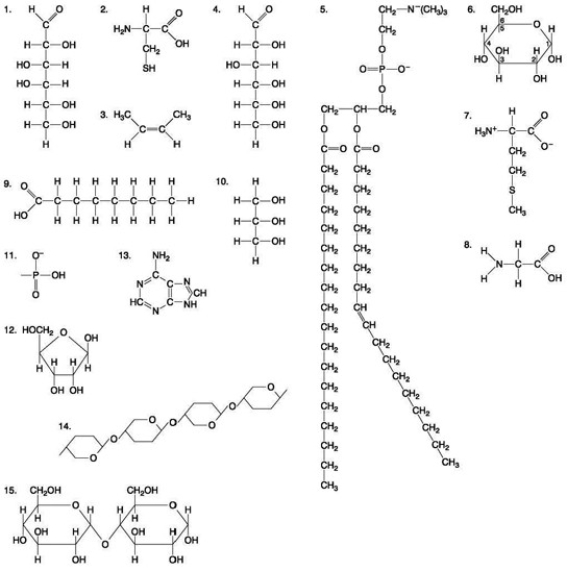 -Which type of interaction stabilizes the α-helix and the β-pleated sheet structures of proteins?
 (Multiple Choice)
4.7/5  (80)
(80) Which one of the following is NOT a component of each monomer used to make proteins?
(Multiple Choice)
4.8/5 (79)
(79) In a normal cellular protein, where would you expect to find a hydrophobic amino acid like valine?
(Multiple Choice)
4.9/5 (72)
(72) You disrupt all hydrogen bonds in a protein. What level of structure will be preserved?
(Multiple Choice)
4.9/5 (87)
(87) When polymerization of a protein is complete, but a protein is still completely linear, what is the highest level of structure in the protein?
(Multiple Choice)
4.9/5 (75)
(75) What type of covalent bond between amino acid side chains (R-groups) functions in maintaining a polypeptide's specific three-dimensional shape?
(Multiple Choice)
4.8/5 (83)
(83) Refer to the following paragraph and accompanying figure to answer the following question(s). 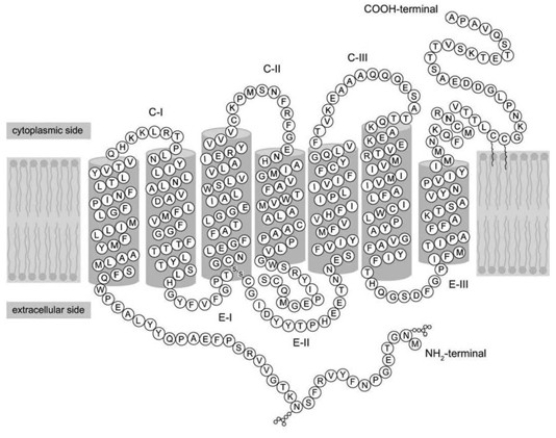 -If you were reading off the sequence of amino acids in the figure to a biologist friend, what should the first three letters be?
 (Multiple Choice)
4.9/5 (76)
(76) Identify the location of the disulfide bond in the figure, located at the bottom of the third transmembrane segment. What is the name of the amino acids that are forming this bond?
(Multiple Choice)
4.8/5 (68)
(68) You determine the amino acid sequence of a protein and find it contains a long sequence of methionine, followed by a long sequence of proline, followed by a long sequence of valine. Using these data you predict the sequence of this protein's secondary structure will be ________.
(Multiple Choice)
4.8/5 (102)
(102) Changing a single amino acid in a protein consisting of 325 amino acids would ________.
(Multiple Choice)
4.8/5 (80)
(80) 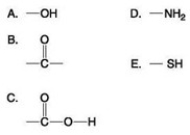 Which of the groups shown above is a functional group that helps stabilize proteins by forming covalent cross-links within or between protein molecules?
 (Multiple Choice)
4.9/5 (80)
(80) Suppose you discovered a new amino acid. Its R-group contains only hydrogen and carbon atoms. Predict the behavior of this amino acid.
(Multiple Choice)
4.7/5 (101)
(101) Why are polymerization reactions endergonic? Polymerization reactions ________.
(Multiple Choice)
4.9/5 (70)
(70) 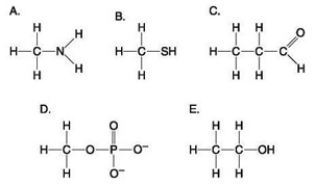 Which molecule shown above contains an amino functional group but is NOT an amino acid?
 (Multiple Choice)
4.8/5 (77)
(77) The following questions are based on the 15 molecules illustrated in the accompanying figure. Each molecule may be used once, more than once, or not at all. 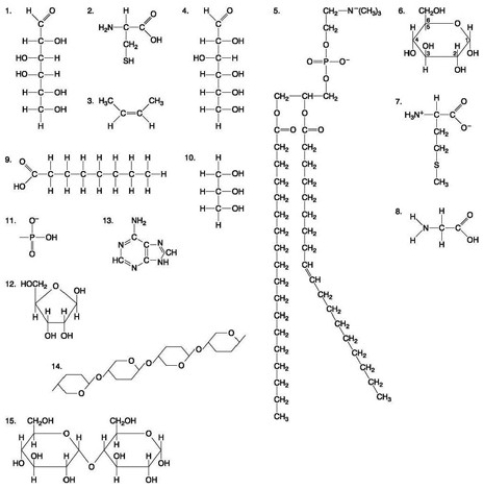 Which of the following molecules act as building blocks (monomers) of polypeptides?
 (Multiple Choice)
4.9/5 (78)
(78) 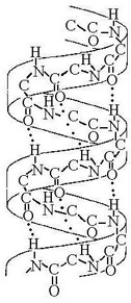 -The structure depicted the accompanying figure shows the ________.
 (Multiple Choice)
4.9/5 (84)
(84) Refer to the following paragraph and accompanying figure to answer the following question(s). 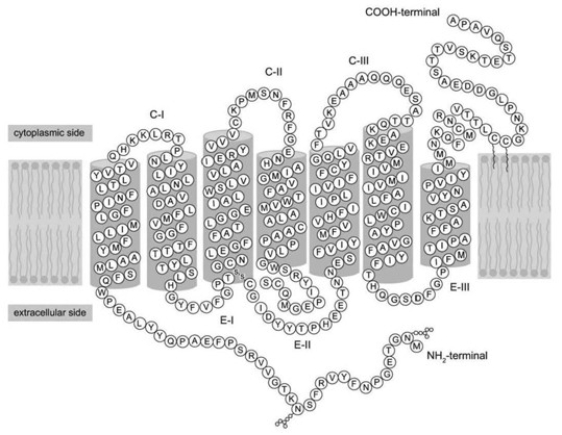 -How many times does the protein in the figure cross the cell membrane?
 (Multiple Choice)
4.8/5 (75)
(75) In solution, why do hydrolysis reactions occur more readily than condensation reactions?
(Multiple Choice)
4.9/5 (85)
(85) 
Filters
- Essay(0)
- Multiple Choice(0)
- Short Answer(0)
- True False(0)
- Matching(0)