



 Chat with AI
Exam 41: Animal Nutrition

Exam 1: Biology and the Tree of Life37 Questions
Exam 2: Water and Carbon: the Chemical Basis of Life59 Questions
Exam 3: Protein Structure and Function59 Questions
Exam 4: Nucleic Acids and the Rna World43 Questions
Exam 5: An Introduction to Carbohydrates44 Questions
Exam 53: Ecosystems and Global Ecology57 Questions
Exam 6: Lipids, Membranes, and the First Cells59 Questions
Exam 7: Inside the Cell60 Questions
Exam 8: Energy and Enzymes: an Introduction to Metabolism60 Questions
Exam 9: Cellular Respiration and Fermentation61 Questions
Exam 10: Photosynthesis58 Questions
Exam 11: Cellcell Interactions52 Questions
Exam 12: The Cell Cycle59 Questions
Exam 13: Meiosis63 Questions
Exam 14: Mendel and the Gene60 Questions
Exam 15: Dna and the Gene: Synthesis and Repair51 Questions
Exam 16: How Genes Work48 Questions
Exam 17: Transcription, Rna Processing, and Translation58 Questions
Exam 18: Control of Gene Expression in Bacteria29 Questions
Exam 19: Control of Gene Expression in Eukaryotes56 Questions
Exam 20: The Molecular Revolution: Biotechnology and Beyond70 Questions
Exam 21: Genes, Development, and Evolution38 Questions
Exam 22: Evolution by Natural Selection38 Questions
Exam 23: Evolutionary Processes37 Questions
Exam 24: Speciation56 Questions
Exam 25: Phylogenies and the History of Life63 Questions
Exam 26: Bacteria and Archaea38 Questions
Exam 27: Protists37 Questions
Exam 28: Green Algae and Land Plants59 Questions
Exam 29: Fungi47 Questions
Exam 30: An Introduction to Animals48 Questions
Exam 31: Protostome Animals54 Questions
Exam 32: Deuterostome Animals60 Questions
Exam 33: Viruses44 Questions
Exam 34: Plant Form and Function46 Questions
Exam 35: Water and Sugar Transport in Plants47 Questions
Exam 36: Plant Nutrition54 Questions
Exam 37: Plant Sensory Systems, Signals, and Responses48 Questions
Exam 38: Plant Reproduction and Development51 Questions
Exam 39: Animal Form and Function53 Questions
Exam 40: Water and Electrolyte Balance in Animals60 Questions
Exam 41: Animal Nutrition94 Questions
Exam 42: Gas Exchange and Circulation93 Questions
Exam 43: Animal Nervous Systems100 Questions
Exam 44: Animal Sensory Systems50 Questions
Exam 45: Animal Movement40 Questions
Exam 46: Chemical Signals in Animals59 Questions
Exam 47: Animal Reproduction and Development104 Questions
Exam 48: The Immune System in Animals77 Questions
Exam 49: An Introduction to Ecology40 Questions
Exam 50: Behavioral Ecology40 Questions
Exam 51: Population Ecology57 Questions
Exam 52: Community Ecology55 Questions
Exam 54: Biodiversity and Conservation Biology43 Questions
Select questions type


Shortly after ingesting a big plate of carbohydrate-rich pasta, you measure your blood's hormone levels. What results would you expect, compared to before the meal?
(Multiple Choice)
4.8/5  (90)
(90) What is the importance of consuming an adequate amount of proteins in the diet?
(Multiple Choice)
5.0/5 (71)
(71) Food labels provide nutrient information and express the amount of a given nutrient as ________.
(Multiple Choice)
4.9/5 (74)
(74) If you found a vertebrate skull in the woods and the teeth were sharp and scissor-like, what type of food would you expect this animal to eat?
(Multiple Choice)
4.7/5 (82)
(82) Pancreatic enzymes are involved in the digestion of ________.
I. protein
II. fat
III. nucleic acids
IV. carbohydrates
(Multiple Choice)
4.8/5 (79)
(79) Which of the following animals is correctly paired with its feeding mechanism?
(Multiple Choice)
5.0/5 (76)
(76) 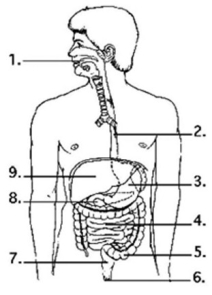 -Examine the digestive system structures in the accompanying figure. Most of the digestion of fats occurs in structure(s) ________.
 (Multiple Choice)
4.9/5 (75)
(75) For a nondiabetic person, the greatest variation in glucose concentration occurs in this part of the circulatory system.
(Multiple Choice)
4.7/5 (85)
(85) Complex macromolecules in food are digested and then absorbed into the lymph or bloodstream as ________.
(Multiple Choice)
4.9/5 (75)
(75) Glucose is transported from the intestinal lumen into epithelial cells through ________ and from the intestinal epithelium into circulation by ________.
(Multiple Choice)
4.7/5 (80)
(80) Refer to the following nutrition label to answer the question(s) below.
-Based on the label shown and the energy content of foods, how many food calories does the entire container of apple juice contain?
(Multiple Choice)
4.8/5 (98)
(98) A mineral that is especially important for preventing anemia is ________.
(Multiple Choice)
4.7/5 (89)
(89) After eating a carbohydrate-rich meal, the mammalian pancreas increases its secretion of ________.
(Multiple Choice)
4.8/5 (68)
(68)
-Examine the digestive system structures in the accompanying figure. Bacteria that produce vitamins are found in the greatest concentration in location ________.
-Examine the digestive system structures in the accompanying figure. Bacteria that produce vitamins are found in the greatest concentration in location ________. (Multiple Choice)
4.8/5 (79)
(79) When the body's blood glucose level rises, the pancreas secretes insulin and, as a result, the blood glucose level declines. When the blood glucose level is low, the pancreas secretes glucagon and, as a result, the blood glucose level rises. Such regulation of the blood glucose level is the result of ________.
(Multiple Choice)
4.9/5 (71)
(71) Aquaporins have been identified in the epithelium of the large intestine. What is the function of these aquaporins?
(Multiple Choice)
4.7/5 (78)
(78) The process of obtaining food is known as ________ and requires specialized mouthparts.
(Multiple Choice)
4.9/5 (77)
(77) Historically inaccurate diagnosis of acid reflux disorders and gastric ulcers has been improved by ________.
(Multiple Choice)
4.9/5 (85)
(85) 
Filters
- Essay(0)
- Multiple Choice(0)
- Short Answer(0)
- True False(0)
- Matching(0)