



 Chat with AI
Exam 47: Animal Reproduction and Development

Exam 1: Biology and the Tree of Life37 Questions
Exam 2: Water and Carbon: the Chemical Basis of Life59 Questions
Exam 3: Protein Structure and Function59 Questions
Exam 4: Nucleic Acids and the Rna World43 Questions
Exam 5: An Introduction to Carbohydrates44 Questions
Exam 53: Ecosystems and Global Ecology57 Questions
Exam 6: Lipids, Membranes, and the First Cells59 Questions
Exam 7: Inside the Cell60 Questions
Exam 8: Energy and Enzymes: an Introduction to Metabolism60 Questions
Exam 9: Cellular Respiration and Fermentation61 Questions
Exam 10: Photosynthesis58 Questions
Exam 11: Cellcell Interactions52 Questions
Exam 12: The Cell Cycle59 Questions
Exam 13: Meiosis63 Questions
Exam 14: Mendel and the Gene60 Questions
Exam 15: Dna and the Gene: Synthesis and Repair51 Questions
Exam 16: How Genes Work48 Questions
Exam 17: Transcription, Rna Processing, and Translation58 Questions
Exam 18: Control of Gene Expression in Bacteria29 Questions
Exam 19: Control of Gene Expression in Eukaryotes56 Questions
Exam 20: The Molecular Revolution: Biotechnology and Beyond70 Questions
Exam 21: Genes, Development, and Evolution38 Questions
Exam 22: Evolution by Natural Selection38 Questions
Exam 23: Evolutionary Processes37 Questions
Exam 24: Speciation56 Questions
Exam 25: Phylogenies and the History of Life63 Questions
Exam 26: Bacteria and Archaea38 Questions
Exam 27: Protists37 Questions
Exam 28: Green Algae and Land Plants59 Questions
Exam 29: Fungi47 Questions
Exam 30: An Introduction to Animals48 Questions
Exam 31: Protostome Animals54 Questions
Exam 32: Deuterostome Animals60 Questions
Exam 33: Viruses44 Questions
Exam 34: Plant Form and Function46 Questions
Exam 35: Water and Sugar Transport in Plants47 Questions
Exam 36: Plant Nutrition54 Questions
Exam 37: Plant Sensory Systems, Signals, and Responses48 Questions
Exam 38: Plant Reproduction and Development51 Questions
Exam 39: Animal Form and Function53 Questions
Exam 40: Water and Electrolyte Balance in Animals60 Questions
Exam 41: Animal Nutrition94 Questions
Exam 42: Gas Exchange and Circulation93 Questions
Exam 43: Animal Nervous Systems100 Questions
Exam 44: Animal Sensory Systems50 Questions
Exam 45: Animal Movement40 Questions
Exam 46: Chemical Signals in Animals59 Questions
Exam 47: Animal Reproduction and Development104 Questions
Exam 48: The Immune System in Animals77 Questions
Exam 49: An Introduction to Ecology40 Questions
Exam 50: Behavioral Ecology40 Questions
Exam 51: Population Ecology57 Questions
Exam 52: Community Ecology55 Questions
Exam 54: Biodiversity and Conservation Biology43 Questions
Select questions type


Among human males, the passage within the penis through which sperm moves is the ________.
(Multiple Choice)
4.8/5  (75)
(75) Which of the following is an example of sexual reproduction?
(Multiple Choice)
4.8/5 (81)
(81) Somites give rise to all of the following tissues EXCEPT ________.
(Multiple Choice)
4.8/5 (93)
(93) A reproductive hormone that is secreted directly from a structure in the brain is ________.
(Multiple Choice)
4.9/5 (82)
(82) The embryonic precursor to the human brain is the ________.
(Multiple Choice)
4.8/5 (73)
(73) Refer to the accompanying figure, which diagrams the reproductive anatomy of the human male, to answer the question(s) below. 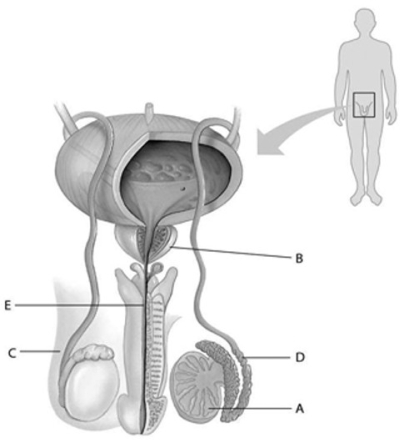 -In the figure, which letter points to the vas deferens?
 (Multiple Choice)
4.9/5 (63)
(63) Why was it informative for researchers to study the proximate causation of Daphnia switching reproductive tactics in the laboratory?
(Multiple Choice)
5.0/5 (86)
(86) For the initial days following ovulation in a nonpregnant menstrual cycle, the main source of progesterone is the ________.
(Multiple Choice)
4.9/5 (71)
(71) The use of birth control pills (oral contraceptives) ________.
(Multiple Choice)
4.8/5 (69)
(69) Asexual reproduction results in offspring that are genetically identical to their parent. What type of cell process occurs to generate this type of offspring?
(Multiple Choice)
4.7/5 (83)
(83) The junction of the upper vagina and the uterus is called the ________.
(Multiple Choice)
4.8/5 (77)
(77) In excreted urine, a reliable "marker" that a pregnancy has initiated is ________.
(Multiple Choice)
4.7/5 (84)
(84) An inactivating mutation in the progesterone receptor gene would likely result in ________.
(Multiple Choice)
4.8/5 (79)
(79) In male mammals, excretory and reproductive systems share the ________.
(Multiple Choice)
4.8/5 (86)
(86) Which of the following is a correct description of the fate of the germ layers?
(Multiple Choice)
4.9/5 (79)
(79) Asexual reproduction results in offspring that are genetically identical to their parent. What type of cell process commonly occurs to generate this type of offspring?
(Multiple Choice)
4.9/5 (73)
(73) Which of the following contributes to the continued development and maintenance of the uterus during pregnancy?
(Multiple Choice)
4.9/5 (83)
(83) 
Filters
- Essay(0)
- Multiple Choice(0)
- Short Answer(0)
- True False(0)
- Matching(0)