



 Chat with AI
Exam 47: Animal Reproduction and Development

Exam 1: Biology and the Tree of Life37 Questions
Exam 2: Water and Carbon: the Chemical Basis of Life59 Questions
Exam 3: Protein Structure and Function59 Questions
Exam 4: Nucleic Acids and the Rna World43 Questions
Exam 5: An Introduction to Carbohydrates44 Questions
Exam 53: Ecosystems and Global Ecology57 Questions
Exam 6: Lipids, Membranes, and the First Cells59 Questions
Exam 7: Inside the Cell60 Questions
Exam 8: Energy and Enzymes: an Introduction to Metabolism60 Questions
Exam 9: Cellular Respiration and Fermentation61 Questions
Exam 10: Photosynthesis58 Questions
Exam 11: Cellcell Interactions52 Questions
Exam 12: The Cell Cycle59 Questions
Exam 13: Meiosis63 Questions
Exam 14: Mendel and the Gene60 Questions
Exam 15: Dna and the Gene: Synthesis and Repair51 Questions
Exam 16: How Genes Work48 Questions
Exam 17: Transcription, Rna Processing, and Translation58 Questions
Exam 18: Control of Gene Expression in Bacteria29 Questions
Exam 19: Control of Gene Expression in Eukaryotes56 Questions
Exam 20: The Molecular Revolution: Biotechnology and Beyond70 Questions
Exam 21: Genes, Development, and Evolution38 Questions
Exam 22: Evolution by Natural Selection38 Questions
Exam 23: Evolutionary Processes37 Questions
Exam 24: Speciation56 Questions
Exam 25: Phylogenies and the History of Life63 Questions
Exam 26: Bacteria and Archaea38 Questions
Exam 27: Protists37 Questions
Exam 28: Green Algae and Land Plants59 Questions
Exam 29: Fungi47 Questions
Exam 30: An Introduction to Animals48 Questions
Exam 31: Protostome Animals54 Questions
Exam 32: Deuterostome Animals60 Questions
Exam 33: Viruses44 Questions
Exam 34: Plant Form and Function46 Questions
Exam 35: Water and Sugar Transport in Plants47 Questions
Exam 36: Plant Nutrition54 Questions
Exam 37: Plant Sensory Systems, Signals, and Responses48 Questions
Exam 38: Plant Reproduction and Development51 Questions
Exam 39: Animal Form and Function53 Questions
Exam 40: Water and Electrolyte Balance in Animals60 Questions
Exam 41: Animal Nutrition94 Questions
Exam 42: Gas Exchange and Circulation93 Questions
Exam 43: Animal Nervous Systems100 Questions
Exam 44: Animal Sensory Systems50 Questions
Exam 45: Animal Movement40 Questions
Exam 46: Chemical Signals in Animals59 Questions
Exam 47: Animal Reproduction and Development104 Questions
Exam 48: The Immune System in Animals77 Questions
Exam 49: An Introduction to Ecology40 Questions
Exam 50: Behavioral Ecology40 Questions
Exam 51: Population Ecology57 Questions
Exam 52: Community Ecology55 Questions
Exam 54: Biodiversity and Conservation Biology43 Questions
Select questions type


During pregnancy, mother's cardiovascular and pulmonary systems can change in which of the following ways?
I. larger heart
II. larger lungs
III. faster heart beat
IV. faster breathing
V. increased blood volume
(Multiple Choice)
4.8/5  (75)
(75) Hormone-based methods of birth control typically provide a continuous or cyclical dose of which hormone?
(Multiple Choice)
4.7/5 (79)
(79) Ovulation is the follicular response to a burst of secretion of ________.
(Multiple Choice)
4.9/5 (77)
(77) The outer-to-inner sequence of tissue layers in a post-gastrulation vertebrate embryo is ________.
(Multiple Choice)
4.9/5 (79)
(79) Peaks of luteinizing hormone (LH) and follicle-stimulating hormone (FSH) production occur during ________.
(Multiple Choice)
4.8/5 (74)
(74) Sperm cells mature and are stored within human males in the ________.
(Multiple Choice)
4.8/5 (66)
(66) Refer to the accompanying figure, which diagrams the reproductive anatomy of the human female, to answer the question(s) below. 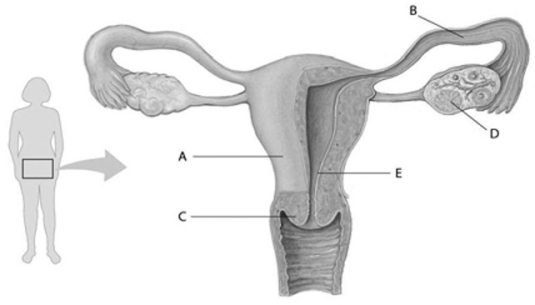 -In the accompanying figure, which letter points to the uterus?
 (Multiple Choice)
4.7/5 (75)
(75) Contact of a sperm with signal molecules in the jelly layer of an egg causes the sperm to undergo ________.
(Multiple Choice)
4.8/5 (86)
(86) Refer to the accompanying figure, which diagrams the reproductive anatomy of the human male, to answer the question(s) below. 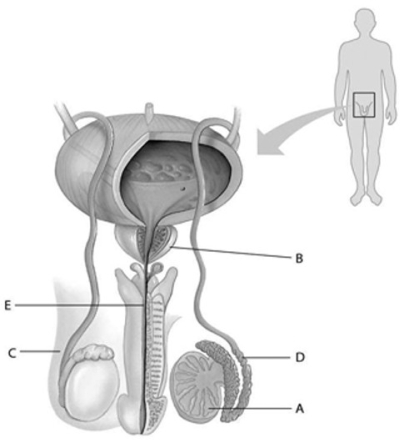 -In the figure, which letter points to the prostate gland?
 (Multiple Choice)
4.9/5 (94)
(94) Which of the following statements support the hypothesis that the onset of puberty is related to nutritional state?
I. On average, puberty occurs at a younger age now than it did 200 years ago.
II. Girls with large fat stores generally enter puberty earlier than thin girls do.
III. The nutritional state of the U.S. population is much better than it was 200 years ago.
(Multiple Choice)
4.8/5 (96)
(96) Changes in cell position occur extensively during ________.
(Multiple Choice)
4.9/5 (82)
(82) Labor contractions can be increased by the medical use of a synthetic drug that mimics the action of ________.
(Multiple Choice)
4.9/5 (84)
(84) Refer to the accompanying figure, which diagrams the reproductive anatomy of the human male, to answer the question(s) below.
-In the accompanying figure, which letter points to the testis?
-In the accompanying figure, which letter points to the testis? (Multiple Choice)
4.9/5 (81)
(81) Refer to the accompanying figure, which diagrams the reproductive anatomy of the human male, to answer the question(s) below.
-In the figure, which letter points to the urethra?
-In the figure, which letter points to the urethra? (Multiple Choice)
4.8/5 (76)
(76) Refer to the accompanying figure, which diagrams the reproductive anatomy of the human female, to answer the question(s) below.
-In the figure, which letter points to the oviduct?
-In the figure, which letter points to the oviduct? (Multiple Choice)
4.7/5 (70)
(70) Cells move to new positions as an embryo establishes its three germ-tissue layers during ________.
(Multiple Choice)
4.9/5 (95)
(95) 
Filters
- Essay(0)
- Multiple Choice(0)
- Short Answer(0)
- True False(0)
- Matching(0)