



 Chat with AI
Exam 6: Merchandising Activities

Exam 1: Accounting: Information for Decision Making135 Questions
Exam 2: Basic Financial Statements158 Questions
Exam 3: The Accounting Cycle: Capturing Economic Events161 Questions
Exam 4: The Accounting Cycle: Accruals and Deferrals160 Questions
Exam 5: The Accounting Cycle: Reporting Financial Results136 Questions
Exam 6: Merchandising Activities144 Questions
Exam 7: Financial Assets233 Questions
Exam 8: Inventories and the Cost of Goods Sold169 Questions
Exam 9: Plant and Intangible Assets154 Questions
Exam 10: Liabilities221 Questions
Exam 11: Stockholders Equity: Paid-In Capital166 Questions
Exam 12: Income and Changes in Retained Earnings153 Questions
Exam 13: Statement of Cash Flows181 Questions
Exam 14: Financial Statement Analysis165 Questions
Exam 15: Global Business and Accounting95 Questions
Exam 16: Management Accounting: a Business Partner124 Questions
Exam 17: Job Order Cost Systems and Overhead Allocations116 Questions
Exam 18: Process Costing103 Questions
Exam 19: Costing and the Value Chain89 Questions
Exam 20: Cost-Volume-Profit Analysis147 Questions
Exam 21: Incremental Analysis119 Questions
Exam 22: Responsibility Accounting and Transfer Pricing108 Questions
Exam 23: Operational Budgeting115 Questions
Exam 24: Standard Cost Systems130 Questions
Exam 25: Rewarding Business Performance71 Questions
Exam 26: Capital Budgeting125 Questions
Exam 28: Forms of Business Organization52 Questions
Exam 27: The Time Value of Money: Future Amounts and Present Values Answer Key49 Questions
Select questions type


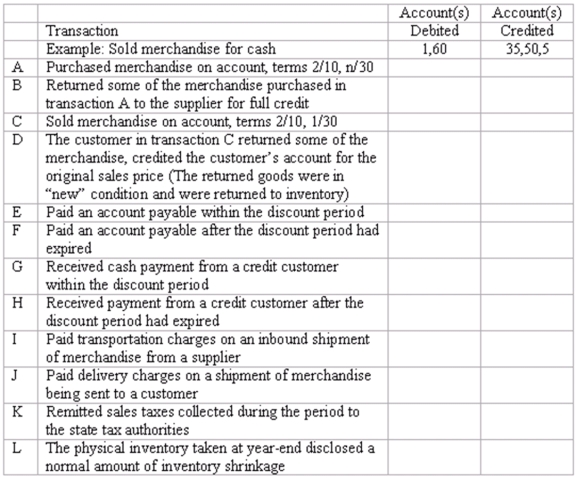
Journal entries for merchandising transactions Shown below is a partial chart of accounts for Main Street Markets, followed by a series of merchandising transactions. The company uses a perpetual inventory system, records purchases at net cost, and records sales at the full invoice price. Sales taxes are collected on all sales, and the sales tax liability is recorded immediately. Freight charges on inbound shipments are recorded in the Transportation-in account.
1 Cash 50 Sales 2 Accounts Receivable 51 Sales Discounts 5 Inventory 52 Sales Returns \& Allowances 30 Accounts Payable 60 Cost of Goods Sold 35 Sales Taxes Payable 62 Transportation-in 39 Income Taxes Payable XX All other expense account
Indicate the accounts that should be credited in recording each transaction by placing the appropriate account number(s) in the space provided.
(Essay)
4.8/5  (82)
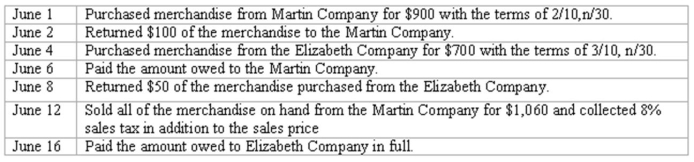
(82) Prepare journals entries for the following, assuming the company uses a perpetual inventory method and records purchases at their net amounts.
(Essay)
4.8/5 (77)
(77) At the beginning of 2010, England Dresses has an inventory of $140,000. However, management wants to reduce the amount of inventory on hand to $80,000 at December 31. If net sales for 2010 are forecast at $400,000 and the gross profit rate is expected to be 40%, compute the cost of the merchandise which management should expect to purchase during 2010. (Hint: First compute the expected cost of goods sold.)
(Multiple Choice)
4.7/5 (82)
(82) In a periodic inventory system, the Cost of Goods Sold account may be created during the closing process by debiting Cost of Goods Sold and crediting the Beginning Inventory and the Purchases account.
(True/False)
4.9/5 (80)
(80) Accounting terminology Listed below are nine technical accounting terms introduced in this chapter:
Gross profit
Gross profit rate
General ledger
Cost of goods sold
Physical inventory
Subsidiary ledger
Perpetual inventory system
Periodic inventory system Inventory shrinkage
Each of the following statements may (or may not) describe one of these technical terms. In the space provided below each statement, indicate the accounting term described, or answer "None" if the statement does not correctly describe any of the terms.
____ a. An approach to accounting for inventories and the cost of goods sold used primarily in small businesses with manual accounting systems.
____ b. A reason why perpetual inventory records may not be entirely accurate.
____ c. The difference between the revenue earned by selling merchandise and the cost of goods sold.
____ d. Gross profit divided by average total stockholders' equity.
____ e. An accounting procedure used in both perpetual and periodic inventory systems. In a perpetual system, this procedure brings to light the amount of inventory shrinkage. In a periodic system, it is the basis for computing the cost of goods sold.
____ f. An accounting record showing the individual items comprising the balance of a general ledger account.
____ g. The accounting record in which transactions initially are recorded.
(Essay)
4.9/5 (75)
(75) Refer to the information above. If Washington uses a perpetual inventory system, the journal entry to record the sale on February 12th would include all of the following except:
(Multiple Choice)
4.8/5 (85)
(85) Which of the following should not be classified as inventory in the balance sheet of a large automobile dealership?
(Multiple Choice)
4.8/5 (78)
(78) The following information is available: Calculate the gross profit:
(Multiple Choice)
4.7/5 (84)
(84) Periodic inventory system Armstrong Creation uses a periodic inventory system. During the current year, the company purchased merchandise at a cost of $245,000. You are to compute the cost of goods sold under each of the following alternative assumptions:

(Essay)
4.9/5 (78)
(78) Today, most large merchandising companies use a perpetual inventory system.
(True/False)
4.8/5 (78)
(78) Net sales and gross profit
Mayflower Supply House had gross sales revenue of $1,700,000, cost of goods sold of $950,000, sales returns and allowances of $52,500, and allowed sales discounts of $30,000.
Compute for the year:

(Essay)
4.9/5 (74)
(74) In a periodic inventory system, the cost of goods sold is:
(Multiple Choice)
4.9/5 (103)
(103) Which account listed below is classified as a contra-revenue account?
(Multiple Choice)
4.9/5 (68)
(68) Beacon Food Stores purchased canned goods at an invoice price of $4,000 and terms of 2/10, n/30. Half of the goods had been mislabeled and were returned immediately to the supplier. If Harvest Food pays the remaining amount of the invoice within the discount period, the amount paid should be:
(Multiple Choice)
4.9/5 (73)
(73) Refer to the information above. The gross profit on the Flat TVs as of February 12th is:
(Multiple Choice)
4.7/5 (90)
(90) Gross profit The table below contains information from a recent annual report of Molloy, Inc. (Dollar amounts are stated in millions.) Fill in the missing amounts.
2009 2010 Net sales \ 28,800 \ 32,200 Cost of goods sold ? \ 16,600 Gross profit \ 12,200 ?
(Essay)
4.8/5 (86)
(86) 
Filters
- Essay(0)
- Multiple Choice(0)
- Short Answer(0)
- True False(0)
- Matching(0)