



 Chat with AI
Exam 6: Merchandising Activities

Exam 1: Accounting: Information for Decision Making135 Questions
Exam 2: Basic Financial Statements158 Questions
Exam 3: The Accounting Cycle: Capturing Economic Events161 Questions
Exam 4: The Accounting Cycle: Accruals and Deferrals160 Questions
Exam 5: The Accounting Cycle: Reporting Financial Results136 Questions
Exam 6: Merchandising Activities144 Questions
Exam 7: Financial Assets233 Questions
Exam 8: Inventories and the Cost of Goods Sold169 Questions
Exam 9: Plant and Intangible Assets154 Questions
Exam 10: Liabilities221 Questions
Exam 11: Stockholders Equity: Paid-In Capital166 Questions
Exam 12: Income and Changes in Retained Earnings153 Questions
Exam 13: Statement of Cash Flows181 Questions
Exam 14: Financial Statement Analysis165 Questions
Exam 15: Global Business and Accounting95 Questions
Exam 16: Management Accounting: a Business Partner124 Questions
Exam 17: Job Order Cost Systems and Overhead Allocations116 Questions
Exam 18: Process Costing103 Questions
Exam 19: Costing and the Value Chain89 Questions
Exam 20: Cost-Volume-Profit Analysis147 Questions
Exam 21: Incremental Analysis119 Questions
Exam 22: Responsibility Accounting and Transfer Pricing108 Questions
Exam 23: Operational Budgeting115 Questions
Exam 24: Standard Cost Systems130 Questions
Exam 25: Rewarding Business Performance71 Questions
Exam 26: Capital Budgeting125 Questions
Exam 28: Forms of Business Organization52 Questions
Exam 27: The Time Value of Money: Future Amounts and Present Values Answer Key49 Questions
Select questions type


If cost of goods sold is $480,000 and the gross profit rate is 40%, what is the gross profit?
(Multiple Choice)
4.8/5  (78)
(78) The accounting cycle of a merchandising business is the length of time covered by the company's income statement.
(True/False)
4.8/5 (70)
(70) Net Sales is computed as total sales revenue less sales returns and allowances less sales discounts.
(True/False)
4.9/5 (85)
(85) Which of the following appears in the income statement of a merchandising business, but not in the income statement of a business that renders only services?
(Multiple Choice)
4.8/5 (77)
(77) Which of the following statements about a periodic inventory system is not correct?
(Multiple Choice)
4.8/5 (79)
(79) If World of Sound uses a perpetual inventory system, the journal entry to record the sale on February 12th would include which of the following?
(Multiple Choice)
4.9/5 (76)
(76) Jayson Products uses a perpetual inventory system. At year-end, the Inventory account had a balance of $280,000, but a complete year-end physical inventory indicated goods on hand costing only $273,000. Jayson should:
(Multiple Choice)
4.8/5 (87)
(87) Which of the following statements about merchandising activities is true? (More than one answer may be correct)
(Multiple Choice)
4.8/5 (72)
(72) At the beginning of 2011, Midway Hardware has an inventory of $400,000. Because sales growth was strong during 2011, the owner wants to increase inventory on hand to $450,000 at December 31, 2011. If net sales for 2011 are expected to be $1,600,000, and the gross profit rate is expected to be 35%, compute the cost of the merchandise the owner should expect to purchase during 2011.
(Multiple Choice)
4.9/5 (82)
(82) In a perpetual inventory system, two entries usually are made to record each sales transaction. The purposes of these entries are best described as follows:
(Multiple Choice)
4.9/5 (78)
(78) Inventories are assets that a company holds for sale in the ordinary course of business.
(True/False)
4.8/5 (79)
(79) Prior to taking a physical inventory at year-end, the perpetual inventory records of Athena Designs showed an inventory of $26,000, sales of $358,000, and a cost of goods sold of $215,000. The year-end physical inventory indicated merchandise on hand costing $24,000. The company's gross profit for the year was:
(Multiple Choice)
4.9/5 (86)
(86) Perpetual inventory system: transactions and closing entries Danny's Wholesale Company uses a perpetual inventory system. A partial chart of accounts is shown below, followed by a series of merchandising transactions. Indicate the accounts that should be debited and credited in recording each transaction. (Ignore sales taxes.)
1 Cash 50 Sales 2 Accounts Receivable 60 Cost of Goods Sold 5 Inventory 99 Income Summary 30 Accounts Payable 40 Retained Earnings 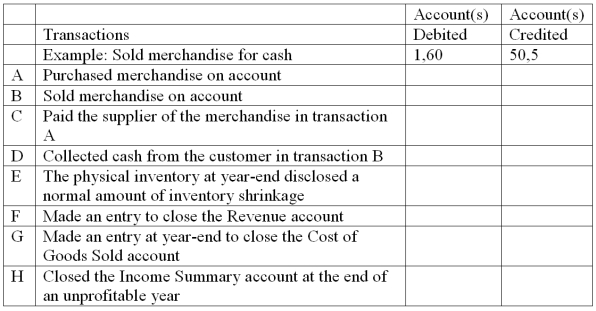
(Essay)
4.7/5 (94)
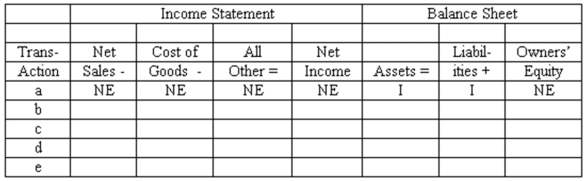
(94) Effects of transactions upon the accounting equation Listed below are selected transactions of Simon's, a retail store which uses a perpetual inventory system:
(a) Purchased merchandise on account.
(b) Made an entry to recognize the revenue from a sale of merchandise on account. (Ignore the cost of goods sold.)
(c) Recognized the cost of goods sold relating to the sale in Transaction b.
(d) Collected in cash the account receivable from the customer in Transaction b.
(e) Following the taking of a physical inventory at year-end, made an adjusting entry to record a normal amount of inventory shrinkage.
Indicate the effects of each of these transactions upon the elements of the company's financial statements. Organize your answer in tabular form, using the column headings shown below. (Notice that the cost of goods sold is shown separately from all other expenses.) Use the code letters I for increase, D for decrease, and NE for no effect. The answer for Transaction a is provided as an example.
(Essay)
4.7/5 (79)
(79) Parkside Pool reports net sales of $625,000, gross profit of $275,000, and net income of $15,000. The company's cost of goods sold is:
(Multiple Choice)
4.7/5 (64)
(64) Which of the following credit terms is the most advantageous to the purchaser of merchandise?
(Multiple Choice)
4.8/5 (83)
(83) In comparing a perpetual inventory system with a periodic inventory system, which of the following statements is not correct?
(Multiple Choice)
4.9/5 (71)
(71) 
Filters
- Essay(0)
- Multiple Choice(0)
- Short Answer(0)
- True False(0)
- Matching(0)