



 Chat with AI
Exam 8: Inventories and the Cost of Goods Sold

Exam 1: Accounting: Information for Decision Making135 Questions
Exam 2: Basic Financial Statements158 Questions
Exam 3: The Accounting Cycle: Capturing Economic Events161 Questions
Exam 4: The Accounting Cycle: Accruals and Deferrals160 Questions
Exam 5: The Accounting Cycle: Reporting Financial Results136 Questions
Exam 6: Merchandising Activities144 Questions
Exam 7: Financial Assets233 Questions
Exam 8: Inventories and the Cost of Goods Sold169 Questions
Exam 9: Plant and Intangible Assets154 Questions
Exam 10: Liabilities221 Questions
Exam 11: Stockholders Equity: Paid-In Capital166 Questions
Exam 12: Income and Changes in Retained Earnings153 Questions
Exam 13: Statement of Cash Flows181 Questions
Exam 14: Financial Statement Analysis165 Questions
Exam 15: Global Business and Accounting95 Questions
Exam 16: Management Accounting: a Business Partner124 Questions
Exam 17: Job Order Cost Systems and Overhead Allocations116 Questions
Exam 18: Process Costing103 Questions
Exam 19: Costing and the Value Chain89 Questions
Exam 20: Cost-Volume-Profit Analysis147 Questions
Exam 21: Incremental Analysis119 Questions
Exam 22: Responsibility Accounting and Transfer Pricing108 Questions
Exam 23: Operational Budgeting115 Questions
Exam 24: Standard Cost Systems130 Questions
Exam 25: Rewarding Business Performance71 Questions
Exam 26: Capital Budgeting125 Questions
Exam 28: Forms of Business Organization52 Questions
Exam 27: The Time Value of Money: Future Amounts and Present Values Answer Key49 Questions
Select questions type


In a period of rising prices, a company is most likely to use the FIFO method of pricing inventory if:
(Multiple Choice)
4.9/5  (66)
(66) Inventory flow assumptions
Flat TV uses a perpetual inventory system. Shown below are Flat TV's beginning inventory of a particular product and purchases during January:
 On January 23 (prior to the purchase on January 25), Flat TV sold 13 units of this product.
Determine the cost of goods sold relating to the sale on January 23 under each of the following flow assumptions. (Show your computations.)

On January 23 (prior to the purchase on January 25), Flat TV sold 13 units of this product.
Determine the cost of goods sold relating to the sale on January 23 under each of the following flow assumptions. (Show your computations.) (Essay)
4.7/5 (86)
(86) Inventory turnover
In the spaces provided, indicate the likely effect of each of the following events or strategies upon the inventory turnover rate. Use the following code letters: I for Increase, D for Decrease, and NE for No Effect.
____ (a) Switched from the LIFO flow assumption to FIFO during a period of rising prices.
____ (b) Dramatically increased advertising expense.
____ (c) Increased the sales price of merchandise that is so popular it is difficult to keep in stock.
____ (d) Implemented internal control procedures to reduce a serious inventory shrinkage problem.
____ (e) Switched from a restrictive credit policy to offering liberal terms to credit customers.
(Essay)
4.9/5 (87)
(87) The cost flow assumption selected by a company must correspond to the actual physical movement of the company's merchandise.
(True/False)
4.9/5 (80)
(80) The Multi-Tech Company uses the gross profit method to estimate inventories. Fill in the missing amounts.
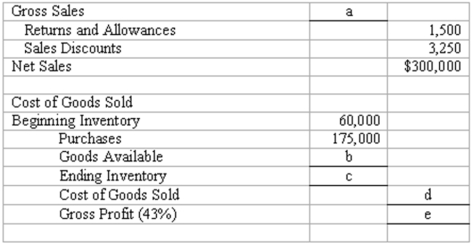
(Essay)
5.0/5 (82)
(82) During periods of inflation, the specific identification cost flow assumption will yield a higher cost of goods sold than LIFO.
(True/False)
4.9/5 (89)
(89) Periodic inventory systems
Funky Fashions uses a periodic inventory system. The beginning inventory of a particular product, and the purchases during the current year, were as follows:
 At December 31, the ending inventory of this product consisted of 1,300 units.
Determine the cost of the year-end inventory and the cost of goods sold for this product under each of the following methods of inventory valuation:
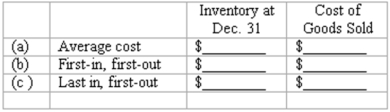
At December 31, the ending inventory of this product consisted of 1,300 units.
Determine the cost of the year-end inventory and the cost of goods sold for this product under each of the following methods of inventory valuation:
(Essay)
5.0/5 (76)
(76) The choice of inventory valuation method can help achieve each of the following independent goals, except:
(Multiple Choice)
4.8/5 (79)
(79) Assuming that Anderson uses the LIFO flow assumption, it should record this inventory shrinkage by:
(Multiple Choice)
4.9/5 (82)
(82) During periods of inflation, the LIFO cost flow assumption will yield a lower inventory value than FIFO.
(True/False)
4.8/5 (77)
(77) Lower-of-cost-or-market
Elite Systems sells a single product. At December 31, the company's perpetual inventory records indicate 2,500 units on hand with a total cost (FIFO basis) of $155,000. The replacement cost of this product at this date is $35 per unit.
Prepare journal entries to record (a) the write-down of the inventory to the lower-of-cost-or-market value at December 31, and (b) the cash sale of 100 units on January 4 at a retail price of $50 per unit.
Date General Journal 20
(a) Dec. 31
(b) Jan. 4
(Essay)
5.0/5 (88)
(88) The inventory turnover rate provides an indication of how quickly the average quantity of inventory on hand:
(Multiple Choice)
4.9/5 (78)
(78) Inventory flow assumptions
Arrow, Inc. uses a perpetual inventory system. On January 22, 2010, the company had 200 units of a particular product on hand, with a total cost of $2,400. The per-unit costs were:
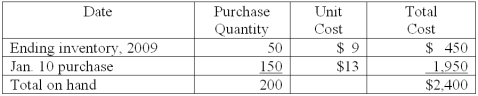 On January 24, 2010, Arrow sold 65 units of this product.
Using the three flow assumptions listed below, compute (1) the cost of goods sold, and (2) the cost of the inventory of this product on hand after this sale. Show your computations.
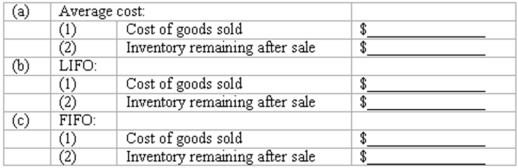
On January 24, 2010, Arrow sold 65 units of this product.
Using the three flow assumptions listed below, compute (1) the cost of goods sold, and (2) the cost of the inventory of this product on hand after this sale. Show your computations.
(Essay)
4.8/5 (82)
(82) Assume that Castle TV, Inc. uses the FIFO flow assumption. The cost of the 200 units in inventory at year-end is:
(Multiple Choice)
4.9/5 (68)
(68) Inventory flow assumptions
Briefly discuss the factors management should consider in deciding:
(a) Whether to use specific identification or a flow assumption in measuring the cost of goods sold.
(b) Whether to use FIFO or LIFO. (Assume a long-run trend of slowly rising prices.)
(Essay)
4.8/5 (87)
(87) Accounting terminology
Listed below are nine technical accounting terms introduced in this chapter:
Just-in-time
Average-cost method
LIFO method
Gross profit method
Inventory shrinkage
FIFO method
Retail method
Inventory turnover
Each of the following statements may (or may not) describe one of these technical terms. In the space provided below each statement, indicate the accounting term described, or answer "None" if the statement does not correctly describe any of the terms.
_____ a. The flow assumptions in which the oldest units purchased are assumed to have remained in inventory.
_____ b. A method of estimating the cost of goods sold and ending inventory based upon cost relationships from prior periods.
_____ c. The practice of valuing inventory in the balance sheet at expected sales prices, rather than at cost.
_____ d. An inventory flow assumption involving only one "cost layer."
_____ e. The inventory flow assumption likely to result in the highest reported amount of gross profit during a period of rising prices.
_____ f. A technique for minimizing a company's investment in inventory, particularly inventories of raw materials and finished goods.
_____ g. A measure of a company's ability to sell its inventory quickly.
(Essay)
4.8/5 (75)
(75) 
Filters
- Essay(0)
- Multiple Choice(0)
- Short Answer(0)
- True False(0)
- Matching(0)